


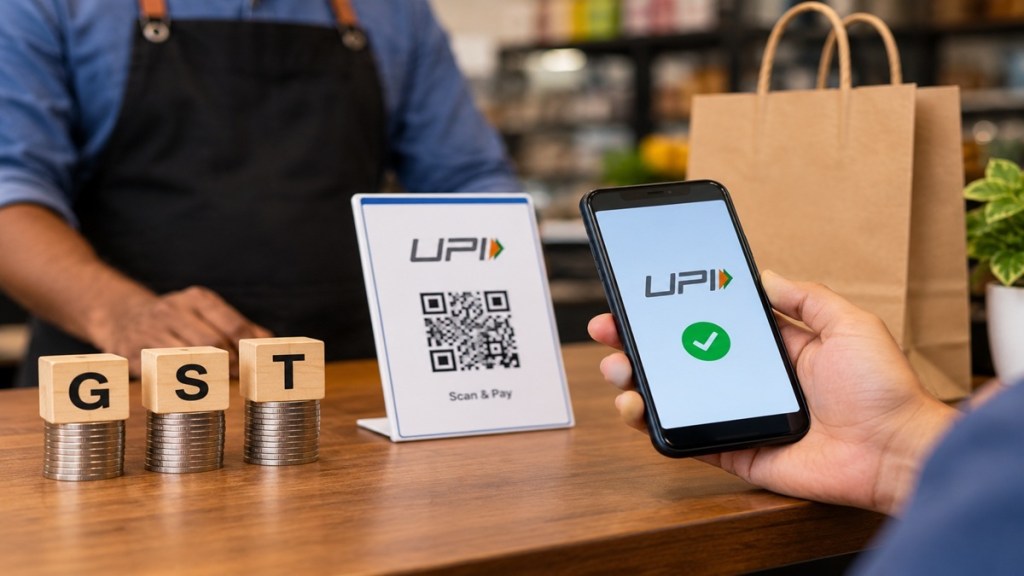

The new Merchant Discount Rate (MDR) on certain high-value UPI payments will come into effect from October 15, 2026. While customers will not have to pay this charge, merchants receiving eligible UPI payments will have to bear the MDR.
The bigger question for merchants is also that how Goods and Services Tax (GST) will apply to this new charge.
Under the new framework, UPI payments to merchants above Rs 2,000 will attract an MDR in specified cases. For most such transactions, the MDR will be 0.4%, capped at Rs 300 per transaction. Some sectors will attract a flat MDR of Rs 5, while capital market transactions will attract an MDR of 0.02%, subject to the applicable cap.
Importantly, the MDR is not a charge that customers will have to pay, the government clarified. Person-to-person UPI transactions will continue to remain free, while merchant payments up to Rs 2,000 will also remain free. Small merchants covered under the zero-MDR framework will continue to get the benefit. The government said around 96% of P2M UPI transactions will remain unaffected.
GST will apply to the MDR, not the UPI payment
The GST treatment is relatively straightforward. The 18% GST will be charged on the MDR amount and not on the full value of the UPI transaction.
For example, suppose a customer makes an eligible UPI payment of Rs 10,000 to a merchant. If the applicable MDR is 0.4%, the merchant will pay Rs 40 as MDR. GST at 18% will then be calculated on this Rs 40, which comes to Rs 7.20.
Therefore, the total payment-processing cost for the merchant will be Rs 47.20.
Prabhat Ranjan, Senior Director, Nexdigm, explains: “Under the framework effective 15 October 2026, GST will not be charged on the value of the UPI payment itself; it will apply only on the MDR charged to the merchant. For example, on a Rs. 10,000 eligible UPI payment, a 0.4% MDR would be Rs 40. GST at 18% would apply on Rs 40—i.e., Rs 7.20—taking the merchant’s total payment-processing charge to Rs 47.20, subject to applicable caps and exemptions.”
For transactions where the MDR is a flat Rs 5, the 18% GST would work out to 90 paise. The merchant would therefore pay Rs 5.90 as the MDR and GST component.
GST can be claimed as input tax credit
For GST-registered businesses, the GST paid on the MDR can ordinarily be claimed as input tax credit, subject to the applicable conditions.
This means the GST component does not necessarily become a permanent cost for a business that is eligible to claim ITC.
Ranjan said: “The GST component is therefore a tax on the payment-processing service, not an additional tax on the customer’s purchase. GST-registered merchants should ordinarily be able to claim input-tax credit, subject to the usual statutory conditions. For businesses not eligible for ITC, however, GST becomes an additional cost.”
This distinction is important because the GST is not being imposed on the customer’s Rs 10,000 purchase. It is being charged on the payment-processing service represented by the MDR.
Various reports citing government sources also claimed that there is no separate GST on the UPI transaction itself.
As reported by The Indian Express, GST will apply to the MDR charged on eligible UPI payments, while businesses can claim input tax credit on the GST paid.
What happens to small merchants?
The GST impact will be limited for many small merchants because the new MDR itself does not apply to all UPI payments above the Rs 2,000 threshold.
Under the zero-MDR framework, small merchants receiving up to Rs 1 lakh per month through UPI QR codes under the P2PM category will continue to enjoy zero MDR on their transactions.
According to a senior Finance Ministry official cited by The Indian Express, most businesses below the Rs 40 lakh GST registration threshold are unlikely to face MDR and therefore GST on MDR. This could be because they receive less than Rs 1 lakh a month through UPI or because their UPI payments are mostly below Rs 2,000.
The official said 96% of P2M UPI transactions are below Rs 2,000, while for small merchants with turnover below Rs 40 lakh, 99% of their UPI payments may be below this threshold.
However, there could be some exceptions. The official acknowledged that an unregistered seller with annual turnover below Rs 40 lakh but UPI receipts of more than Rs 1 lakh a month may not qualify as a small merchant for zero MDR. Such a merchant could therefore face MDR and GST on eligible transactions above Rs 2,000. The official said this would be a very small number of merchants and that the issue could be addressed by the GST Council.
How should businesses account for MDR and GST?
Businesses will also need to keep track of the MDR and GST separately when reconciling their UPI settlements.
Ranjan said: “Businesses should separately book the gross customer receipt, MDR expense, GST input credit and net amount settled by the bank or payment provider. Settlement reports should be reconciled with bank credits and the corresponding GST invoice/GSTR-2B reflection.”
The key point for merchants is that GST is not being charged on the amount received from the customer. It is being charged on the MDR levied for eligible UPI transactions.
The new MDR framework will apply from October 15. The GST Council is scheduled to meet on October 7, although the Finance Ministry official cited by The Indian Express did not say whether this issue would be taken up at the meeting.
The government has also said merchants should not pass the MDR on to customers. Banks have been advised to ensure that merchants do not transfer the charge to customers.
Every financial journey has a turning point. What’s yours?
Financial Express is launching a new series highlighting real experiences with money, investments, and the taxman. Did a sudden tax rule catch you off guard? Did a piece of financial advice change your life? Your story could provide invaluable, practical lessons for thousands of fellow taxpayers. Share your experience with us. We respect your privacy: no stories will be featured without a direct conversation and your full consent. Thank you.