


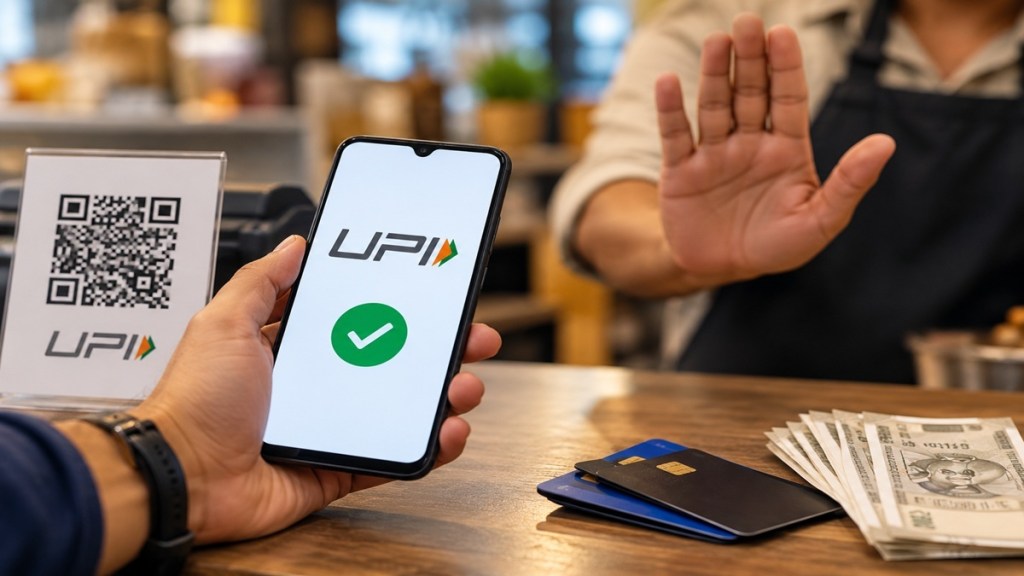

The National Payments Corporation of India (NPCI) has postponed the implementation of the merchant discount rate (MDR) for certain Person-to-Merchant (P2M) UPI transactions until after Diwali in 2026, which was earlier scheduled to start from today, i.e., 15th October 2026.
The new MDR framework, as the NPCI announced on October 13, shall be implemented post-Diwali immediately on a date to be notified separately.
The Financial Express had earlier reported, citing sources, that the introduction of the new merchant discount rate (MDR) framework for UPI transactions may be postponed until January 1, 2027.
At this stage, the implementation timeline appears to have shifted from the original October schedule to a post-Diwali rollout, with the final effective date yet to be formally notified by NPCI.
“Market expectations are that the revised MDR framework could be introduced in the weeks following the festive season, potentially around the start of the new calendar year, but businesses should await the official notification before making operational or pricing decisions,” said Ramkumar Subramanian, Partner, Grant Thornton Bharat.
Which UPI transactions will attract MDR charges after Diwali 2026?
Under the proposed UPI MDR framework, the charge is intended to apply only to select Person-to-Merchant (P2M) transactions above Rs 2,000, while person-to-person transfers and small-value merchant payments remain exempt.
Above that amount, a charge of 0.4% applies, which works out to roughly Rs 20 on a Rs 5,000 payment, with a cap of Rs 300 per transaction.
Sectors such as railways, telecom, insurance, and fuel attract a flat Rs 5, while capital market payments attract 0.02%. The charge is borne by the merchant and not the customer.
Hence, large-value merchant payments would generally attract a 0.4% MDR, subject to the prescribed cap, whereas certain sectors such as fuel, telecom, insurance and railways are proposed to be covered under a concessional fixed-fee structure.
The objective appears to be balancing the sustainability of the UPI ecosystem with continued affordability for consumers and small merchants.
Will merchants pass on the additional MDR cost to customers, directly or indirectly?
While the MDR is levied on merchants and not directly on customers, businesses ultimately evaluate all operating costs as part of their pricing strategy.
“In highly competitive sectors, many merchants may absorb the cost to preserve customer experience, but over time some businesses could recover it indirectly through product pricing, reduced discounts, or lower promotional offers,” said Subramanian.
“The extent of pass-through will depend on merchant margins, transaction volumes, and competitive pressures rather than the MDR itself,” Subramanian further added.
How will the revised MDR rules affect small merchants, kirana stores and small businesses?
The framework keeps most small business payments outside the charge.
Merchant payments up to Rs 2,000 carry no MDR, and small merchants and street vendors receiving up to Rs 1 lakh a month through UPI QR codes are exempt on all transactions.
“As a result, about 96% of merchant transactions remain unaffected, as per government data. The 0.4% charge applies only to payments above Rs 2,000, with essential sectors paying a flat Rs 5 instead. Customers are not charged,” said Adhil Shetty, CEO, BankBazaar.
The revised MDR framework is designed to shield small merchants, kirana stores and micro-businesses from additional costs, preserving the affordability that has driven UPI adoption.
Businesses with predominantly low-value transactions are unlikely to see any material impact.
The bigger effect will be on larger merchants and higher-value transactions, while small retailers should continue to benefit from the convenience, transparency and customer reach that digital payments provide.
UPI MDR: Who benefits from merchant fees?
“Any MDR collected is likely to be shared across the key participants in the UPI value chain, including banks, payment service providers and UPI app operators, since each plays a role in processing, securing and servicing transactions,” according to Subramanian.
The exact split may evolve through commercial arrangements, but a sustainable revenue-sharing model would strengthen incentives for continued investment in infrastructure, cybersecurity, innovation and merchant acceptance.
Ultimately, the objective should be to ensure the long-term resilience of the UPI ecosystem while preserving its affordability and scale.
Disclaimer: This article is for informational purposes only and should not be construed as investment, financial, tax, or legal advice. Any illustrations, examples, or return projections used in this article are for explanatory purposes only and do not guarantee actual investment outcomes. The views and opinions expressed by experts quoted in this article are their own and should not be considered investment recommendations. Readers should consult a qualified professional before making any financial decisions.
Every financial journey has a turning point. What’s yours?
Financial Express is launching a new series highlighting real experiences with money, investments, and the taxman. Did a sudden tax rule catch you off guard? Did a piece of financial advice change your life? Your story could provide invaluable, practical lessons for thousands of fellow taxpayers. Share your experience with us. We respect your privacy: no stories will be featured without a direct conversation and your full consent. Thank you.