


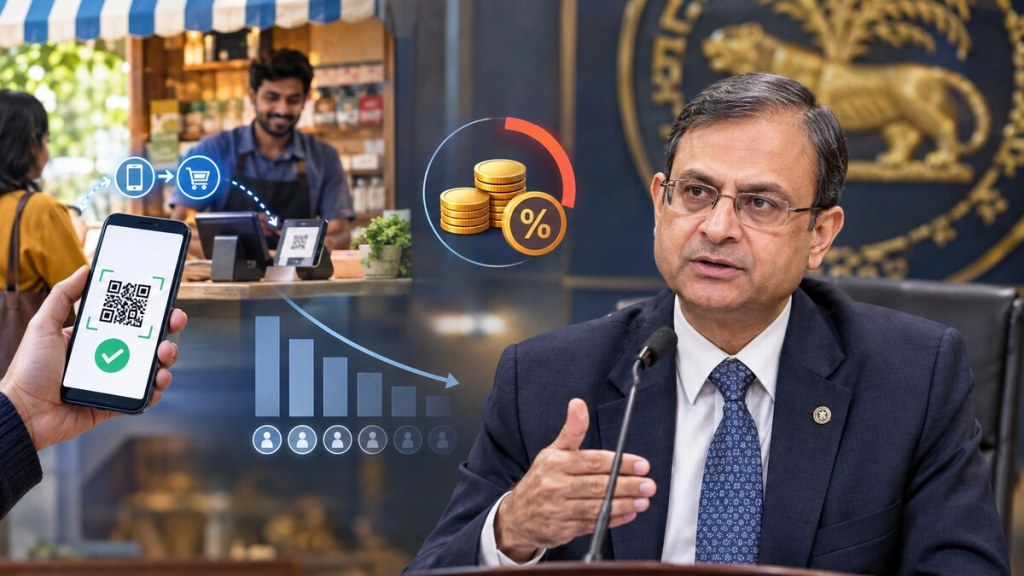

The introduction of Merchant Discount Rate (MDR) on select UPI payments from October 15 has raised concerns about whether charging merchants could eventually affect the rapid growth in UPI transactions. The issue came up with Reserve Bank of India Governor Sanjay Malhotra during the post-policy press conference on Wednesday, October 7.
He was asked whether the new MDR could impact UPI transaction volumes. The governor said the decision on MDR has been taken and will be in force from October 15. But Malhotra said he did not expect the small fee to have a meaningful impact on UPI usage.
“I don’t personally think the small fee will have any impact on volume,” he said when asked if this new charge will hit numbers.
What is changing for UPI from October 15?
Under the new framework, a 0.4% MDR will apply to specified person-to-merchant, or P2M, UPI transactions above Rs 2,000 from October 15.
The important point for consumers is that MDR is a merchant-side charge. It is not a fee that consumers will have to pay for making UPI payments.
For example, if an eligible merchant receives a UPI payment of Rs 10,000, the MDR at 0.4% would work out to Rs 40.
Similarly, a Rs 50,000 transaction would attract Rs 200 MDR.
For transactions of Rs 75,000 and above, the MDR will be capped at Rs 300 per transaction.
The new charge does not apply to all UPI transactions.
Person-to-person, or P2P, payments will continue to remain free irrespective of the amount. UPI merchant payments up to Rs 2,000 will also remain free. Small merchants covered under the zero-MDR framework will continue to be exempt.
The government has said around 96% of P2M transactions will remain unaffected, with MDR applying only to a limited set of merchant transactions.
Why is there concern about UPI volumes?
UPI has grown rapidly because it has been a low-cost and convenient way to make digital payments. The introduction of MDR means merchants will now face a cost on certain higher-value transactions.
This has led to questions over whether some merchants could discourage UPI payments, shift customers towards other payment methods or try to structure transactions differently to avoid the charge.
There have also been concerns that merchants operating on thin margins could be more sensitive to even a small transaction cost.
However, the RBI Governor’s comments suggest that the central bank does not expect the 0.4% MDR to materially change consumer behaviour or bring down UPI transaction volumes.
The government has also made it clear that merchants cannot pass the MDR on to customers as a separate UPI charge.
RBI Governor’s comments came after 25 bps repo rate hike
The comments on UPI MDR came shortly after the RBI’s October monetary policy announcement.
The Monetary Policy Committee raised the repo rate by 25 basis points to 5.50% on October 7. This was the first repo rate hike in nearly four years. The RBI also shifted its policy stance towards calibrated tightening as inflationary pressures increased.
The rate decision was the main focus of Wednesday’s policy announcement, but the post-policy press conference also covered several other issues, including the upcoming changes to UPI charges.
For consumers, the UPI MDR change is important because it marks a shift in the way the country’s largest digital payments network is funded.
The key question now is whether the new cost remains largely within the payment ecosystem, as intended, or whether it eventually changes how merchants and consumers use UPI.
For now, the RBI Governor’s message is clear: the central bank does not expect the small MDR charge to hurt UPI transaction volumes.
Disclaimer: The UPI MDR rates and transaction limits discussed in this story are based on the proposed framework and expert inputs available at the time of writing. Actual charges may vary depending on the merchant category, payment network, acquiring bank, transaction type and applicable exemptions. Debit and credit card charges used for comparison are illustrative and may differ across banks, card networks and merchants. Readers should check the applicable terms before making financial or business decisions.
Every financial journey has a turning point. What’s yours?
Financial Express is launching a new series highlighting real experiences with money, investments, and the taxman. Did a sudden tax rule catch you off guard? Did a piece of financial advice change your life? Your story could provide invaluable, practical lessons for thousands of fellow taxpayers. Share your experience with us. We respect your privacy: no stories will be featured without a direct conversation and your full consent. Thank you.