


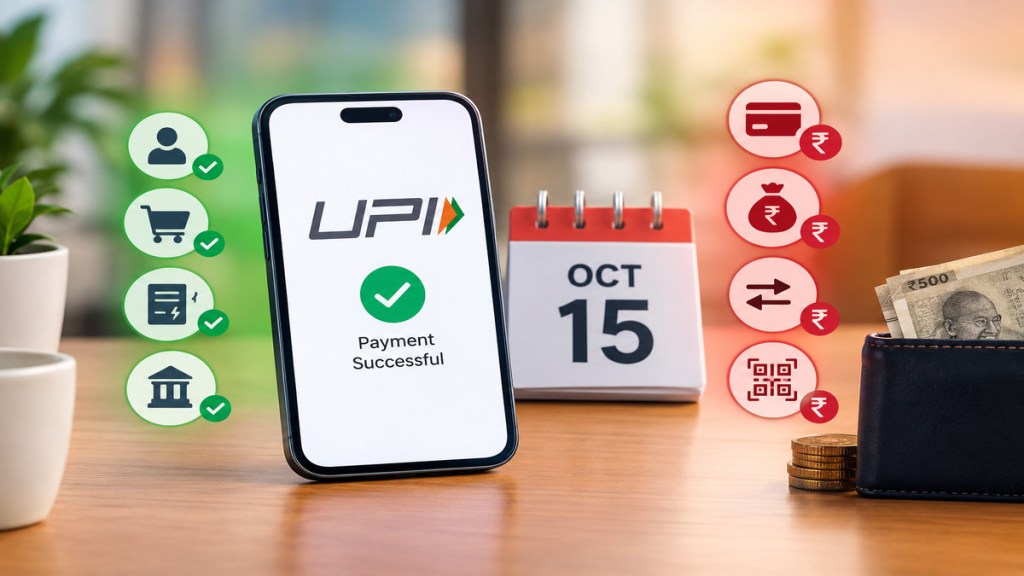

Unified Payments Interface (UPI), which completed 2,451 crore transactions worth Rs 29.9 lakh crore in August 2026 alone, has emerged as the most popular way for Indians to make payments without incurring charges for everything from groceries and a cup of tea to utility bills and online shopping.
However, starting on October 15, 2026, the regulations governing charges will be revised for a certain set of merchant transactions.
A 0.4% Merchant Discount Rate (MDR) has been enforced by the National Payments Corporation of India (NPCI) for specific Person-to-Merchant (P2M) UPI transactions over Rs 2,000. The MDR would be limited to Rs 300 per transaction for amounts over Rs 75,000.
“It is clarified that MDR is neither a tax nor a charge collected by the Government or NPCI. It is distributed among payment ecosystem participants, including banks and payment application providers, to support the operation and continued expansion of the UPI ecosystem,” the Ministry of Finance has said.
This announcement, made on 15th September 2026, has raised a bunch of questions among the common day-to-day UPI users, i.e., will the new UPI MDR rule be applicable to them, will small-value UPI transactions be impacted, what will remain, and what will attract the new MDR, and much more.
UPI MDR: Why the change now?
UPI has evolved significantly over the last six years – from a new digital payments rail to one of the country’s most important pieces of financial infrastructure. As the ecosystem has scaled, the focus now has to extend beyond adoption to long-term sustainability.
“The calibrated MDR framework introduces an economic model for selected higher-value merchant transactions while protecting consumers, small merchants and everyday low-value payments. This can help support continued investment in the infrastructure, technology, cybersecurity, and innovation required to make UPI more resilient and scalable as volumes continue to grow,” said Harsh Vardhan Masta, CEO, PB Pay.
MDR, or Merchant Discount Rate, is the fee associated with processing certain merchant payments. From October 15, eligible P2M UPI transactions above Rs 2,000 will attract an MDR of 0.4%, subject to a cap of Rs 300 for transactions of Rs 75,000 and above.
For example, on an eligible UPI payment of Rs 10,000, the MDR would work out to Rs 40. On Rs 75,000, 0.4% would be Rs 300, which is the applicable cap. This is a merchant-side charge and not a separate fee that the consumer has to pay to use UPI.
“MDR is a charge within the merchant payment ecosystem. It is not a charge on customers making UPI payments. Banks have been advised to ensure that merchants do not pass MDR charges on to customers. UPI application providers are expressly prohibited from imposing platform fees or hidden charges. Individuals will continue to have unlimited free usage, with no monthly quotas, volume restrictions or tiered caps on free UPI transactions,” the Ministry of Finance has clarified.
What will remain free and what will attract MDR?
According to NPCI, regardless of the amount transferred, all person-to-person (P2P) UPI transactions will continue to be totally free. Users using UPI to transfer or receive money are not subject to any transaction fees, platform fees, or other fees.
As a result, UPI transactions that make up 70% of the total transaction value will continue to be not subject to the MDR framework. MDR will not apply to any person-to-merchant (P2M) transactions up to Rs 2,000, and when using UPI to make such payments, customers won’t be charged anything. Under the Person-to-Person-Merchant (P2PM) category, small merchants, including street sellers, who receive up to Rs 1 lakh monthly using UPI QR codes would continue to benefit from 0% MDR on all transactions.
According to the Ministry of Finance, however, only P2M transactions above Rs 2,000 would be subject to an MDR of 0.4%. The MDR would be limited to Rs 300 per transaction for amounts over Rs 75,000. A fixed MDR of Rs 5 would be applied to transactions above Rs 2,000 in essential sectors including railways, telecommunications, insurance, fuel, and agricultural supplies. An MDR of 0.02%, with a maximum of Rs 300 per transaction, would be applied to payments made to stockbrokers, dealers, mutual funds, and securities.
Under the new framework, eligible person-to-merchant UPI transactions of up to Rs 2,000 will continue to attract zero MDR. This means the vast majority of everyday UPI payments – whether for groceries, retail purchases, or routine expenses – remain unaffected. For consumers, the experience of making these payments remains unchanged.
This means that for everyday users, there is no new UPI usage fee being introduced. The MDR applies within the merchant payments ecosystem and is not a separate charge that consumers have to pay for using UPI. P2P payments remain free, eligible merchant payments up to Rs 2,000 remain at zero MDR, and UPI AutoPay mandates remain outside the framework.
What is the impact on small vendor QR payments?
The framework also protects small merchants, ensuring that eligible small vendors continue to accept UPI through QR without the new MDR. This is important because QR-based UPI acceptance has been a key driver of financial inclusion, particularly for small businesses and merchants across Tier II, Tier III, and smaller markets.
What is the impact on UPI AutoPay mandates?
UPI AutoPay and recurring mandates remain outside the new MDR framework. Consumers can therefore continue using UPI mandates for recurring payments such as SIPs, insurance premiums, OTT subscriptions, and utility payments without the new MDR being applied to these transactions.
UPI MDR: Can shops pass it to you?
Nothing changes for the consumer. Eligible P2M UPI payments of Rs 2,000 or below continue to attract zero MDR. Consumers can continue making these everyday payments through UPI just as they do today.
MDR is a merchant-side payment processing charge and is not intended to become a separate UPI charge for consumers. The consumer should not be presented with an additional UPI fee on account of the MDR.
Disclaimer: This article is for informational purposes only and should not be construed as investment, financial, tax, or legal advice. Any illustrations, examples, or return projections used in this article are for explanatory purposes only and do not guarantee actual investment outcomes. The views and opinions expressed by experts quoted in this article are their own and should not be considered investment recommendations. Readers should consult a qualified professional before making any financial decisions.
Every financial journey has a turning point. What’s yours?
Financial Express is launching a new series highlighting real experiences with money, investments, and the taxman. Did a sudden tax rule catch you off guard? Did a piece of financial advice change your life? Your story could provide invaluable, practical lessons for thousands of fellow taxpayers. Share your experience with us. We respect your privacy: no stories will be featured without a direct conversation and your full consent. Thank you.