


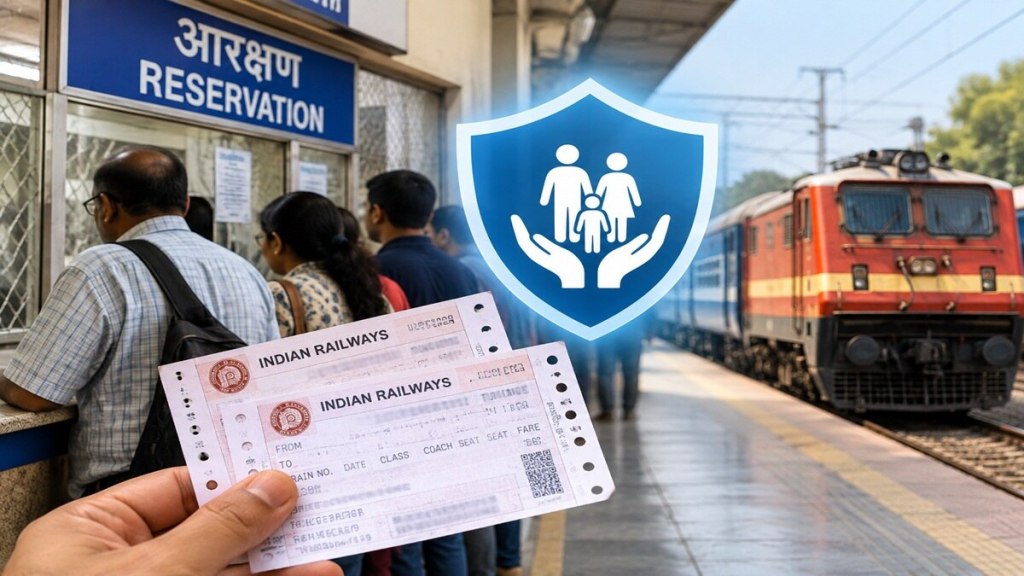

Indian Railways has been mandated by the Supreme Court to provide insurance coverage to passengers nationwide who purchase train tickets offline at station counters starting on October 27, 2026.
On October 6, 2026, a bench of Justices Ahsanuddin Amanullah and R Mahadevan issued the ruling.
Only Indian citizens who purchase their tickets online through Indian Railway Catering and Tourism Corporation (IRCTC) are currently eligible for the travel insurance scheme.
This means that from October 27, 2026, it will become mandatory for Indian Railways to provide travel insurance for passengers who book tickets either online and offline.
Railway ticket insurance coverage
The insurance coverage shall be uniform for all classes. The details are as follows.
| Death | Permanent total Disability | Permanent partial Disability | Hospitalization expenses for injury | Transportation of mortal remains |
| Rs. 10,00,000 | Rs.10,00,000 | Rs. 7,50,000 | Rs.2,00,000 | Rs. 10,000 |
Source: IRCTC
Hospitalization expenses for injuries are covered in addition to death, permanent total disability, and partial disabilities.
The coverage is applicable only for Indian Citizens only and citizens of foreign countries are not eligible for this scheme.
“The coverage for the policy shall be for each passenger under the PNR in case of Death, Permanent Total Disability, Permanent Partial Disability, and Hospitalization Expenses for Injury and Transportation of mortal remains following Rail Accident or untoward incident,” IRCTC stated.
Children less than five years old who purchase a ticket without a seat or berth are not covered by railway insurance. However, children aged 5 to 11 who purchase a ticket with or without a berth are insured under the insurance.
Liberty General Insurance, Royal Sundaram General Insurance Company, and United India Insurance Company are the three enrolled general insurance companies that the Indian Railway Catering and Tourism Corporation (IRCTC) collaborates with to provide this coverage.
“In case of short termination of trains due to any reason, if the passenger opts for the alternate mode of transportation arranged by railway upto the destination station, then this part of the journey of the passenger shall also be covered under the policy taken by the passenger. In case of diversion of train due to any reason, the coverage shall be for the diverted route,” according to IRCTC.
If a passenger is shifted to a Vikalp train, the insurance policy purchased for the original train journey will also cover the journey on the Vikalp train.
“Any payment in case of more than one claim in respect of any Insured under this Policy during any one Period of Insurance should not exceed the Sum Insured applicable to such Insured. However, the amount relating to carriage of dead body of the Insured and medical expenses would be payable in addition, if applicable,” as per IRCTC.
Railway travel insurance premium
According to IRCTC, the premium for railway travel insurance starting on February 17, 2024, is 45 paise per passenger, including all taxes.
It is optional to choose the insurance plan, and if customers do so while purchasing a train ticket, the insurance companies will send them the policy details by SMS and email to their registered email ID, along with a link to fill out the nomination form.
Passengers can check the policy number in the ticket booking history available on the IRCTC portal.
All classes of Indian Railway passengers who purchase a ticket with a confirmed, RAC, or partially confirmed berth in a group and who choose to purchase travel insurance and pay the premium are eligible to claim the insurance.
Train insurance claim procedure
Within four months of the date of the train accident, the insured passenger, his nominee, or his legal heir must submit a detailed written statement in accordance with the claim form, along with any other relevant information and documents, to the nearest office of the insurance company.
As per IRCTC, proof in accordance with the policy details shall be furnished to the insurance
company in connection with all matters upon which a claim is based.
The passenger must properly fill out the personal accident claim form, get it signed by the nominee or legal heir, provide the NEFT mandate details, and cancel the cheque in order to claim the insurance.
Additionally, a photo identity proof of the nominee must be submitted by the passenger. According to the Legal Heir/Succession Certificate, the claim shall only be paid to the Legal Heir in the absence of a nominee.
Once all required documents are received, benefits under the insurance scheme will be paid to the eligible passenger within 15 days.
If an offer of settlement is authorized by the insured but payment is delayed for more than seven days after the acceptance date, the insurance company will be responsible for paying interest on the sum paid or payable under the railway insurance policy at a rate 2% higher than the bank rate in effect at the start of the fiscal year in which the claim is made/filed and reviewed.
Disclaimer: This article is for informational purposes only and should not be construed as investment, financial, tax, or legal advice. Any illustrations, examples, or return projections used in this article are for explanatory purposes only and do not guarantee actual investment outcomes. The views and opinions expressed by experts quoted in this article are their own and should not be considered investment recommendations. Readers should consult a qualified professional before making any financial decisions.
Every financial journey has a turning point. What’s yours?
Financial Express is launching a new series highlighting real experiences with money, investments, and the taxman. Did a sudden tax rule catch you off guard? Did a piece of financial advice change your life? Your story could provide invaluable, practical lessons for thousands of fellow taxpayers. Share your experience with us. We respect your privacy: no stories will be featured without a direct conversation and your full consent. Thank you.