



Silver has been one of the biggest stories in the commodities market over the past year. Prices have surged, attracting investors into silver ETFs and pushing inflows sharply higher. But there is a surprising gap between the return delivered by silver and the return actually earned by the average investor.
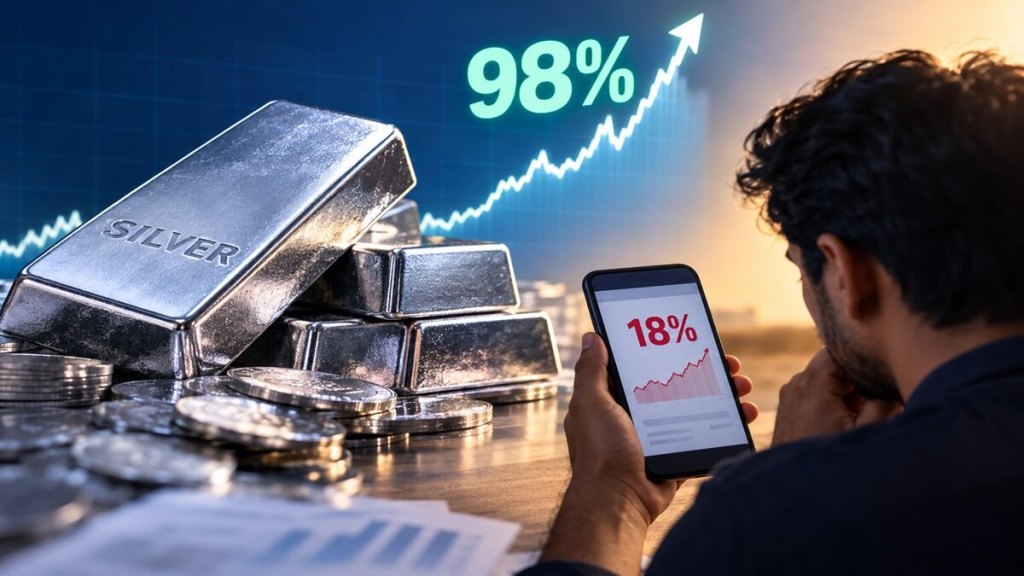
“Silver’s return over the last 1 year is 98%. The average investor actually made only 18% (money-weighted return) in last 1 year versus 98% the market had to offer,” according to DSP’s September 2026 edition of its Netra report.
Even more striking, 56% of the money invested in silver ETFs during the last 12 months was sitting at a loss as of July 31, 2026, the report further said. So how can an asset rise 98%, while the average investor makes only 18%?
The answer has less to do with silver’s return and more to do with when investors entered the market.
Silver’s big rally attracted investors
Gold and silver have both seen strong interest during a period of geopolitical uncertainty and sharp moves across global financial markets.
Gold has benefited from investment demand, central-bank buying and safe-haven interest. The World Gold Council said strong investment flows and a softer US dollar were among the key drivers of gold’s sharp August rally.
Silver has had some of the same macro support, but its story is slightly different because it is both a precious metal and an industrial commodity. Expectations around industrial demand, renewable energy and technology have also influenced prices.
Geopolitical tensions have added another layer. Periods of uncertainty in the Middle East have supported demand for precious metals, while movements in the US dollar, interest-rate expectations and bond yields have also affected bullion prices.
As silver prices climbed, more investors started looking at Silver ETFs.
That is where the story gets interesting.
The 98% return was not the return most investors captured
DSP’s report makes an important distinction between asset return and investor return. The 98% figure represents the return delivered by silver. The 18% figure represents the money-weighted return of the average rupee invested in Silver ETFs over the period.
These are not the same thing. If an investor had bought silver at the beginning of the rally and stayed invested throughout, the investor would have participated in most of the rise. But that was not how most of the money entered the market. A large part of the investment came after silver had already risen sharply.
Sahil Kapoor, Executive Director, Investment Strategist and Head of Product at DSP Mutual Fund, says the difference is essentially a timing story.
“The 98% is the return of silver. The 18% is the return earned by the average rupee invested in Silver ETFs. These are very different things,” Kapoor says.
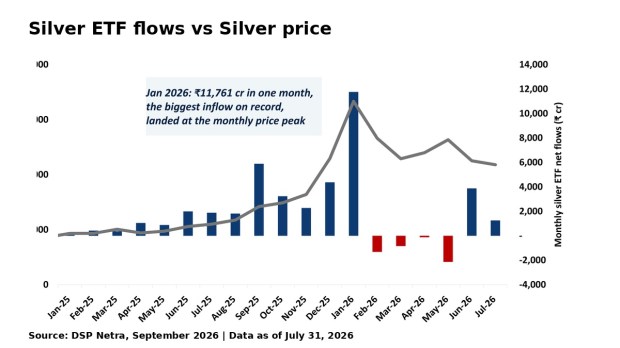
The numbers in the DSP report illustrate this clearly. In January 2026 alone, Silver ETFs received Rs 11,761 crore, the biggest monthly inflow on record. The report says this one month’s inflow was roughly equal to the cumulative inflows between September 2024 and August 2025, when silver prices were below Rs 1.41 lakh.
In other words, investors put in an enormous amount of money when silver prices were already near their monthly peak.
That is the basic reason why the average investor’s return was so much lower than silver’s return.
Investors came in after the rally
Think of two investors. The first investor buys silver before the rally and remains invested for the full year. The second investor watches silver climb sharply and decides to invest after seeing the spectacular returns. Both own silver. But their returns can be completely different.
The first investor captures most of the rally. The second investor enters after a significant part of the rally has already happened. That is what DSP describes as performance chasing.
“FOMO does not necessarily make you buy the wrong asset. It can make you buy the right asset after most of the return has already happened,” Kapoor says.
This is also visible in the Silver ETF flow data in the DSP report. The chart shows monthly inflows rising as silver prices climbed, with the biggest inflow coming around the price peak. The report describes this as a pro-cyclical pattern: the higher silver went, the more money investors chased it.
Why are 56% of recent investments sitting at a loss?
This is perhaps the most counter-intuitive part of the data. Despite silver’s 98% one-year gain, 56% of the money invested in Silver ETFs during the last 12 months was sitting at a loss as of July 31, 2026, according to DSP.
That does not mean 56% of investors lost money. The statistic refers to the money invested during the period and how that money was performing as of July 31. The reason is again timing.
A large amount of money entered after silver had already risen sharply. When prices subsequently moved lower from their peak, that late money was left with losses even though silver’s overall one-year return remained very strong.
This is an important lesson for investors.
A strong trailing return does not tell you what a new investor will earn from today.
Silver ETFs have delivered strong returns too, but not 98%
There is another distinction investors need to understand. The 98% figure in the DSP report is the return of silver. Actual Silver ETF returns can differ because of the period considered, tracking differences, expenses and other factors.
For example, Value Research data as of September 9 showed one-year returns of 86.03% for DSP Silver ETF, 85.62% for SBI Silver ETF and 85.40% for Nippon India Silver ETF. HDFC Silver ETF was at 85.03%.
The numbers are still exceptionally strong. But they also reinforce why investors should be precise about what return they are talking about. Silver’s return, an ETF’s NAV return and the return actually earned by an investor are three different things. And the last one depends heavily on when the money entered and exited.
The bigger question: Is it too late to buy silver?
The sharp rally naturally raises another question. After such a big move, should investors still be putting fresh money into silver? Kapoor says the risk-reward equation has changed after the rally. “The risk has certainly increased,” he says.
According to Kapoor, DSP’s valuation framework had shown a significant margin of safety when silver prices were much lower. After the sharp rally, he says that margin of safety is no longer visible.
This does not mean silver cannot rise further. It means investors should not assume that the next one-year return will look anything like the previous one.
That distinction is important because commodities can remain expensive or cheap for long periods, and momentum can continue even after valuations have moved significantly.
Silver’s supply-demand equation is also changing
There is another factor investors need to watch. Higher prices can change the supply side of the silver market.
Kapoor points to expectations from the Silver Institute that silver recycling could rise by about 7% in 2026 to roughly 211 million ounces. Higher prices can encourage consumers to sell old jewellery and silverware, bringing more metal back into the market.
At the same time, he expects industrial demand to soften partly because solar manufacturers are reducing the amount of silver used per panel and looking for substitutes.
This does not mean the long-term industrial story for silver has disappeared. But it does mean investors need to look beyond the recent price rally. “The price at which you enter matters enormously,” Kapoor says.
The risk of chasing the recent winner
For investors, the silver story is therefore not simply about whether silver is a good or bad investment.
The more immediate issue is the difference between owning an asset as part of a portfolio and buying it because it has just delivered spectacular returns.
DSP’s report makes this point across its broader discussion of investor behaviour. Its analysis shows that investor returns can differ significantly from market or fund returns because money tends to flow in after strong performance becomes visible.
The Silver ETF data is a particularly sharp example.
Silver delivered 98%.
The average rupee invested in Silver ETFs delivered 18%.
The difference was not because silver failed to perform.
It was because investors did not own it for the entire rally.
What should investors look at before buying Silver ETFs now?
Kapoor suggests that investors should separate portfolio allocation from performance chasing.
Before investing, he says investors should ask three basic questions: What return am I expecting from here? What valuation support exists if that expectation is wrong? And how much volatility can I tolerate?
The questions are particularly relevant after a large rally.
An investor buying silver today is not buying the silver that was available at much lower prices a year ago. The price has changed, the supply response is changing and investment demand has become a much bigger part of the recent move.
That does not mean silver cannot rise further. As Kapoor points out, momentum can continue for longer than valuation models suggest.
But investors should not use the past year’s 98% gain as their expected return for the next year.
The lesson from the silver rally
The biggest takeaway from the DSP report is perhaps not about silver at all. It is about the difference between market returns and investor returns. An asset can deliver a spectacular return, but an investor can still earn much less if most of the investment comes after the rally.
That is exactly what happened with Silver ETFs over the period analysed by DSP. The Rs 11,761 crore inflow in January 2026, arriving around the monthly price peak, is a telling example. For investors, the lesson is simple. Do not confuse a high past return with a high future return.
Silver may continue to have a place in a diversified portfolio. But buying it simply because it has risen 98% can produce a very different outcome from the one investors see in the headlines.
As Kapoor puts it, there is a difference between having a strategic allocation to silver and chasing it after a big rally.
One is portfolio construction. The other is performance chasing.
Disclaimer: This article is for information purposes only and should not be construed as investment advice. Commodity prices and Silver ETF returns can be highly volatile. Past performance does not indicate future returns. Investors should consider their investment objectives, risk tolerance and investment horizon before investing.
Every financial journey has a turning point. What’s yours?
Financial Express is launching a new series highlighting real experiences with money, investments, and the taxman. Did a sudden tax rule catch you off guard? Did a piece of financial advice change your life? Your story could provide invaluable, practical lessons for thousands of fellow taxpayers. Share your experience with us. We respect your privacy: no stories will be featured without a direct conversation and your full consent. Thank you.