




Rs 2 crore at 40 may sound like the finish line for early retirement. But when I asked ChatGPT what would happen after I actually reached that target, its calculations showed that the corpus may not be enough to fund my life for the next 40-50 years, especially with my rent assumed to rise 10% every year.
I used here a 50-year retirement horizon because retiring at 40 could mean living off the corpus for several decades. The aim was to stress-test whether Rs 2 crore could support such a long retirement.
I had earlier asked ChatGPT to build a roadmap to reach a Rs 2 crore retirement corpus by 40. The plan focused on increasing my investments over the years and gradually reducing risk as I got closer to retirement.
This time, I changed the question. I assumed that I had already reached Rs 2 crore at 40 and asked ChatGPT how I could fund the next up to 50 years post retiremnt with zero active income.
This is the prompt I used: “Act as an expert financial advisor and investment planner in India. I am 28 years old, earning Rs 70,000/month, living in Noida. I plan to retire at 40 with a corpus of Rs 2 crore. Assume that I have achieved my retirement Rs 2 crore target. After retirement, I will have zero active income. My current rent is Rs 14,000 and there is an expected 10% hike in rent every year. Also expect 6% inflation every year. Build me a complete post-retirement financial plan.”
The first thing ChatGPT told me was not particularly comforting. “Rs 2 crore is not automatically a sufficient retirement corpus for a retirement beginning at 40.” It said that an early retirement could mean funding 50-60 years of expenses and that my assumed 10% annual increase in rent was significantly higher than the 6% general inflation assumption.
Its recommendation was therefore not to simply put Rs 2 crore in an FD and live off the interest. Instead, it suggested building the retirement plan around capital preservation, inflation protection and controlled withdrawals.
My Rs 14,000 rent could become nearly Rs 44,000 by 40
The first calculation immediately showed why my retirement plan could become difficult. I currently pay Rs 14,000 a month in rent. If rent increases by 10% every year, ChatGPT calculated that it could reach approximately:
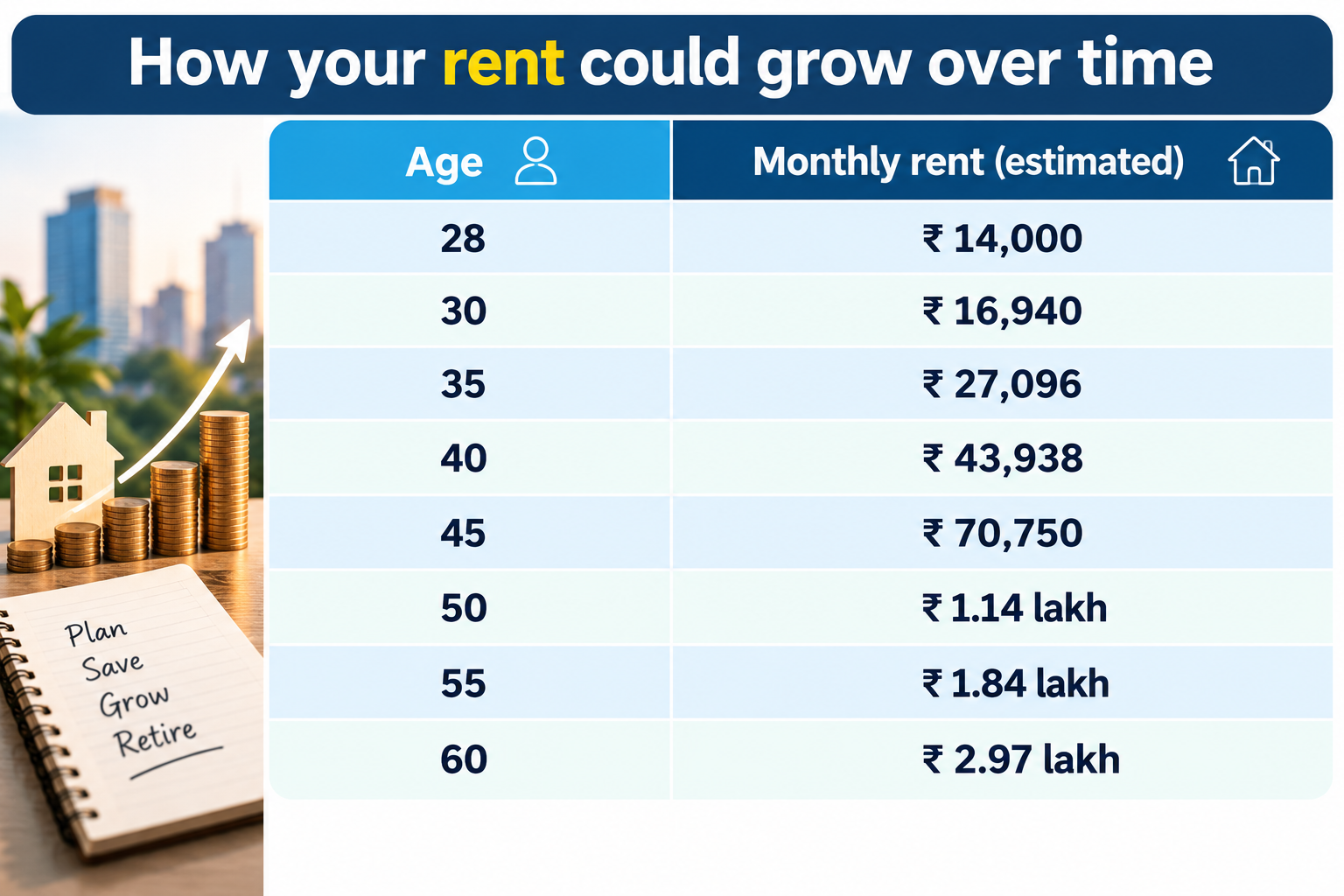
By age 40, rent alone would therefore cost about Rs 5.27 lakh a year. That means if I retire with Rs 2 crore, my projected rent alone would represent a withdrawal of about 2.64% of the corpus in the first year. That amount is before paying for food, electricity, healthcare, insurance, transportation, entertainment, travel, taxes and emergencies.
ChatGPT therefore suggested changing the way I think about my retirement target. Instead of asking whether I can accumulate Rs 2 crore, it said I should ask whether I have enough assets at 40 to fund inflation-adjusted expenses until at least age 90-95, with a separate emergency and medical reserve.
How much can Rs 2 crore actually support?
ChatGPT then tested the Rs 2 crore corpus against different hypothetical returns. Assuming retirement at 40, no salary after retirement, inflation-adjusted withdrawals and a retirement horizon of 50-60 years, the amount I could initially withdraw would depend heavily on the portfolio’s return.
At a hypothetical 6% annual return, Rs 2 crore could support an initial withdrawal of roughly Rs 27,800 a month for a 60-year retirement or Rs 33,300 a month for a 50-year retirement.
At 7%, the figures rise to roughly Rs 38,700 and Rs 44,500 a month respectively. At 8%, the initial withdrawal could be around Rs 49,400 a month for a 60-year horizon or Rs 54,900 for 50 years.
But these figures are based on smooth annual returns. Actual markets do not deliver the same return every year, and a major market fall early in retirement can significantly damage a portfolio from which withdrawals are already being made.
That created another problem for me: my projected rent at 40 alone is about Rs 43,938 a month. Hence, under several of these scenarios, rent could consume most or all of the sustainable initial withdrawal from the Rs 2 crore corpus.
ChatGPT said I should not keep the entire Rs 2 crore in FD
ChatGPT specifically warned against the idea of putting the entire Rs 2 crore into a bank FD and simply living off the interest.
The problem is that FD interest may not keep pace with inflation. If an investment earns 7% before tax while inflation is 6%, the real return before tax is already only around 1%. Taxes can reduce the effective return further.
Instead, it suggested maintaining a diversified retirement portfolio.
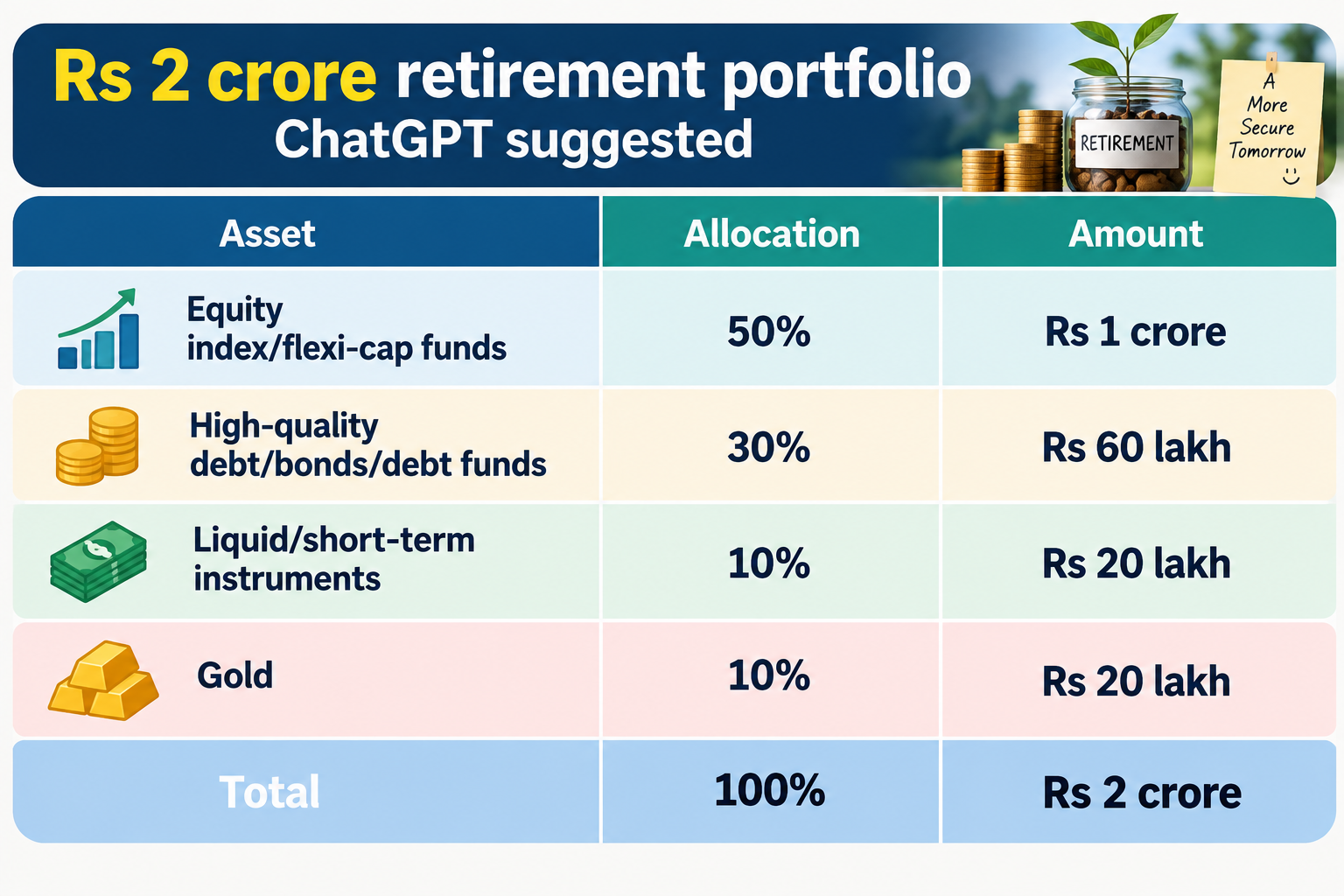
This was presented as an illustrative framework rather than a recommendation to buy any particular fund. The reason for retaining a sizable equity allocation even after retirement is the unusually long retirement horizon. If I stop working at 40, the money potentially needs to last another five decades.
That means the portfolio cannot be designed only around protecting the money I need at 40. It also needs to provide growth for my expenses at 60, 70, 80 and beyond.
Instead of one Rs 2 crore corpus, ChatGPT suggested 3 retirement buckets
ChatGPT then made the plan more practical by dividing the retirement corpus into different buckets.
Bucket 1: First three years of expenses
Around Rs 20-30 lakh would be kept in highly liquid and relatively low-volatility investments. The purpose is that if the stock market crashes immediately after retirement, I should not have to sell equity investments just to pay my rent or monthly bills.
Bucket 2: Medium-term expenses
Another Rs 40-50 lakh could be placed primarily in high-quality debt or other relatively stable fixed-income investments.
This bucket would fund expenses for the following years while allowing the long-term equity portfolio to remain invested.
Bucket 3: Long-term growth
The remaining roughly Rs 1 crore or more would be predominantly invested in diversified equity. This money would be meant for the later decades of retirement.
How would I actually withdraw money every month?
ChatGPT also suggested that I should not think of retirement income as simply “interest” generated by my investments. Instead, I could use a Systematic Withdrawal Plan (SWP) from suitable mutual-fund holdings to create regular cash flow.
But an SWP is not free income. It involves selling units and withdrawing the money. What matters is the portfolio’s overall return, the withdrawal rate and how the portfolio performs while withdrawals are being made.
The suggested system was:
Monthly: Take the required spending from the cash/liquidity bucket.
Once or twice a year: Replenish that bucket from debt or equity, depending on market conditions.
If equity markets are falling sharply, I would avoid selling equity simply to pay the next month’s expenses. Cash and debt would act as a buffer while the equity portfolio recovers.
My biggest retirement risk may actually be rent
The more I looked at the numbers, the more obvious the housing problem became. ChatGPT called the 10% annual rent increase assumption particularly dangerous because it is substantially higher than the 6% general inflation assumption I had used.
At the assumed rate, my monthly rent could rise from Rs 14,000 today to nearly Rs 44,000 at 40, Rs 1.14 lakh at 50 and nearly Rs 3 lakh at 60.
Of course, rent is unlikely to mechanically increase by exactly 10% every year for five decades.
But the calculation showed why I cannot simply assume that my current rental lifestyle will remain affordable after retirement.
ChatGPT suggested treating housing as a separate retirement objective.
One option would be to buy a house before retirement, which would remove rent from the regular retirement cash-flow requirement, although ownership brings costs such as maintenance, property tax and repairs.
A second option would be to continue renting but target a substantially larger retirement corpus.
A third would be a hybrid approach – retire with the Rs 2 crore corpus and eventually use part of it to buy a modest home, after considering the purchase price and the opportunity cost of taking money out of the investment portfolio.
Healthcare needs its own reserve
Another part of the plan that stood out was healthcare. ChatGPT suggested maintaining adequate health insurance even after retirement and creating a separate medical and emergency reserve rather than assuming that the main investment portfolio could handle every unexpected expense.
As an illustrative target, it suggested eventually building a Rs 10-20 lakh or higher medical/emergency reserve, depending on insurance coverage, family responsibilities and individual circumstances. That reserve would sit outside the money I expect to use for regular monthly expenses.
What happens if the market crashes just after I retire?
This is where ChatGPT introduced the concept of sequence-of-returns risk. Imagine two retirees who eventually get similar long-term average returns. One experiences strong returns in the first few years, while the other suffers a major market crash immediately after retirement.
The second retiree can end up in a much weaker position because they are simultaneously withdrawing money and selling assets after those assets have fallen.
That is why ChatGPT suggested keeping a sizable liquidity and debt allocation during the early years of retirement. It also suggested having retirement “guardrails”.
In a normal market year, spending could broadly rise with inflation. During a major market decline, discretionary spending could temporarily be frozen.
If the portfolio falls significantly, the idea would be to use cash and debt rather than sell equity at depressed prices.
When markets recover, the cash and debt buckets could then be replenished.
So is Rs 2 crore enough for me to retire at 40?
This was probably the most important conclusion from the exercise.
ChatGPT suggested thinking about the retirement goal in three levels:
Rs 2 crore: My stated minimum target.
Rs 3 crore: A safer target with more breathing room.
Rs 4 crore+: A stronger early-retirement target, particularly if I want to continue renting, travel, provide for healthcare, support my family or have no active income at all.
But it also cautioned that a Rs 3 crore or Rs 4 crore corpus does not automatically guarantee retirement security. The required corpus depends heavily on actual spending, housing costs and other individual circumstances.
The most important number, therefore, is not my current Rs 70,000 salary. It is how much I expect to spend every year after retirement.
Post-retirement roadmap ChatGPT gave me
The plan it ultimately suggested was divided into different phases.
Age 28-35: Accumulation
Focus heavily on building the corpus, maintain a growth-oriented portfolio, increase investments whenever income rises and eliminate expensive debt before retirement.
Age 35-40: Transition
Gradually increase debt allocation, build a multi-year emergency and withdrawal reserve, ensure health insurance is in place and decide whether I will rent or own my home.
Age 40-50: Early retirement
Avoid chasing maximum returns. Maintain a combination of equity, debt, liquidity and diversification, use controlled withdrawals and review the portfolio annually.
Age 50-70: Capital preservation plus growth
Keep enough equity because retirement could still last decades, while increasing healthcare provisions and reviewing housing costs.
Age 70+: Longevity and simplicity
Gradually simplify the portfolio, increase liquidity, maintain strong healthcare and emergency reserves and review nominations and estate planning.
ChatGPT’s post-retirement calculation made one thing clear that the real finish line is not a corpus number. It is having enough assets and a sustainable withdrawal plan to fund the life I want after the salary stops.
Disclaimer: This story is based on a personal experiment in which the author used ChatGPT to explore a hypothetical post-retirement financial plan. The calculations, asset-allocation examples, withdrawal strategies and corpus estimates generated by ChatGPT are illustrative and based on the assumptions provided in the prompt. They should not be treated as personalised financial advice or a recommendation to invest in any specific financial product. Actual retirement requirements and investment outcomes may vary depending on inflation, market returns, taxes, expenses, healthcare costs, longevity and individual circumstances. Financial Express Digital does not endorse or guarantee the accuracy or suitability of the AI-generated financial plan. Financial Express Digital also does not encourage or discourage the use of AI to generate personalized financial plans.
Every financial journey has a turning point. What’s yours?
Financial Express is launching a new series highlighting real experiences with money, investments, and the taxman. Did a sudden tax rule catch you off guard? Did a piece of financial advice change your life? Your story could provide invaluable, practical lessons for thousands of fellow taxpayers. Share your experience with us. We respect your privacy: no stories will be featured without a direct conversation and your full consent. Thank you.