


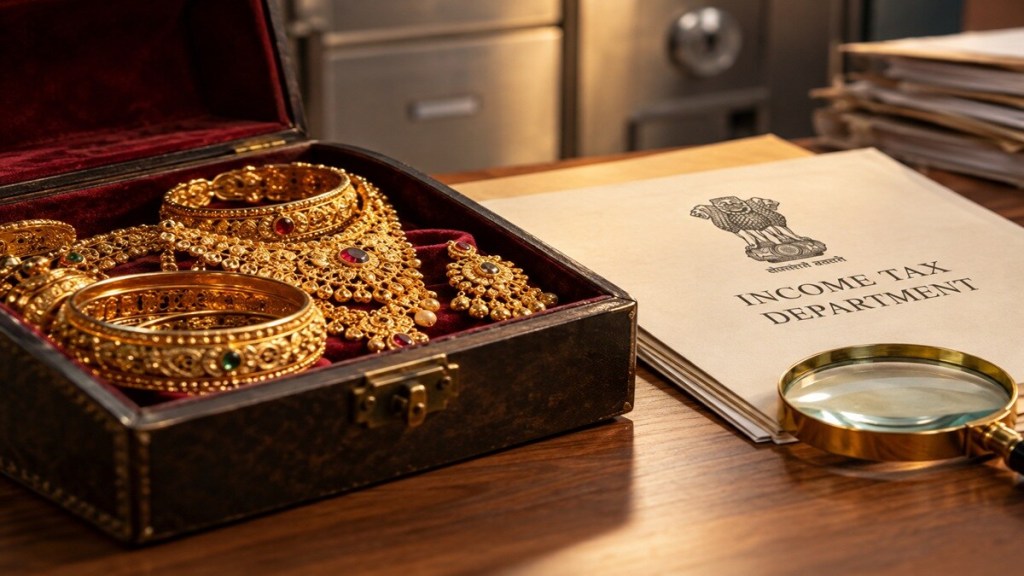

Finding gold jewellery during an Income Tax search does not automatically mean that the entire jewellery belongs to the person being searched. A recent ruling by the Kolkata bench of the Income Tax Appellate Tribunal (ITAT) has highlighted the importance of ownership records, family lockers and old valuation documents when authorities question jewellery found during a search.
Income Tax search finds jewellery worth Rs 14.69 crore
The case involved Miraj Digvijay Shah, whose residential and business premises were searched on June 21, 2022. During the search, jewellery and bullion worth around Rs 14.69 crore were found. Jewellery and bullion worth about Rs 14 crore were seized after the authorities were not satisfied with the explanation given for the assets.
The dispute eventually centred on jewellery worth Rs 1.56 crore, weighing 3,233.11 grams.
Shah told the authorities that this jewellery did not belong to him personally. He claimed that it was ancestral and belonged to his deceased grandmother, grandfather and father, as well as his late father’s HUF.
Jewellery was found in family lockers
One of the important facts in the case was where the jewellery was found.
The disputed jewellery was recovered from UCO Bank lockers held in the names of several family members. These included Shah’s mother, his deceased father and grandfather, his brother, aunt and other relatives.
The jewellery was not found in Shah’s personal possession or in a locker held exclusively in his name.
Shah had also told the authorities that he was not aware of some of the lockers and had not visited the UCO Bank lockers for around five to seven years.
This became important in deciding whether the jewellery could automatically be treated as Shah’s unexplained asset.
Dinkar Sharma, Company Secretary and Partner, Jotwani Associates, said: “Finding jewellery during a search does not by itself establish that it belongs to the person being searched. The ownership and source have to be examined in the context of where the jewellery was found and what supporting evidence is available.”
1997 valuation reports helped establish ownership
Shah produced valuation reports prepared in 1997 for his deceased family members. The appellate authority found that the descriptions in the old valuation reports matched the jewellery found during the search.
His mother also submitted an affidavit claiming ownership of the jewellery. The affidavit was not successfully challenged by the Revenue.
The old records therefore became important evidence in explaining the history and ownership of the jewellery.
The appellate authority also noted that Shah was not the executor or legal heir responsible for producing the wealth-tax records of his deceased relatives. Therefore, the absence of those old records could not, by itself, be used to reject his explanation.
Sharma said: “Old valuation reports can become important evidence in family jewellery cases, particularly when they can be linked with the jewellery found during a search. The stronger the documentary trail showing ownership, the easier it is to explain the asset.”
ITAT refuses to treat Rs 1.56 crore jewellery as Shah’s unexplained wealth
The ITAT examined the facts and agreed with the CIT(A).
The Tribunal noted that the jewellery was not found in Shah’s personal possession or in a locker held exclusively in his name. It also took note of the old valuation reports and the unchallenged affidavit submitted by his mother.
The ITAT therefore upheld the deletion of the Rs 1.56 crore addition relating to 3,233.11 grams of jewellery.
The ruling does not mean that a taxpayer can simply claim that jewellery is ancestral whenever gold is found during an Income Tax search. The decision was based on the evidence available in this particular case.
The old valuation reports, family ownership details, location of the lockers and the mother’s affidavit all formed part of the explanation accepted by the tax authorities.
What about the other Rs 64.93 lakh jewellery?
There was another jewellery holding of 1,293.43 grams valued at Rs 64.93 lakh.
Shah said this jewellery belonged to his mother. Her claim was supported by a valuation report dated April 9, 1997, and an affidavit. The CIT(A) accepted the explanation. The Revenue did not challenge this part before the ITAT.
The case also referred to the CBDT’s 1994 instruction on jewellery found during searches. The appellate authority noted that the prescribed jewellery limits are not an absolute rule and that the social and financial circumstances of a family can also be considered.
Rs 40 lakh cash was also explained
The case was not limited to jewellery.
During the search, authorities found Rs 2.89 crore in cash, of which about Rs 2.48 crore was seized. The Assessing Officer treated Rs 1.98 crore as unexplained after allowing credit for Rs 50 lakh reflected in the books of a group entity.
The taxpayer was able to explain another Rs 40 lakh through the cash book of D J Shah & Co.
The CIT(A) examined the cash book and found that some entries appearing later were post-dated receipts. After removing those entries, the available cash on the relevant date was around Rs 40.99 lakh. The ITAT accepted this explanation and upheld the deletion of the Rs 40 lakh addition.
Sharma said: “The practical lesson is that families holding substantial jewellery should maintain whatever records are available to establish ownership and history. Old valuation reports, purchase records, inheritance documents and other supporting papers can become important when the source or ownership of jewellery is questioned.”
What should families holding inherited gold keep?
The ruling highlights the importance of maintaining a documentary trail for inherited or ancestral jewellery.
Families should preserve old valuation reports, purchase invoices where available, wills, inheritance or succession documents, family settlement records and other documents that can help establish ownership and the history of the jewellery.
The more difficult the ownership history, the more important these records can become.
The Kolkata ITAT ultimately dismissed the Revenue’s appeal.
Disclaimer: This article is based on the facts and findings recorded in the Kolkata ITAT order in Deputy Commissioner of Income Tax, Central Circle 1(1), Kolkata vs Miraj Digvijay Shah, pronounced on September 11, 2026. The outcome is fact-specific and should not be interpreted as a general exemption for inherited or ancestral jewellery from Income Tax scrutiny. Tax treatment can vary depending on the facts and supporting documents available in each case. The expert comments included above are drafted from the facts and reasoning of the order and should be confirmed with Dinkar Sharma before publication as direct quotes.
Every financial journey has a turning point. What’s yours?
Financial Express is launching a new series highlighting real experiences with money, investments, and the taxman. Did a sudden tax rule catch you off guard? Did a piece of financial advice change your life? Your story could provide invaluable, practical lessons for thousands of fellow taxpayers. Share your experience with us. We respect your privacy: no stories will be featured without a direct conversation and your full consent. Thank you.