


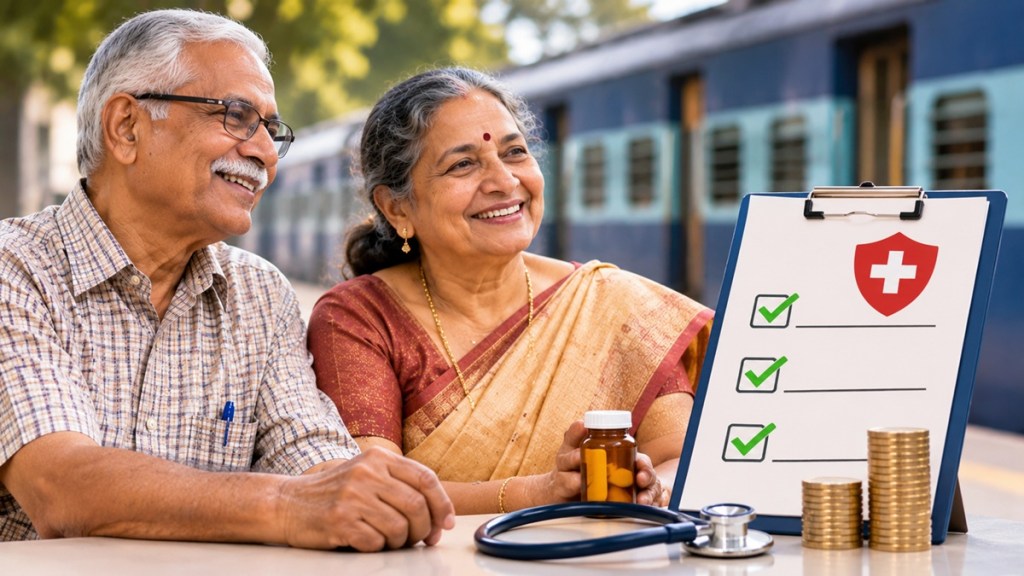

A retired railway employee may have to make an important healthcare decision before leaving service. Should they choose full medical facilities for life under the Retired Employees Liberalised Health Scheme, or opt for a monthly Fixed Medical Allowance of Rs 1,000 along with their pension?
The choice can affect how they access routine medical care after retirement. It can also determine whether they can use railway hospitals for regular outpatient treatment.
The Railway Board has issued a set of frequently asked questions on healthcare facilities for retired railway employees under the Retired Employees Liberalised Health Scheme, or RELHS. The FAQs explain the two options available at retirement, the process for joining the scheme, treatment at private empanelled hospitals and the rules for emergency care and reimbursement.
The document also explains how retired employees can use their UMID cards to access medical services and why they should complete the necessary formalities before retirement.
Here is what retired railway employees and those approaching retirement need to know.
Full medical facilities or Rs 1,000 monthly allowance: Which option should you choose?
The Railway Board’s FAQs set out two options for retired employees joining RELHS.
Under the first option, employees can join RELHS without the Fixed Medical Allowance. This provides medical facilities for life at par with serving railway employees, subject to applicable railway rules.
Under the second option, employees can join RELHS and receive a Fixed Medical Allowance of Rs 1,000 per month along with their pension. However, routine outpatient department treatment is not available in railway hospitals under this option, except in emergencies or for chronic illnesses, as specified in the FAQs.
The choice matters because the allowance does not offer the same access to routine railway hospital outpatient services as RELHS without FMA.
The Railway Board recommends RELHS without FMA for retirees who live in, or may move to, a city where railway healthcare facilities are available. The FMA option may be more suitable for those who permanently settle in rural areas where a railway healthcare facility is not available within 50 km.
The decision should depend on where the retiree plans to live, access to railway healthcare facilities and the family’s medical needs.
RELHS with FMA vs RELHS without FMA
| Feature | RELHS without FMA | RELHS with FMA |
|---|---|---|
| Monthly Fixed Medical Allowance | Not available | Rs 1,000 |
| Routine OPD treatment at railway hospitals | Available | Not available, except in specified cases |
| Emergency treatment | Available | Available |
| Treatment for chronic illnesses | Available | Available |
| Medical facilities | Full facilities under applicable rules | Restricted as specified in the FAQs |
The FAQs state that a beneficiary gets only one opportunity to switch between the two options. Retired employees should therefore consider their long-term healthcare needs before making their choice.
How much do you have to pay to join RELHS?
Retired railway employees have to make a one-time contribution to join RELHS.
According to the Railway Board’s FAQs, the amount is equal to the employee’s last Basic Pay at retirement or a fixed amount based on the employee’s 7th Central Pay Commission level, whichever is lower.
The amount is deducted from the retirement settlement or Death-cum-Retirement Gratuity. Employees do not have to make a separate cash deposit.
The FAQs do not provide a single contribution amount for all retirees. The applicable amount depends on the relevant pay level and the rules in force.
Employees approaching retirement should confirm their contribution with the Personnel Branch and ensure that the deduction is made as required.
When should you apply for RELHS?
Retired employees should exercise their option for RELHS before retirement. The Railway Board recommends submitting the option form to the Personnel Branch about three months before retirement.
Waiting until the last moment could leave important formalities incomplete.
The FAQs advise employees to complete the following steps before retirement:
- Submit the RELHS option form.
- Ensure the required contribution is deducted from the retirement settlement.
- Check that the UMID card has been generated.
- Add the spouse and other eligible dependent family members to UMID.
- Verify the mobile number registered with UMID.
- Keep the Pension Payment Order, Aadhaar and UMID details safely.
Completing these steps in advance can help retirees access medical facilities without avoidable administrative delays.
Can retired railway employees get treatment at any railway hospital?
Yes. The FAQs clarify that eligible RELHS beneficiaries can seek treatment at any railway hospital or health unit in India. They do not have to restrict themselves to the railway hospital at their home location or the hospital selected earlier.
The facilities available at a particular hospital or health unit may vary. Depending on availability, these can include outpatient consultations, inpatient treatment, specialist services, laboratory tests, diagnostic investigations, pharmacy services and referrals.
The Railway Board states that inpatient admission and treatment are free, including specialist services available through visiting specialists or case-by-case arrangements.
However, hospital diet, if taken, may be chargeable at prescribed rates depending on the applicable rules and pay level.
The FAQs also state that X-rays, ECGs, ultrasound, laboratory tests and CT or MRI scans are available free of cost where the required facilities exist. Referral services to empanelled diagnostic centres are also available.
If a railway hospital cannot provide the required investigation or treatment, the railway doctor may refer the patient to a higher railway hospital or an empanelled facility.
Are medicines for chronic illnesses available free?
Yes. The Railway Board’s FAQs state that required medicines are provided free of cost to eligible patients.
If a medicine is unavailable at the railway hospital or health unit, the Chief Medical Superintendent may arrange for it to be procured through an indent or local purchase. The medicine is then provided to the patient on a cashless basis.
Retirees who need regular medicines should visit the hospital on a preferred working day each month and carry their previous prescription, if available.
Those planning to travel abroad or requiring medicines for three months should inform the railway medical authorities at least one week in advance. This allows the authorities time to arrange the medicines.
The FAQs also list certain facilities for older beneficiaries. These include a separate queue at outpatient departments and pharmacies for senior citizens above 80 years, wheelchair assistance on request and annual medical examinations on request.
RELHS beneficiaries above 70 years who are not availing FMA can also directly visit empanelled hospitals for outpatient consultations, according to the FAQs.
Can retired railway employees visit private hospitals?
Yes. Railway hospitals may refer eligible beneficiaries to private empanelled hospitals when the required specialist consultation, investigation or treatment is unavailable within the railway healthcare system.
For planned treatment, however, retirees should follow the prescribed referral process.
The Railway Board’s FAQs set out the following steps:
- Visit the outpatient department of a railway hospital or health unit.
- Get examined by the railway doctor.
- Obtain a referral if the required treatment is not available within the railway healthcare system.
- Visit the empanelled hospital with the UMID and referral letter, either in physical or digital form.
- Receive treatment on a cashless basis, subject to the terms of the agreement between the railway administration and the hospital.
A routine referral is valid for 30 days. For cancer treatment, the referral is valid for 90 days.
The list of empanelled hospitals and their specialities is available through the HMIS app. Retirees should check the current list before visiting a hospital because empanelment details may change.
The FAQs also state that beneficiaries above 70 years who are not availing FMA can directly approach empanelled hospitals for outpatient consultations.
What happens if a railway pensioner needs emergency treatment?
Emergency treatment follows a different process from planned treatment.
The Railway Board’s FAQs state that retired employees can directly approach an empanelled railway hospital in a life-threatening emergency without first obtaining a railway referral. Examples include chest pain, stroke, an accident, severe breathlessness, a fracture or unconsciousness.
This facility is available across India. A beneficiary does not have to return to the railway hospital in their registered location before seeking emergency care.
The FAQs state that the empanelled hospital will verify the beneficiary’s identity through UMID and an OTP before providing cashless emergency treatment, as per its agreement with the railways. The facility is described as available 24 hours a day, throughout the year.
Beneficiaries should show their UMID details and follow the hospital’s verification process.
The important distinction is that planned treatment generally requires a railway hospital consultation and referral, while a life-threatening emergency does not require the beneficiary to delay care to obtain a referral.
What if you need emergency treatment at a private hospital that is not empanelled?
A retired railway employee may sometimes need emergency treatment at a private hospital that does not have a railway empanelment agreement.
In such cases, the Railway Board’s FAQs advise beneficiaries to preserve the original bills, discharge summary and investigation reports.
The reimbursement claim should be submitted to the Chief Medical Superintendent’s office at the registered location within six months of completion of treatment.
However, there is an important restriction. Planned treatment for elective cases at a non-empanelled private hospital is not eligible for reimbursement under the FAQs.
Retirees should therefore distinguish between emergency treatment at a non-empanelled hospital and a voluntary decision to seek planned treatment there.
They should also retain all relevant documents and confirm the applicable claim procedure with the concerned railway medical authorities.
Is a physical UMID card compulsory?
No. The Railway Board’s FAQs state that the UMID card is auto-generated and that a separate physical card is not required.
Retired employees should download the HMIS app from the Play Store and log in using the mobile number registered with UMID. They may also keep a PVC print of the card from the UMID portal if they prefer.
UMID helps beneficiaries access medical services and their digital records. The integrated HMIS platform supports registration, consultations, prescriptions, investigations and digital referrals to empanelled hospitals.
The FAQs state that the HMIS app also provides a directory of empanelled healthcare organisations, including their locations and specialities.
Beneficiaries should keep their UMID details secure and should not share them with other people.
The Railway Board also recommends keeping digital copies of important documents, including the Pension Payment Order, Aadhaar, prescriptions and relevant medical records. These can be stored in DigiLocker for easy access.
What should retired railway employees remember?
The most important decision comes before retirement. Employees should understand the difference between RELHS with FMA and RELHS without FMA, check their contribution and complete the required formalities in time.
After retirement, they should remember three basic rules.
For planned treatment, visit a railway hospital or health unit first and obtain a referral if required. For a life-threatening emergency, approach the nearest appropriate hospital without delaying treatment to obtain a referral. If emergency treatment takes place at a non-empanelled private hospital, preserve the original documents and submit the reimbursement claim within six months, as prescribed in the FAQs.
These steps can help retired railway employees and their families understand how to access healthcare facilities under RELHS.
The Railway Board has clarified that its FAQs are for informational purposes. The applicable railway rules and policy guidelines will prevail in case of any variation or dispute.
Disclaimer: This article is based on the Railway Board’s FAQs on healthcare facilities for retired railway employees under RELHS. The applicable railway rules and policy guidelines will prevail in case of any variation or dispute. Beneficiaries should confirm the latest rules with the concerned railway authorities.
Every financial journey has a turning point. What’s yours?
Financial Express is launching a new series highlighting real experiences with money, investments, and the taxman. Did a sudden tax rule catch you off guard? Did a piece of financial advice change your life? Your story could provide invaluable, practical lessons for thousands of fellow taxpayers. Share your experience with us. We respect your privacy: no stories will be featured without a direct conversation and your full consent. Thank you.