


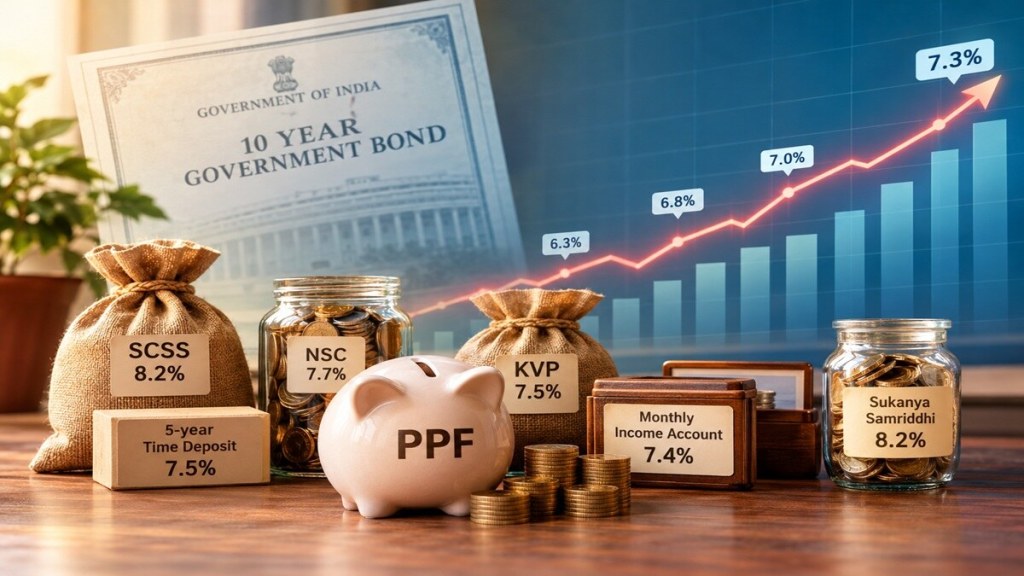

The Public Provident Fund (PPF) offers an interest rate of 7.1%. But with government bond yields climbing to their highest levels in nearly three years, could PPF investors finally get a higher return? An indicative calculation based on a 10-year government security yield of 7.3% points to a PPF rate of 7.55%. The government, however, has kept the rate unchanged for the October-December quarter.
The gap raises an important question for millions of households that depend on government-backed savings schemes to build a retirement corpus, fund their children’s education or earn a regular income after retirement. If the government’s borrowing costs are rising, why are returns on small savings schemes not keeping pace?
The answer lies in how these rates are calculated, the government’s discretion over the final decision and the cost of maintaining attractive returns for savers without increasing its own borrowing burden.
The latest quarterly review offers little immediate relief. On September 30, the Finance Ministry retained the existing rates for the October-December 2026 quarter. PPF continues to offer 7.1%, the National Savings Certificate offers 7.7%, and the Senior Citizens’ Savings Scheme pays 8.2%.
For savers, the issue is bigger than PPF alone. It is about whether the rise in government bond yields will eventually translate into better returns across small savings schemes, many of which have not seen an interest rate revision for years.
Why a 7.3% bond yield points to a 7.55% PPF rate
Government securities (G-Secs) through which the government borrows money from investors. Their yields reflect the return investors demand for lending to the government. These yields move with expectations about inflation, interest rates, government borrowing and demand for bonds.
Small savings rates are reviewed every three months. The government uses a formula recommended by the Shyamala Gopinath Committee as a reference for setting rates. The recommendation links scheme rates to the yields on government securities of comparable maturities, with a spread added to make small savings attractive.
For PPF, the recommended spread is 25 basis points above the average yield on 10-year government securities over the relevant reference period. One basis point is one-hundredth of a percentage point.
A 10-year yield of 7.3%, therefore, gives the following indicative calculation:
| Particulars | Rate |
|---|---|
| Illustrative 10-year G-Sec yield | 7.30% |
| Recommended PPF spread | 0.25 percentage point |
| Indicative PPF rate | 7.55% |
| Current PPF rate | 7.10% |
| Difference | 0.45 percentage point |
The important word here is indicative. The formula uses an average yield over a specified period, not the yield on a single trading day. A spot yield of 7.3% does not automatically mean the formula-based rate for the next quarter is 7.55%.
Adhil Shetty, CEO of BankBazaar, explains that the PPF rate is guided by the government’s 10-year borrowing cost, with a small margin added for savers.
“When this cost rises, the formula can point to a higher rate,” he says.
He also points out that the formula looks at how the borrowing cost has averaged over recent months. The Finance Ministry reviews small savings rates every quarter and announces the final rates close to the end of the quarter.
This distinction matters because a sharp rise in yields towards the end of a quarter may not fully show up in the average used for the calculation.
PPF rates have stayed at 7.1% since April 2020
The bigger question is why PPF has not seen an increase despite changes in government bond yields.
PPF paid 7.9% in the January-March 2020 quarter. The rate was cut to 7.1% from April 2020 and has remained unchanged since then. That means savers have received the same notified rate for more than six years, even as the bond market has gone through different phases.
The period has included the pandemic, sharp monetary tightening across major economies, changes in domestic inflation and shifts in the government’s borrowing requirements.
The 10-year G-Sec yield fell sharply during the pandemic as monetary policy eased and demand for government bonds increased. It subsequently moved higher as inflation rose and interest rates increased. It then eased during parts of 2024 and 2025 before moving up again in 2026.
The PPF rate, however, did not follow these market movements quarter by quarter.
This is because the recommended formula is not a binding rule that automatically determines the rate. The government makes the final decision and can retain existing rates even when the calculation suggests a change.
Shetty says bond yields are only one of the factors considered in the quarterly review.
“Inflation, bond yields and how much money is coming into these schemes all play a part,” he says.
Steady inflows and returns that already appeal to savers could also influence the decision. The government must consider the interests of depositors as well as the cost of offering higher returns on money raised through these schemes.
A stable rate also gives savers some certainty in a product designed for long-term financial goals. But the flip side is that investors may not benefit immediately when market yields rise.
How the 10-year bond yield has moved over three years
The movement in government bond yields shows why the question of higher small savings rates has returned to the spotlight.
The 10-year G-Sec yield was around 7.2% at the end of 2023. It eased through much of 2024 and early 2025, falling to around 6.3% in May 2025 on monthly data. It then moved higher again. The September 2026 monthly reading was around 7.18%, while market reports in October put the yield above 7.3%, with a move to 7.39% reported on October 13.
The latest rise is significant because it has pushed the benchmark close to levels last seen several years ago. It also raises the government’s cost of raising fresh funds and refinancing maturing debt.
Chart: India’s 10-year government bond yield
The following chart uses selected monthly observations and the latest reported market level. Monthly averages and a daily market quote are not directly comparable, so the final point should be read as an indication of the latest move rather than a continuous monthly series.
| Period | 10-year G-Sec yield |
|---|---|
| December 2023 | 7.22% |
| December 2024 | 6.78% |
| December 2025 | 6.63% |
| September 2026 | 7.18% |
| October 13, 2026 | 7.39% |
The trend shows that yields did not rise continuously over the three-year period. They first eased and then moved higher again. That distinction is important when comparing market movements with small savings rates. The government may not respond to a short-lived rise in yields in the same way it would respond to a sustained change in borrowing costs.
What is pushing Indian bond yields higher?
Bond yields and bond prices move in opposite directions. When investors demand a higher return to hold a bond, its price falls and its yield rises.
Several factors have contributed to the latest increase in Indian government bond yields.
One is the government’s borrowing requirement. When the government needs to raise large sums through bond sales, investors may seek higher yields, particularly if they expect the supply of bonds to remain heavy.
Inflation expectations are another factor. If investors expect prices to rise, they may demand a higher return to protect the purchasing power of their money. Higher oil prices can add to these concerns because India imports a large share of its crude oil requirements.
Monetary policy and liquidity conditions also matter. The Reserve Bank of India influences short-term interest rates through its policy rate and liquidity operations. Changes in liquidity can affect demand for government securities and the yields at which investors are willing to buy them.
The recent rise in yields has also reflected tighter liquidity conditions. Market reports have linked the latest move to the RBI’s actions to reduce liquidity and measures intended to support the rupee.
Global bond markets are another influence. When US Treasury yields rise, investors reassess the returns they demand across markets. That can put pressure on emerging-market bond yields, including those in India, although domestic borrowing, inflation and liquidity conditions remain important drivers.
For investors, the implication is straightforward. Higher yields mean the government may have to offer better returns to attract buyers for new bonds. But that does not automatically require it to increase the rates on small savings schemes.
What the rise means for other small savings schemes
PPF is not the only scheme for which bond yields matter. The government’s recommended framework links small savings rates to yields on government securities of comparable maturities, with different spreads for different schemes.
The five-year government security yield is particularly relevant when assessing the recommended rates for certain five-year savings products. The Senior Citizens’ Savings Scheme has a recommended spread of 100 basis points over the average five-year G-Sec yield under the committee’s framework.
This makes the comparison useful, but it should not be treated as a mechanical forecast. The actual notified rate may differ from the indicative rate, and the government retains discretion over the final decision.
The latest rates, effective from October 1 to December 31, 2026, are as follows:
| Small savings scheme | Interest rate | Last rate revision |
|---|---|---|
| Public Provident Fund | 7.1% | April 2020 |
| Senior Citizens’ Savings Scheme | 8.2% | April 2023 |
| National Savings Certificate | 7.7% | April 2023 |
| Kisan Vikas Patra | 7.5% | April 2023 |
| National Savings Monthly Income Account | 7.4% | April 2023 |
| Five-year Time Deposit | 7.5% | April 2023 |
| Sukanya Samriddhi Account | 8.2% | April 2023 |
The table highlights how long several rates have remained unchanged. PPF has seen no revision since April 2020, while the listed schemes that last changed in April 2023 have gone more than three years without a fresh rate revision.
These dates refer to the last change in the notified rate, not the last quarterly review. The government continues to review rates every quarter even when it decides to leave them unchanged.
For investors, the differences between schemes matter. PPF is designed for long-term savings and has a 15-year maturity period. NSC has a five-year tenure. SCSS is aimed at eligible senior citizens and pays interest quarterly. The Monthly Income Account provides monthly payouts, while KVP has a defined maturity period linked to the notified rate.
A higher bond yield may strengthen the case for a rate increase in some of these schemes. It does not mean every scheme will receive the same increase or that all rates will be revised together.
Would a higher PPF rate make a difference?
For someone who invests regularly over 15 years, even a modest increase in the interest rate can add to the final corpus.
Consider an investor who deposits Rs 1.5 lakh every year, the maximum annual contribution permitted under PPF. If the rate were 7.1% throughout the period, the maturity amount would be lower than it would be at 7.55%, assuming the higher rate applied for the entire 15 years.
Shetty estimates that the higher rate could add roughly Rs 1.6 lakh to the maturity amount for someone investing the maximum Rs 1.5 lakh a year over 15 years.
But there is an important qualification. PPF rates are reviewed every quarter. A rate increase today would not guarantee that the rate stays at 7.55% for the next 15 years. The final maturity amount would depend on the rates notified in future quarters and the timing of deposits.
Shetty also cautions against focusing only on the rate.
“In a long-term scheme like PPF, regular deposits matter more to the final amount than a small change in rate,” he says.
For investors, the lesson is that a possible rate increase should be seen as an added benefit rather than the sole reason to invest. The decision should also depend on the investment horizon, liquidity needs and the role of PPF in the household’s broader savings plan.
What about global bond yields, especially in the US?
The recent rise in Indian yields is taking place against a broader global increase in government borrowing costs.
US Treasury yields have climbed sharply, with the 10-year yield reaching around 5.34% in early October 2026, its highest level since 2002, according to Reuters. The rise has reflected concerns about inflation, higher energy costs, strong economic activity and the scale of government borrowing.
There are also concerns about the amount of debt governments need to issue and the returns investors demand to hold it. In the US, heavy investment in artificial intelligence and data centres has added to expectations of strong capital spending and borrowing. At the same time, large fiscal deficits have raised questions about the supply of Treasury securities.
The rise in US yields matters because Treasuries are a key benchmark for global financial markets. When their yields increase, investors may seek higher returns from other bonds as well. This can make it more expensive for governments and companies in other markets to borrow.
However, Indian and US bond yields do not move in lockstep. India’s inflation outlook, fiscal position, RBI policy and demand for government securities also determine domestic yields.
For Indian savers, the global bond sell-off provides useful context for the recent rise in G-Sec yields. It does not, by itself, establish whether the government will raise small savings rates.
Will the government raise small savings rates in the next review?
The next quarterly review will be watched closely by savers, especially those who have seen PPF remain at 7.1% for more than six years.
There are reasons a rate increase could come under consideration. Higher government bond yields can lift the rate suggested by the formula. Rising inflation can also strengthen the case for improving the returns available to savers.
But there are reasons the government may continue to hold rates steady. It must weigh the benefit to depositors against the cost of paying higher interest on small savings collections. It also considers the returns already offered by the schemes, the flow of deposits and the broader interest-rate environment.
As Shetty points out, a stable rate offers savers some certainty. If a rate change is announced, it applies to the whole PPF balance and not just new deposits. That can make a revision meaningful for existing investors as well as those opening new accounts.
For now, however, the government has chosen continuity. The October-December rates remain unchanged, and the 7.55% figure is an illustration based on a spot yield, not an announced PPF rate.
The central question for the next review is whether the recent rise in bond yields is sustained enough to influence the average yield used in the formula, and whether the government decides that the case for higher small savings returns outweighs the cost.
Until then, PPF investors should continue to plan around the notified 7.1% rate rather than assume a hike is imminent. A higher rate may be possible, but it is not guaranteed.
Disclaimer: This article is for informational purposes only and should not be considered investment advice. The 7.55% PPF rate discussed in the article is an illustrative calculation based on a 10-year government bond yield of 7.3% and the recommended spread. It is not an announced or guaranteed interest rate. Actual small savings rates are notified by the government every quarter and may differ from indicative calculations. Investors should check the latest official notifications before making financial decisions.
Every financial journey has a turning point. What’s yours?
Financial Express is launching a new series highlighting real experiences with money, investments, and the taxman. Did a sudden tax rule catch you off guard? Did a piece of financial advice change your life? Your story could provide invaluable, practical lessons for thousands of fellow taxpayers. Share your experience with us. We respect your privacy: no stories will be featured without a direct conversation and your full consent. Thank you.