


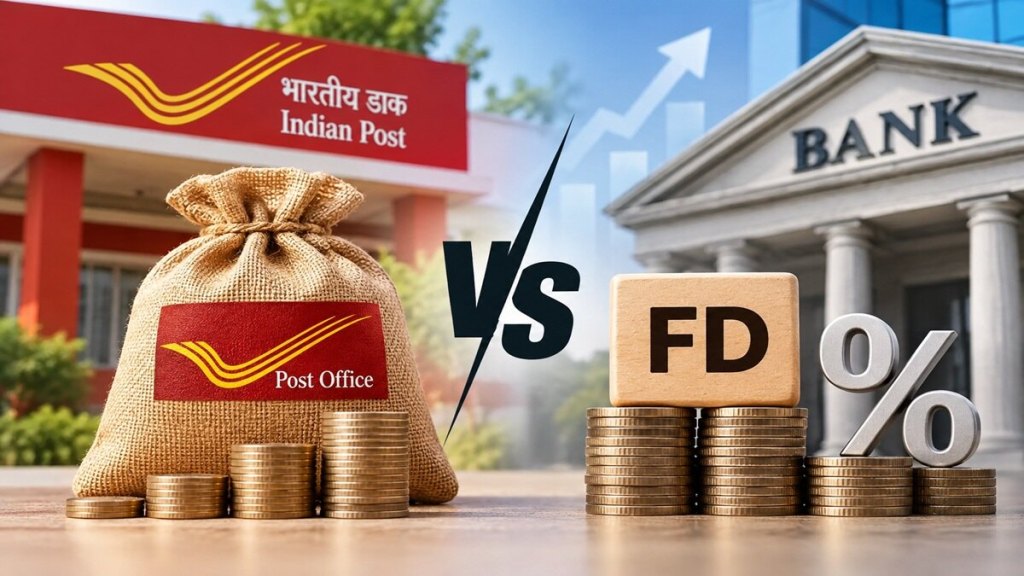

Post Office small-savings rates have stayed unchanged for 11 quarters, even as bank deposit rates have come down. The RBI says the relatively high small-savings rates could affect how quickly interest-rate cuts are transmitted to bank deposits. Before today’s 25 bps rate hike, the RBI had cut the repo rate by 125 bps between February 2025 and September 2026. Here is how the latest Post Office rates compare with FDs of major banks.
If you are looking for a safe place to park your money, the choice is no longer just between one bank FD and another. Post Office small-savings schemes are offering competitive rates, with some schemes offering more than the FD rates of large banks.
The government last reviewed small-savings rates on September 30, 2026, and kept them unchanged for the October-December quarter. This was the 11th consecutive quarter without a change in these rates. The RBI has now highlighted why this matters for bank depositors.
Small-savings rates stay unchanged for 11 quarters
The RBI’s October 2026 Monetary Policy Report says the government reviewed the rates on small-savings schemes and kept them unchanged for Q3 2026-27.
The report says this marked “11 consecutive quarters with no change in rates.” The rates are linked to yields on government securities of similar maturities. But the rates currently offered on several small-savings schemes are higher than the rates arrived at under the formula.
The RBI says this has created a “substantial positive spread” between the actual small-savings rates and their formula-based rates, except for PPF. This is important for bank FD investors because the RBI says the gap could affect how quickly banks reduce their deposit rates.
What are the current Post Office rates?
Here are the rates for the October-December 2026 quarter:
| Post Office scheme | Current interest rate |
| Savings Account | 4.00% |
| 1-year Time Deposit | 6.90% |
| 2-year Time Deposit | 7.00% |
| 3-year Time Deposit | 7.10% |
| 5-year Time Deposit | 7.50% |
| Recurring Deposit | 6.70% |
| Monthly Income Scheme | 7.40% |
| Kisan Vikas Patra | 7.50% |
| National Savings Certificate | 7.70% |
| Senior Citizens Savings Scheme | 8.20% |
| Sukanya Samriddhi Account | 8.20% |
| PPF | 7.10% |
These rates are listed in the RBI’s Table II. (Q3 2026-27).
The highest rate among these schemes is 8.2%, available on SCSS and Sukanya Samriddhi. NSC offers 7.7%, while the 5-year Post Office Time Deposit and Kisan Vikas Patra offer 7.5%.
How do Post Office rates compare with bank FDs?
The latest BankBazaar data you shared gives the rates advertised by banks on October 2, 2026 for deposits below Rs 1 crore with a 1-2 year tenure.
Among large public-sector banks, the rates are mostly between 6.45% and 6.60%.
| Bank | FD rate |
| Bank of Baroda | 6.60% |
| Bank of India | 6.60% |
| Canara Bank | 6.60% |
| Punjab National Bank | 6.60% |
| State Bank of India | 6.45% |
| Yes Bank | 7.00% |
| Kotak Bank | 6.65% |
| Axis Bank | 6.50% |
| HDFC Bank | 6.45% |
| ICICI Bank | 6.30% |
Source: BankBazaar
So, a 1-year Post Office Time Deposit at 6.9% is currently higher than the rates listed for these large public-sector banks. It is also higher than the FD rates of Kotak Bank, Axis Bank, HDFC Bank and ICICI Bank in the data provided. Yes Bank’s 7% rate is higher than the 1-year Post Office rate.
Some small finance banks are offering even higher rates
There is another side to the comparison.
Some small finance banks are offering rates higher than both large banks and several Post Office schemes.
According to the BankBazaar data you shared:
| Small finance bank | FD rate |
| Utkarsh Small Finance Bank | 8.10% |
| Suryoday Small Finance Bank | 7.80% |
| ESAF Small Finance Bank | 7.75% |
| Jana Small Finance Bank | 7.30% |
| AU Small Finance Bank | 7.10% |
Source: BankBazaar
So it would not be correct to say that Post Office schemes are offering the highest rates across the board. For a 1-2 year deposit, some small finance banks are offering more. But for savers who prefer government-backed small-savings products, the current rates remain attractive compared with many large-bank FDs.
Why is RBI worried about the gap?
This is where the RBI report becomes important. The central bank says the widening gap between small-savings rates and their formula-based rates “may be limiting the transmission” of policy rates to banks’ deposit rates.
In simple terms, when RBI cuts interest rates, banks normally reduce their lending and deposit rates over time. But if Post Office schemes continue to offer relatively attractive returns, banks may find it difficult to reduce their FD rates quickly.
A depositor may simply move money to a small-savings scheme if the difference becomes meaningful. The RBI says a large difference in favour of small savings could lead to “migration of deposits away from banks.” That could make it harder for banks to attract deposits while their loan books continue to grow.
RBI’s rate-cut data also shows why this matters
The RBI has cut the repo rate by 125 basis points between February 2025 and September 2026. But deposit rates have not fallen by the same amount. The RBI’s data shows that the weighted average rate on fresh domestic term deposits declined by 66 basis points during this easing cycle.
The rate on outstanding deposits declined by 53 basis points on the measure shown in the RBI’s transmission table. This compares with the 125-basis-point reduction in the repo rate. So, the benefit of the RBI’s rate cuts has not translated one-for-one into lower deposit rates. For savers, that is important.
It means FD rates can remain relatively attractive even after a rate-cut cycle has started, particularly when banks are competing for deposits.
The formula shows how much higher some Post Office rates are
The RBI report also gives the formula-based rates for small-savings schemes. For example, the formula-based rate for a 1-year Time Deposit works out to 5.62%, while the government-announced rate is 6.9%. That is a difference of 128 basis points.
For a 2-year Time Deposit, the formula-based rate is 5.82%, against the announced 7%. The difference is 118 basis points. For a 3-year Time Deposit, the formula-based rate is 6.03%, against the announced 7.1%. The difference is 107 basis points. The 5-year Time Deposit has a formula-based rate of 6.69%, compared with the announced 7.5%.
For NSC, the formula-based rate is 6.85%, against 7.7%. For SCSS, it is 7.44%, against the announced 8.2%. PPF is the exception. Its formula-based rate is 7.22%, while the announced rate is 7.1%.
What does this mean for an FD investor?
For savers, the message is fairly simple. Do not look at only your bank’s FD rate. Compare it with Post Office rates before locking in your money. For example, if you are considering a 1-year deposit, the Post Office Time Deposit is offering 6.9%.
That is higher than the 6.45%-6.60% rates listed for the large public-sector banks in the BankBazaar data you shared. But a saver should also compare small finance banks, where rates can be higher.
There is another important point: tenure matters. A 1-year FD should ideally be compared with a similar-tenure product. A 5-year Post Office scheme offering 7.5% should not be compared directly with a 1-year bank FD simply because the headline interest rate is higher.
Post Office schemes are not all the same
The schemes also serve different purposes. SCSS is meant for senior citizens and currently offers 8.2%. Sukanya Samriddhi is designed for eligible girl-child accounts and also offers 8.2%. PPF has a long maturity period and currently offers 7.1%. NSC offers 7.7% with a five-year maturity. The Post Office Monthly Income Scheme offers 7.4%.
So, the right choice depends not just on the interest rate but also on who can invest, how long the money can remain invested and when the investor needs the money.
What should savers watch now?
For the moment, small-savings investors have something that bank FD investors may value: rate stability. The government has kept these rates unchanged for 11 consecutive quarters. The RBI, meanwhile, is pointing out that these relatively high rates can influence how banks price their deposits.
For bank FD investors, this means the competition for savings is worth watching. For Post Office investors, it means the current rates remain attractive compared with many large-bank FDs. But there is no guarantee that these rates will remain unchanged forever.
The government reviews small-savings rates every quarter. The next review will therefore be important for savers, particularly if market yields and the broader interest-rate environment change.
For now, the key takeaway is simple: if you are about to renew an FD, compare the rate with the Post Office schemes as well. A difference of even 30-50 basis points can matter when the deposit amount is large or the money is invested for several years.
Source: RBI Monetary Policy Report, October 2026; BankBazaar data shared for this story. The bank FD rates are advertised rates as of October 2, 2026 for deposits below Rs 1 crore with a 1-2 year tenure.
Disclaimer: Interest rates mentioned in this story are subject to change and may vary depending on the scheme, tenure, deposit amount and investor eligibility. Bank FD rates are based on rates advertised on the respective banks’ websites and compiled by BankBazaar as of October 2, 2026. Post Office small-savings rates are based on the rates applicable for the October-December 2026 quarter. Readers should check the latest rates and scheme terms with the respective bank or Post Office before investing. This article is for informational purposes only and should not be considered investment advice.
Every financial journey has a turning point. What’s yours?
Financial Express is launching a new series highlighting real experiences with money, investments, and the taxman. Did a sudden tax rule catch you off guard? Did a piece of financial advice change your life? Your story could provide invaluable, practical lessons for thousands of fellow taxpayers. Share your experience with us. We respect your privacy: no stories will be featured without a direct conversation and your full consent. Thank you.