


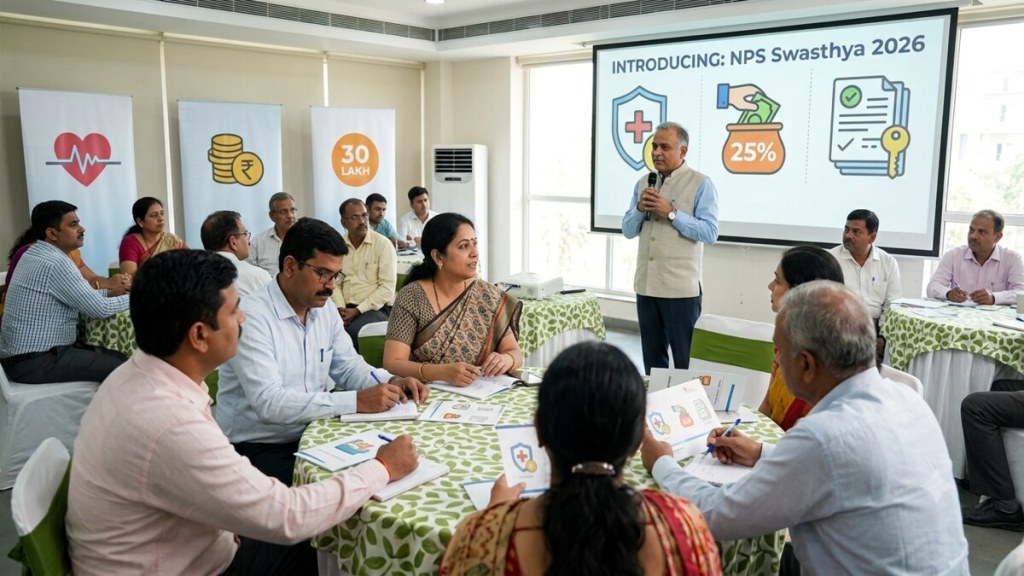

The Pension Fund Regulatory and Development Authority (PFRDA) has released operational guidelines for NPS Swasthya under the National Pension System (NPS), 2026.
These guidelines shall apply to all registered intermediaries of PFRDA, Health Benefit Administrators (HBA), and the Association of NPS Intermediaries (ANPI) registered intermediaries.
Every pension fund (PF) is responsible for ensuring that the HBA and insurer it appoints to administer NPS Swasthya comply with the applicable rules.
“All concerned intermediaries shall take necessary steps to ensure compliance with the provisions of the Guidelines attached to this Circular and shall establish appropriate systems, processes and controls for effective implementation of NPS Swasthya,” PFRDA has said in a circular dated September 18, 2026.
“NPS Swasthya seeks to enable subscribers to build a dedicated corpus for meeting retirement expenses while facilitating access to health insurance and healthcare-related services through the ecosystem established under NPS architecture. The Scheme provides greater flexibility for healthcare-related withdrawals and specified exit options to enable subscribers to meet eligible healthcare expenses in an efficient and timely manner,” according to PFRDA.
Eligibility rules and NPS Swasthya account structure
Any eligible NPS subscriber may sign up for NPS Swasthya, provided they have a separate super top-up health insurance policy and an account with an NPS Swasthya investment scheme.
According to PFRDA, the Insurance Policy shall be mandatory for enrolment under NPS Swasthya and the NPS Swasthya account and the insurance policy shall remain legally and operationally distinct.
Applicable insurance rules will apply to the standard super top-up health insurance under NPS Swasthya, which will be provided by an insurer hired by the PF under a master policy arrangement.
The nomination provisions applicable to non-Government subscribers under the PFRDA regulations, 2015, shall apply to NPS Swasthya.
NPS Swasthya contribution guidelines
As per PFRDA, the minimum initial contribution towards NPS Swasthya shall be at least:
- the applicable first-year Insurance Policy premium, inclusive of applicable taxes;
- annual maintenance charges of Rs 200, plus applicable taxes, payable to HBA through PFs
- for undertaking servicing of NPS Swasthya scheme; and
- Rs 1,000 towards investment in the NPS Swasthya account.
- The minimum subsequent contribution to NPS Swasthya shall be Rs 10.
- The premium shall be remitted to the insurer in accordance with the prescribed fund-flow
- process given in the Standard Operating Procedure (SoP).
Investment guidelines and applicable charges
The investment pattern specified for the Central Government Scheme under the applicable PFRDA investment rules would be used for investment contributions received under NPS Swasthya. For NPS Swasthya, each pension fund must keep a distinct scheme account.
However, the authority may modify the applicable investment pattern from time to time.
The fees and charges applicable to NPS under the all-citizen model, as specified by PFRDA, shall apply to NPS Swasthya. In addition, as per the authority, the pension fund may impose:
a charge up to 0.08% per annum of the AUM of the NPS Swasthya corpus, plus applicable taxes for managing the NPS Swasthya; and
annual maintenance charges of Rs 200, plus applicable taxes, payable to HBA through PFs for undertaking servicing of the NPS Swasthya scheme.
All charges must be disclosed to the subscriber before enrolment and whenever there is any change in the applicable charges. No charge may be recovered from the subscriber unless it is permitted or approved by the PFRDA.
NPS Swasthya partial withdrawal rules
In compliance with the guidelines, a subscriber may make a partial withdrawal toward eligible healthcare expenses, including appropriate out-patient and in-patient costs.
Partial withdrawals are limited to 25% of the subscriber’s contributions to the NPS Swasthya account. The total number of partial withdrawals will not be limited.
The first or any subsequent partial withdrawal will not be subject to a minimum waiting period.
As per PFRDA, the partial withdrawal amount shall not be paid to the subscriber, and the amount shall be settled with the concerned hospital, healthcare provider, or other eligible entity towards the eligible healthcare expenses, in accordance with the prescribed fund-flow process given in the SoP.
NPS Swasthya transfer rules from an existing NPS Scheme and change of NPS Swasthya scheme
Funds from an existing NPS plan under the All Citizen Model may be transferred by a subscriber to the NPS Swasthya account; however, the amount may not exceed the relevant deductible under the insurance policy.
Once the insurance policy is renewed, a subscriber may switch from one NPS Swasthya scheme to another in the way that the PFRDA specifies. A change in the pension fund and the associated insurance policy might be one such change.
In compliance with applicable insurance regulations and guidelines published by IRDAI, the pension fund will make sure that both incoming and departing insurers adhere to the relevant rules for migration, portability, waiting periods, moratoriums, and continuity credits.
The pension fund shall ensure that the outgoing insurer remains responsible for all claims arising during its policy period, in accordance with the terms of the insurance policy and applicable law. A switch shall not affect any admitted, pending or reopened insurance claim or grievance.
NPS Swasthya account closure rules
An NPS Swasthya account shall be closed upon normal exit, premature exit, non-availability of funds to renew insurance, or death of the subscriber. However, closure of the NPS Swasthya account shall not affect any other NPS account already maintained by the subscriber under the authority of PFRDA.
NPS Swasthya premature exit rules
When eligible inpatient medical expenses in a single instance surpass the amount allowed through partial withdrawal, a subscriber can opt to close the NPS Swasthya account prematurely.
The accumulated NPS Swasthya corpus will be used for eligible in-patient medical expenses in the event of a premature exit.
The NPS Swasthya scheme will be discontinued and merged into an NPS scheme under the All Citizen Model if there is any remaining balance. The NPS Swasthya scheme will be converted into an NPS scheme under the All Citizen Model if the subscriber does not already have one.
As per PFRDA, upon such change, the NPS Swasthya account shall stand closed.
NPS Swasthya normal exit and exit due to death
The exit provisions applicable to non-Government subscribers under the Pension Fund Regulatory and Development Authority (Exits and Withdrawals under the National Pension System) Regulations, 2015, shall also apply to NPS Swasthya.
NPS Swasthya rules on non-availability of funds to renew insurance
The pension fund must notify the subscriber at least 90, 60, and 30 days before renewal if the available balance may not be adequate for the renewal payment.
Clear disclosure of the appropriate grace period and the consequences of nonpayment must be provided.
The NPS Swasthya will be deemed closed if the premium is not paid after the relevant grace period and the insurance expires.
As per PFRDA, in such cases, the NPS Swasthya scheme shall be closed and merged into an NPS scheme under the All Citizen Model. Where the subscriber does not have an existing NPS scheme under the All Citizen Model, the NPS Swasthya scheme shall be changed into an NPS scheme under the All Citizen Model.
NPS Swasthya insurance policy guidelines
A basic super top-up health insurance policy shall be arranged by an IRDAI-registered insurer for each pension fund that offers NPS Swasthya.
The insurance policy will be issued under a master policy or any other group arrangement that is allowed by the appropriate insurance legislation. The insurance policy, certificate of insurance, customer information sheet, and other insurance-related documents must be given to every subscriber or covered member, according to the pension fund.
The extent of a super top-up health insurance policy, servicing standards, claims administration, premium remittance, data sharing, grievance handling, reporting requirements, and other operational issues are just a few of the factors that the pension fund will consider before using an insurer’s services.
In order to oversee the execution and maintenance of the insurance policy, the pension fund must also make a suitable agreement with the insurer, as per PFRDA.
NPS insurance policy Swasthya must start within T+1 working days of the subscriber’s successful NPS enrollment date. Swasthya and the payment of the relevant minimum first contribution, where T is the successful enrollment date.
As long as insurance benefits are provided under NPS Swasthya, the pension fund will ensure the insurance policy’s validity and facilitate a smooth transition in the event of an insurer change.
IRDAI guidelines and applicable insurance law will govern renewal and continuity, including waiting periods, migration, portability, and moratorium credits. To prevent a lapse in coverage, a pension fund-initiated insurer change shall be carried out.
The subscriber shall be informed of the material elements of the insurance policy prior to enrollment, including the sum insured, annual aggregate deductible, exclusions, waiting periods, premium, renewal conditions, underwriting standards, claim procedure, and grievance redressal method. An insurer-specific version of the insurance policy that deviates from the standard insurance policy cannot be onboarded by a pension fund.
NPS Swasthya standard insurance policy rules
Eligibility and cover
Subscribers, spouses, and up to two dependent children are covered as a single family floater; parents are not. Age range for subscriber entry: 18 to 70. Premium entry-age cohorts include those between the ages of 18 and 40, 40 and 60, and 60 and 70. Subject to the premium, the conditions of the policy, and any applicable laws, renewal may continue until the age of 85. Cumulative insurance is admissible under the annual aggregate deductible. Costs incurred by every member of the insured family during the policy year and won’t be used for individual claims.
| Annual Aggregate Deductible | Rs 10,000 | Rs 50,000 | Rs 1 lakh | Rs 3 lakh |
| Family Floater Sum Insured | Rs 1 lakh | Rs 5 lakh | Rs 10 lakh | Rs 30 lakh |
Source: PFRDA
Coverage includes a single private room for regular hospitalisation, while ICU charges will be covered at actuals, subject to the applicable sum insured and the final policy wording. Pre-hospitalisation expenses will be covered for up to 30 days, and post-hospitalisation expenses for up to 60 days. Road ambulance expenses will be covered up to Rs 2,500 per emergency hospitalisation, unless a higher uniform limit is specified in the final policy.
Subject to the final policy agreement, the coverage will cover medically necessary daycare procedures, inpatient hospitalization, domiciliary hospitalization, AYUSH treatment, prescription modern treatments, and medical expenses for organ donors. There won’t be any co-payments or disease-specific sub-limits. The normal top-up insurance policy will govern consumables and non-payables, and the NPS Swasthya corpus may be used to cover eligible medical costs that are not covered by insurance.
Waiting periods, underwriting and continuity
With the exception of accidents as specified in the final policy agreement, the initial waiting time will be thirty days. There will be a 12-month waiting period for pre-existing conditions. Subject to the final insurance policy and any applicable insurance laws, the specified disease or operation waiting time will be 12 months.
After the initial 12-month waiting period, controlled Type 2 diabetes, hypertension, hyperlipidemia, and asthma that do not result in enhanced underwriting under the recommended Good Health Declaration will be covered.
Except in cases where the sum insured is increased, new underwriting will not be required upon renewal. In compliance with insurance law and IRDAI guidelines, waiting-period, migration, portability, moratorium, and other continuity credits will be carried over upon switching insurers and/or pension funds.
Payment of a legitimate eligible healthcare expense from the NPS Swasthya corpus cannot be prevented by an insurance assessment based only on material non-disclosure. A falsified or false healthcare request shall not be paid from the corpus, as per PFRDA.
Good Health Declaration
The required Good Health Declaration will typically serve as the basis for insurance enrollment. Subject to the final query allowed under the IRDAI-approved or filed policy, the subscriber shall respond on behalf of themselves, their spouse, and their dependent children, regardless of whether they or any family members suffer from, have been diagnosed with, have been advised to take treatment for, or have undergone or been advised to have surgery for any of the following conditions:
| Heart attack. |
| Stroke, paralysis in any form, or any other cerebrovascular disease. |
| Thyroid or parathyroid disease; chronic or acute kidney disease. |
| Acute or chronic liver failure or disease, cirrhosis of liver, alcoholic liver disease, or pancreatic disease. |
| Lung disease. |
| Blood disorders or gastrointestinal disease such as peptic ulcer. |
| Disorder of the bones, spine or muscle. |
| Cancer or cancerous growth, benign or malignant tumour. |
| Autoimmune disease or disease related to the central nervous system or brain. |
| HIV/AIDS or AIDS-related complications. |
| History of sudden loss of weight in the last one year. |
| Head injury. |
| Major burns. |
| Type 1 diabetes and/or treatment with insulin. |
| Asthma with more than two hospitalisations in the last one year, acute severe bronchial asthma or status asthmaticus. |
Source: PFRDA
The insurer will apply the appropriate premium loading based on the declaration in cases when enhanced underwriting is triggered; formal medical reports are not necessary.
If the proposal is rejected, the subscriber must be informed of the precise reason for the rejection in compliance with the relevant legislation. Subject to the conditions of the insurance policy, the rejection of coverage for one family member does not automatically disqualify other eligible family members.
Minimum claims and service controls
| Service | Minimum requirement |
| Cashless pre authorisation | Within one hour of a complete request, or any stricter applicable IRDAI timeline |
| Final discharge authorisation | Within three hours of a complete hospital request, or any stricter applicable IRDAI timeline. |
| HBA referral/status synchronisation | Referral within 5 minutes and status update within 5 minutes of receipt. |
| Reimbursement target | Within 15 calendar days of the last necessary document, subject to the applicable IRDAI timeline. |
| Documents | Required hospital or insurance documents to be collected through the insurer/TPA process; subscriber document-once principle to apply |
| Adverse decision | Specific policy clause, standard reason code, amount calculation and appropriate grievance route. |
Source: PFRDA
NPS Swasthya insurance premium guidelines
The insurer will use the IRDAI framework to establish the premium. Based on completed age at initial entry, premiums for the entering age cohorts of 18 to 40, 40 to 60, and 60 to 70 years will be quoted for scheme comparability.
The insurer and TPA expenses will be included in the premium quote; any applicable taxes will appear separately. An issued policy will not be subject to a mid-term premium revision unless specifically allowed by the relevant insurance law.
The applicable insurance law shall govern any modifications to renewal premiums, and they won’t be imposed only because a single subscriber filed a claim.
As part of the minimum initial funding requirement, the first-year premium must be paid up front and sent to the insurer via the specified fund-flow procedure outlined in the SoP. The renewal premium may be funded from the NPS Swasthya corpus and in compliance with the subscriber mandate.
The specified fund-flow procedure outlined in the SoP will be used to transfer the money to the insurer. In order to prevent unjustified operational delays in premium remittance from disrupting coverage, the pension fund must maintain controls as well as timely alerts, as per PFRDA.
How will NPS Swasthya work in practice, and what healthcare expenses or treatments are expected to be covered?
NPS Swasthya is designed to bring healthcare planning into the retirement-planning framework. Subscribers will have a dedicated NPS Swasthya account along with a mandatory super top-up health insurance policy, creating two layers of healthcare protection.
The NPS Swasthya corpus can be accessed for eligible healthcare expenses through the prescribed withdrawal mechanism. Subscribers can withdraw up to 25% of their own contributions to the Swasthya account for eligible healthcare needs, without a waiting period for the first or subsequent withdrawal.
“The healthcare basket covers a broad range of expenses, including inpatient and outpatient treatment, while the insurance component provides additional protection once the applicable deductible is crossed. The broader objective is to ensure that a major medical expense does not necessarily have to come at the cost of an individual’s retirement security,” said Vishwajeet Goel, Head of Pensionbazaar.
How will NPS Swasthya integrate with NPS accounts, Pension Funds, CRAs and healthcare providers, and what role will TPAs play?
NPS Swasthya is being built into the existing NPS architecture rather than operating as a standalone healthcare product. The CRA will maintain the Swasthya account under the subscriber’s PRAN, while Pension Funds will manage the investment component.
On the healthcare side, the Health Benefit Administrator (HBA) will act as the key coordination layer between the subscriber, healthcare providers and the NPS ecosystem. It will verify eligibility, facilitate healthcare withdrawals and coordinate the settlement process.
The insurance component will continue to operate through the insurer and its TPA, with the TPA handling insurance-related claims in line with applicable insurance regulations. The HBA and TPA will need to be digitally integrated so that information can move seamlessly between the NPS and insurance components.
For subscribers, the key benefit is that the different pieces are designed to work together rather than requiring them to navigate an entirely separate healthcare-financing system.
Who is likely to benefit most from NPS Swasthya?
NPS Swasthya could be particularly relevant for individuals who want to plan for healthcare costs alongside retirement, rather than treating medical expenses as an unforeseen drain on their retirement corpus.
The framework is open to individuals eligible to join NPS, subject to the prescribed conditions. The initial contribution needs to cover the first-year insurance premium and applicable taxes, the HBA maintenance charge and a minimum investment of Rs 1,000 in the Swasthya account. Subsequent contributions can be as low as Rs 10.
The standard insurance component is structured as a family floater covering the subscriber, spouse and up to two dependent children. There are also defined options for deductibles and sum insured.
“An important point for subscribers is that the Swasthya corpus is still part of their broader retirement planning. Using it for healthcare can provide valuable financial support when needed, but it can also reduce the amount ultimately available for retirement. So the decision to withdraw should be viewed in the context of one’s overall retirement plan,” commented Goel.
What are the key risks or implementation challenges subscribers should understand?
The success of NPS Swasthya will ultimately depend on how seamlessly the NPS, insurance and healthcare ecosystems work together.
“One key factor will be the quality and depth of the hospital network and the ability of hospitals, HBAs, insurers and TPAs to exchange information digitally and process requests efficiently. Claim settlement will also need to remain transparent and predictable, particularly during large medical events when the subscriber is most vulnerable,” stated Goel.
“Data protection will be equally important because the framework involves both financial and health information. Strong consent mechanisms, purpose-specific data sharing and robust cybersecurity will be critical to maintaining subscriber trust,” Goel further added.
Portability and continuity of benefits will also matter as subscribers may change Pension Funds or insurers over time. The framework provides for portability of applicable insurance continuity benefits in line with IRDAI regulations.
Subscribers should see NPS Swasthya as an additional layer of healthcare and retirement planning, not a replacement for evaluating their health insurance coverage independently. Understanding the deductible, sum insured, exclusions, waiting periods and the impact of healthcare withdrawals on the eventual retirement corpus will remain important before opting in.
Disclaimer: This article is for informational purposes only and should not be construed as investment, financial, tax, or legal advice. Any illustrations, examples, or return projections used in this article are for explanatory purposes only and do not guarantee actual investment outcomes. The views and opinions expressed by experts quoted in this article are their own and should not be considered investment recommendations. Readers should consult a qualified professional before making any financial decisions.
Every financial journey has a turning point. What’s yours?
Financial Express is launching a new series highlighting real experiences with money, investments, and the taxman. Did a sudden tax rule catch you off guard? Did a piece of financial advice change your life? Your story could provide invaluable, practical lessons for thousands of fellow taxpayers. Share your experience with us. We respect your privacy: no stories will be featured without a direct conversation and your full consent. Thank you.