




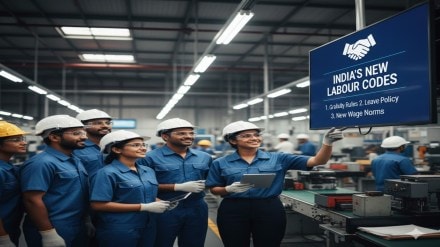
India’s new Labour Codes are set to transform the lives of more than 50 crore workers by rewriting rules around wages, working hours, social security and workplace conditions.
But three reforms stand out sharply for workers: the gratuity ceiling retained at Rs 20 lakh, double overtime wages maintained, and a much easier leave eligibility rule that grants 1 day of leave for every 20 days of work after just 180 working days. Together, these changes mark one of the biggest upgrades to workers’ rights in decades.
New Labour Codes have consolidated 29 labour laws into them. The four Labour Codes include the Code on Wages, 2019, the Industrial Relations Code, 2020, the Code on Social Security, 2020 and the Occupational Safety, Health and Working Conditions Code, 2020.
“The historic reform streamlines compliance, modernizes outdated provisions, and creates a simplified, efficient framework that promotes ease of doing business while safeguarding workers’ rights and welfare,” the labour ministry said.
While the four Labour Codes cover a wide range of reforms, these three directly impact the day-to-day life, financial security and well-being of employees across organised and unorganised sectors.
Rs 20 lakh tax-free gratuity limit retained
The ceiling for tax-free gratuity has been retained at Rs 20 lakh. This reform applies to all establishments covered under gratuity laws and is especially meaningful for long-serving employees nearing the end of their career.
The Rs 20 lakh gratuity limit is a tax exemption limit for gratuity payments received by an employee, which was increased from Rs 10 lakh in 2018. It means any gratuity amount exceeding this Rs 20 lakh limit is added to your taxable income and taxed according to your income tax slab.
Gratuity eligibility period is cut to 1 year from 5 years
Employees in organised and unorganised sectors will now be eligible for gratuity pay-outs if they complete 1 year of service in their organisation. Earlier, a 5-year service was mandatory to become eligible for gratuity.
Fixed-term employees are also eligible for gratuity without the earlier five-year service condition, making the benefit far more inclusive.
This is one of the most widely welcomed reforms because gratuity often forms a major chunk of an employee’s post-retirement corpus.
1 day of leave for every 20 days worked — and eligibility after 180 days (not 240)
Under the Occupational Safety, Health and Working Conditions (OSH) Code, the government has made it easier for workers to earn paid leave.
Two big changes stand out:
- Eligibility for leave after 180 days instead of 240 days
Earlier, a worker needed to complete 240 working days to qualify for annual leave.
Now, the eligibility kicks in at 180 days, helping newer workers access leave benefits sooner.
- One day of earned leave for every 20 days of work
Workers will now earn leave at a rate of 1 day for every 20 days worked, making leave accumulation faster and fairer.
This reform will especially help contract workers, seasonal workers, migrant labourers and workers in industries with high attrition — groups that earlier struggled to meet the 240-day requirement.
Double overtime wages beyond scheduled working hours
Perhaps one of the most impactful reforms for daily wage earners and industrial workers is the strengthening of the overtime law.
Under the new Labour Codes:
-Any work done beyond prescribed working hours must be paid at twice the normal wage rate
-Employers must maintain transparent records of overtime
-Workers cannot be made to work overtime without their consent
Double-rate overtime has long existed in theory, but enforcement was weak and inconsistent. With clear provisions, stricter compliance systems, and web-based inspection mechanisms, workers now have a stronger legal claim to fair overtime compensation.
For industries that regularly depend on extended shifts — manufacturing, textiles, logistics, security services, hospitality — this reform will significantly influence wage payouts.
Minimum wage protections for all — including unorganised workers
For the first time in India’s history, all workers, regardless of sector or job type, are guaranteed minimum wages. The Wage Code introduces:
-A national floor wage to avoid regional disparities
-Minimum wage revisions every five years
-Equal pay for men and women
-Mandatory timely payment of wages
This ensures that even gig workers, platform workers, daily wagers, and workers in small shops or establishments are not left out of wage protection.
Stronger social security coverage
The Social Security Code expands benefits like EPF, ESIC, pension schemes, insurance and maternity benefits to a much wider category of workers. Notable improvements include:
- ESIC coverage from 566 districts extended to all districts
- EPF benefits for organised, unorganised, and self-employed workers
- A national database of unorganised workers for easy benefit delivery
- A new social security fund for gig and platform workers
These changes aim to ensure that even informal workers have access to structured financial protection.
Better working conditions, appointment letters, and night-shift rights
The new Labour Codes also make workplaces more accountable:
- Mandatory appointment letters for all workers
- Annual free health check-ups
- Women can work in all establishments and night shifts, with consent and safety arrangements
- Improved rights and portability for interstate migrant workers
These reforms attempt to modernise the labour ecosystem and bring transparency that has long been missing.
A turning point for India’s workforce
India’s labour reforms have been pending for decades, but the new Labour Codes bring them into a single, simplified, modern framework. For workers, the reforms translate into:
- Higher long-term savings (Rs 20 lakh gratuity)
- Fairer compensation (double overtime wages)
- Better work-life balance (easier earned-leave rules)
- Stronger social protection
- Greater rights and dignity at the workplace
While implementation will ultimately decide their success, the intent and structure of the reforms mark an important transition toward a more worker-friendly India.


