


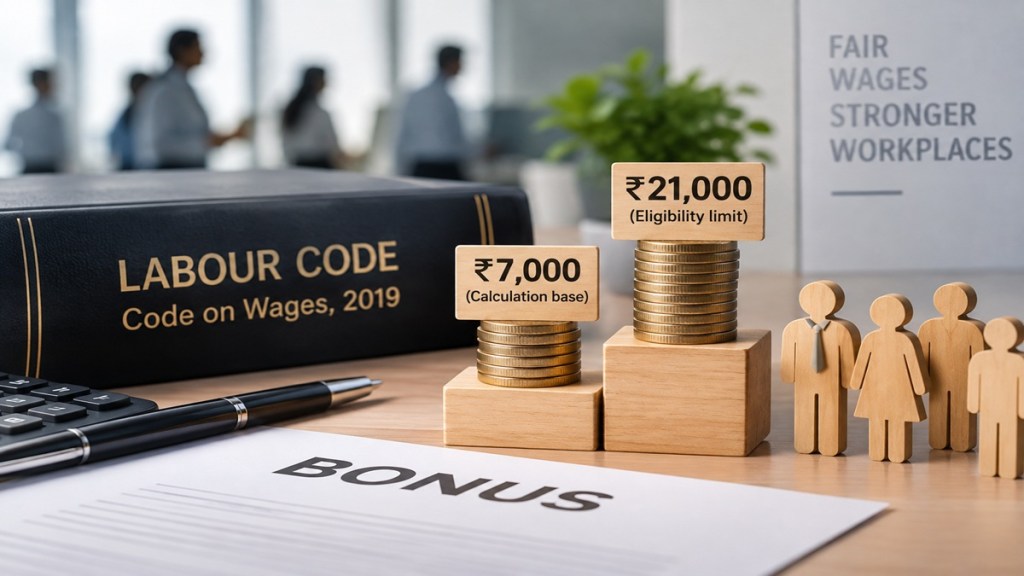

Employees covered by the bonus provisions of the Code on Wages, 2019 now have greater clarity on how their annual bonus will be calculated if their monthly wages are above Rs 7,000.
In a notification dated August 25, 2026, the Ministry of Labour and Employment said that where an employee eligible for bonus earns more than Rs 7,000 a month, the bonus will be calculated as if the employee’s wage were Rs 7,000 a month or the minimum wage fixed by the central government, whichever is higher.
Importantly, the notification is deemed to have come into force from November 21, 2025. This is the same date on which the government brought the four Labour Codes into effect across the country, replacing and consolidating 29 earlier central labour laws.
What does this mean for employees?
The Rs 7,000 figure is not a salary ceiling for receiving bonus. It is the wage amount to be used for calculating bonus for employees whose actual wages are higher than that amount, subject to the minimum-wage provision in the notification.
For example, if an eligible employee earns Rs 15,000 a month and the applicable central government minimum wage is below Rs 7,000, the bonus calculation will be based on Rs 7,000 rather than the employee’s actual Rs 15,000 wage.
If the applicable central government minimum wage is, say, Rs 8,000, the calculation would instead use Rs 8,000 because the notification says to take “7,000 per mensum or the minimum wage fixed by the central government, whichever is higher.”
This distinction is important because the new Wage Code separately provides for determining who is eligible for bonus and the wage amount to be used for calculating that bonus.
Who is eligible for bonus?
Under Section 26(1) of the Code on Wages, an employee is entitled to an annual minimum bonus if the employee has worked for at least 30 days in an accounting year and falls within the wage limit notified by the government.
The Code provides for a minimum bonus of 8.33% of the wages earned during the accounting year or Rs 100, whichever is higher, subject to the conditions in the provision.
The government has separately notified that employees drawing wages of up to Rs 21,000 per month will be covered by this bonus eligibility provision. That notification too is dated August 25, 2026 and is deemed effective from November 21, 2025.
So, in simple terms, there are two different numbers to keep in mind:
Rs 21,000: the notified monthly wage limit for eligibility for bonus.
Rs 7,000 or the applicable Central minimum wage, whichever is higher: the wage amount to be used for calculating bonus when an eligible employee’s actual wage is above Rs 7,000.
What does Section 26(3) say?
Section 26(3) deals with situations where an establishment has enough allocable surplus to pay more than the minimum bonus.
In such a case, the employer has to pay bonus in proportion to the wages earned by the employee, but the bonus cannot exceed 20% of those wages.
This is why the latest notification specifically refers to both sub-sections (1) and (3) of Section 26. The notified wage calculation is relevant not just for the minimum bonus but also when a higher bonus is payable because of the establishment’s allocable surplus.
Why has the government issued this now?
The development comes against the backdrop of the implementation of the four Labour Codes from November 21, 2025.
The four codes are the Code on Wages, 2019; Industrial Relations Code, 2020; Code on Social Security, 2020; and Occupational Safety, Health and Working Conditions Code, 2020. Together, they rationalised 29 central labour laws.
The Code on Wages itself consolidated provisions relating to wages and bonus from four earlier laws: the Payment of Wages Act, 1936, the Minimum Wages Act, 1948, the Payment of Bonus Act, 1965 and the Equal Remuneration Act, 1976.
The government’s stated objective is to create a more uniform wage framework while widening worker protections.
What else changes under the new wage code?
The Code on Wages is broader than just bonus.
One major change is that minimum wages become a statutory right for all employees, rather than being restricted to workers in scheduled employments under the earlier Minimum Wages Act. The Code also provides for a statutory floor wage to be fixed by the Central Government, below which state-fixed minimum wages cannot fall.
The Code also provides for timely payment of wages to all employees and prohibits gender-based discrimination in recruitment and wage payment for the same or similar work.
Another important change concerns the definition of “wages”. Under the Labour Codes, if certain allowances and excluded components exceed 50% of total remuneration, the excess is added back to wages for statutory calculations. This can have implications for benefits such as gratuity and provident fund-related contributions. The Labour Ministry has clarified that the revised definition of wages applies from November 21, 2025.
The broader Labour Code framework also expands social-security coverage, including provisions for unorganised, gig and platform workers, while other codes deal with areas such as industrial relations, workplace safety, health and working conditions.
What employees should take away
For employees, the latest bonus notification does not mean that everyone earning more than Rs 7,000 a month will lose eligibility for bonus.
The more important distinction is this: Rs 21,000 determines the notified eligibility threshold, while Rs 7,000 or the applicable Central minimum wage determines the wage base for calculating bonus for an eligible employee whose wages are above Rs 7,000.
Since both notifications have been given retrospective effect from November 21, 2025, employers and employees may need to look at bonus calculations from that date in light of the new framework.
Disclaimer: This article is based on the Ministry of Labour and Employment notification dated August 25, 2026. Readers should refer to the applicable law, rules and government notifications for the exact provisions governing bonus eligibility and calculation.