


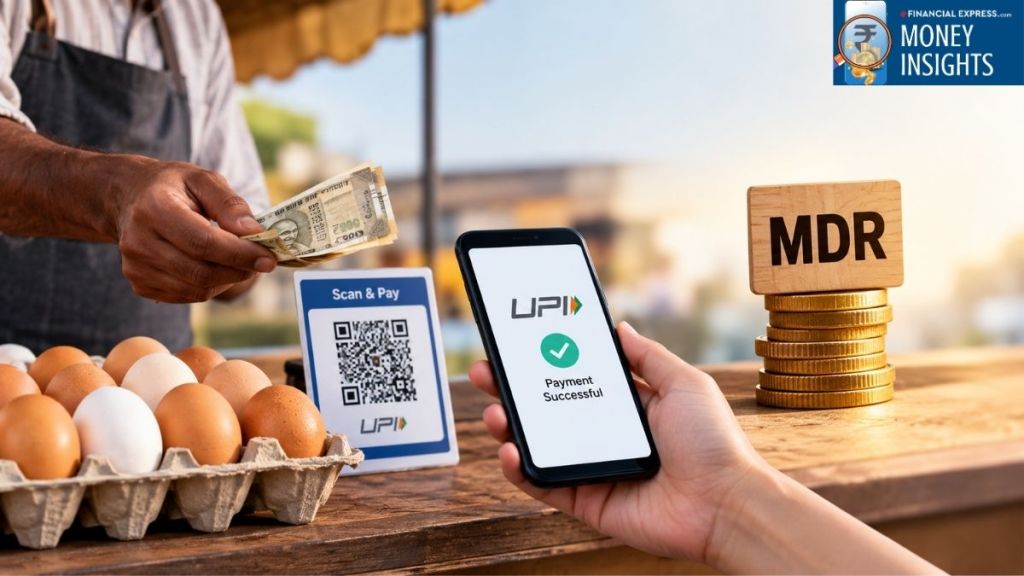

“After October 15, bring cash.” My egg vendor told me this yesterday.
I asked him why. I know my six eggs won’t incur any charge. He said that the wholesaler wants cash. That payment will definitely cross the threshold, and someone will bear the new Merchant Discount Rate (MDR).
I persisted. I suggested he could still accept payments via UPI (Unified Payments Interface) and withdraw cash from the bank. He replied nonchalantly, “I don’t want to go to the bank.” So, asking customers for cash is easier.
It is a small example, but it captures everything around the MDR debate.
The 0.4% Reversal: Why the Zero-MDR Era is Ending
For us, UPI may feel free. But the infrastructure that banks, payment companies and technology providers run is not. The government supports this to some extent, while others cross-subsidise the costs from other parts of their individual businesses.
From October 15, UPI transactions above ₹2,000 will attract an MDR of 0.4%. Essential and thin-margin sectors such as fuel and agricultural inputs get a flat ₹5 charge. While capital-market transactions attract a much lower MDR of 0.02%, the overall MDR is capped at Rs 300 per transaction.
UPI previously carried an MDR of 0.30%, capped at ₹100, until the government abolished it in January 2020. The new charge reverses that zero-MDR policy.
Beyond India: The Global Case for Payment Infrastructure Costs
India isn’t the only country to charge instant payments.
Malaysia started charging after a period of fee waivers on DuitNow QR. Indonesia’s QRIS adopted a tiered structure and special rates for some sectors.
Brazil’s Pix takes a more market-oriented route. Individual transactions are generally free, while payment institutions set merchant charges. BIS research estimates average merchant costs at around 0.22%.
The US, Singapore, and Europe also charge merchants for instant payments.
I am not against MDR. The infrastructure behind UPI needs to be paid for. MDR can help create a sustainable economic model.
Some merchants may respond by returning to cash, as my egg vendor might. But digital payments offer enough convenience that it is hard to ignore.
These charges could be a burden for businesses with small profit margins. Capital markets, fuel and insurance already get lower rates, but concerns remain. Hopefully, they will be addressed too. But I feel such a differential rate system has an inherent problem. The more exceptions and the more rates we create, the greater the scope for classification problems. India has seen enough of those in excise, VAT and GST. We don’t need one in payments.
The Free Market Solution: Should Competition Dictate MDR?
One way to tackle this is to look at debit and credit cards. They already have an MDR system, but it is different from UPI.
For debit cards, the RBI sets a maximum rate rather than a fixed rate. Small merchants also get some concessions. Credit cards are different. There is no universal MDR. Charges depend on the merchant, card type, and the terms agreed with the provider.
We could do something similar with UPI, much like Brazil. The 0.4% rate (or any agreed rate) could be a ceiling or reference rate, while allowing participants to compete below it. Companies could bundle different services or offer different rates to different types of merchants, just as they do with credit cards.
Once companies compete on price and services, merchants get more choices. That could slowly increase competition in a market where two players currently dominate.
The Cognitive Cost: Navigating the Friction of Changing Policies
Digital payments are convenient. There is little debate about that. India spent years building that habit and, more importantly, building trust around it. A sudden change like this can disrupt that habit.
But the cost goes beyond the MDR itself. Businesses also face a cognitive cost in learning rules and following them.
Over the past decade, small businesses have adjusted to new rules on payments, taxes, and paperwork. Demonetisation disrupted cash almost overnight. The GST created confusion and increased compliance costs. E-way bills and e-invoicing added more complications.
Tax laws, on the other hand, made digital payments more attractive. For example, certain businesses could pay tax of 6% of digital sales instead of 8%. Then, cash receipts above ₹2 lakh face restrictions, while large cash withdrawals can attract TDS.
A small business owner has navigated a lot in these years, including Covid. What they need now is stability and certainty. Businesses can adapt to change when they know what is coming, understand the rules and have enough time to adjust. The problem comes when rules are announced first, clarified later and then repeatedly modified. That adds friction for businesses and weakens the policy environment.
Anti-Profiteering Echoes: Will the Government Intervene on Pricing?
Speaking of friction, the government intends to add more. It has said it will monitor whether merchants pass the MDR on to consumers. Banks and payment aggregators have been asked to ensure that this does not happen.
This reminds me of the GST anti-profiteering law experience.
Businesses should decide whether to absorb the cost, pass it on, negotiate it or accept lower profits. The government has no role in it. Prices can rise for many reasons, such as higher material costs or wages, especially today. So it is hard to know exactly why a business charges customers more.
The Real Economy Impact: Why Policy Implementation Matters
This shows poor planning. Wider consultation, pilot projects and clear communication could have made these transitions easier. Even after a decade of demonetisation, these practices haven’t been part of policy design. That’s not a great sign.
If a retailer is still trying to understand the rules after the announcement, uncertainty itself becomes a cost.
My egg vendor is a good example. He does not care about the architecture of UPI or how MDR is distributed among banks, payment companies and other participants. He knows that his dealer wants cash. That is enough to change how he manages his business. This is how policy reaches the real economy.
If merchants start thinking that cash is simpler again, the payment system has acquired a problem that an MDR calculation alone cannot capture. If they don’t, it will show how deeply they have become part of everyday commerce.
Either way, the lesson for policymakers is the same. Communication and careful implementation matter. Policy should reduce friction for businesses, not create more of it. But for small businesses, uncertainty hasn’t left the room yet.
Disclaimer
The views expressed are the author’s own and do not reflect the official policy or position of Financial Express.
Swapnil Karkare likes bridging economics and storytelling. A Chartered Accountant and economist by profession — he analyses finance and policy through research, writing, and podcasts.
Every financial journey has a turning point. What’s yours?
Financial Express is launching a new series highlighting real experiences with money, investments, and the taxman. Did a sudden tax rule catch you off guard? Did a piece of financial advice change your life? Your story could provide invaluable, practical lessons for thousands of fellow taxpayers. Share your experience with us. We respect your privacy: no stories will be featured without a direct conversation and your full consent. Thank you.