


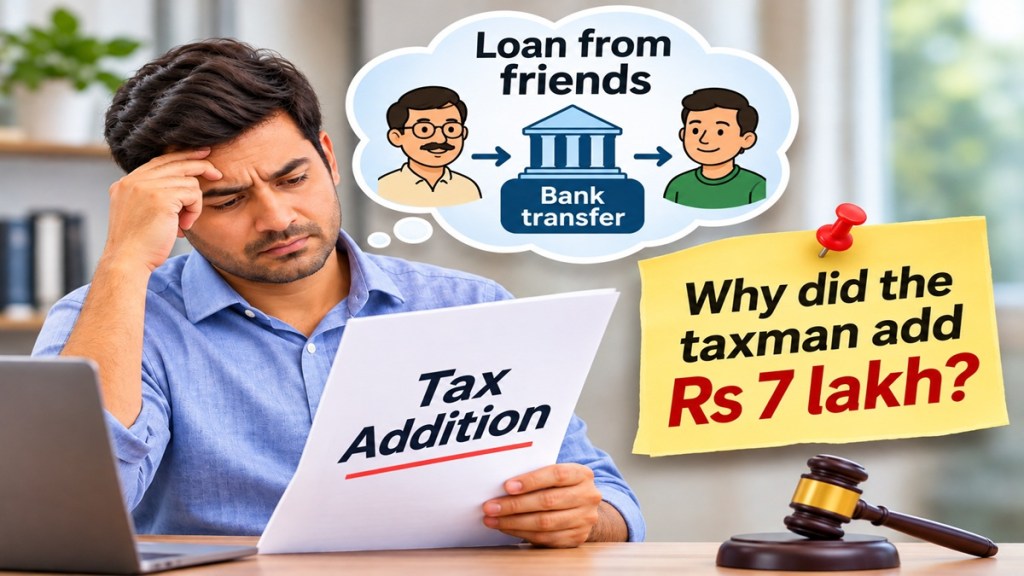

Borrowing money from friends or relatives is common, especially when someone needs funds for a business or personal expenses. But can a bank transfer or a cheque alone prove that the loan is genuine in the eyes of the Income Tax Department? A recent judgment of the Delhi High Court highlights why taxpayers may need to do more than simply show that money has moved through banking channels.
In a judgment dated October 1, 2026, the Delhi High Court upheld a Rs 7 lakh addition made by the Income Tax Department in the case of a businessman who had received unsecured loans from friends and relatives. The court held that the taxpayer had failed to establish the financial capacity of the people who had advanced the money.
The businessman had argued that the loans were genuine and that he had submitted confirmations, affidavits and other supporting documents. However, the tax authorities found that some lenders either denied giving the loans or could not explain where the money had come from.
The court ruled that merely establishing the identity of a lender or showing that the money was received through a bank account is not sufficient. A taxpayer must also establish the lender’s creditworthiness and the genuineness of the transaction.
The judgment is important for taxpayers who borrow money from friends, relatives or acquaintances, as it explains the evidence that may be required to establish the genuineness of unsecured loans.
What was the case about?
The case relates to Raj Pal Katyal, an individual who was the proprietor of Kailash Engineers, a business engaged in trading, servicing and installation of generators and generator parts.
The dispute goes back to Assessment Year 1997-98.
Katyal filed his income tax return on October 31, 1997, declaring an income of Rs 2,02,320. According to the judgment, the return was processed under Section 143(1) of the Income Tax Act on December 18, 1997.
The Assessing Officer subsequently issued a scrutiny notice under Section 143(2) on October 20, 1998.
During the assessment proceedings, the tax department examined unsecured loans of Rs 9,00,400 shown in the taxpayer’s books. The department wanted him to establish the identity and financial capacity of the lenders and prove that the transactions were genuine.
The Assessing Officer was not satisfied with the explanations and supporting evidence. In an assessment order dated March 30, 2000, the officer treated the entire Rs 9,00,400 as unexplained income under Section 68 of the Income Tax Act.
This provision deals with unexplained cash credits appearing in the books of an assessee.
Why did the Income Tax Department question the loans?
The taxpayer maintained that the loans had been received from friends and relatives. He argued that the transactions were genuine because the money had been received through account-payee cheques and supporting confirmations and affidavits had been submitted.
However, the department examined some of the people who had allegedly advanced the money. Their statements raised questions about the source of the funds.
According to the findings recorded in the judgment, five individuals were examined during the assessment proceedings. These included Surender Katyal, Pawan Kumar, Vimla Arora, S L Magoo and Santosh Rani.
The statements of some of these lenders did not support the taxpayer’s claims.
For instance, Pawan Kumar denied having advanced a loan of Rs 50,000 to the businessman. Santosh Rani admitted that she had given a loan of Rs 4.5 lakh. However, she could not explain how she had arranged the money. The department also found unexplained cash entries in her bank account before the loan was advanced.
Vimla Arora’s case was similar. She could not satisfactorily explain the source of the funds. S L Magoo also denied having advanced a loan of Rs 1 lakh.
The department was therefore not convinced that these lenders had the financial capacity to provide the money.
How did the case move through the tax authorities?
The taxpayer challenged the assessment order before the Commissioner of Income Tax Appeals. On August 17, 2000, the Commissioner of Income Tax Appeals examined the loans and the explanations provided by the taxpayer. The appellate authority deleted Rs 2,00,400 out of the total addition of Rs 9,00,400 but sustained the remaining Rs 7 lakh.
The authority accepted a loan of Rs 18,000 from Surender Katyal, who was a government employee. It observed that it was not difficult for a government employee to advance such a relatively small amount.
However, it did not accept the other disputed loans because the lenders had either denied advancing the money or failed to explain their financial capacity.
The appellate authority also deleted certain other amounts, including Rs 1,32,400, on the ground that the loans had been received in an earlier financial year and could not be added to the income of the year under consideration. It also granted relief relating to a Rs 50,000 loan from Narinder Kumar, whose statement had not been recorded by the Assessing Officer.
The businessman was not satisfied with the decision and approached the Income Tax Appellate Tribunal.
However, the ITAT, through its order dated March 2, 2005, upheld the Rs 7 lakh addition. It agreed with the lower authorities that the taxpayer had failed to establish the creditworthiness of the lenders.
The businessman then approached the Delhi High Court by filing an appeal in 2005.
On May 16, 2006, the High Court framed a substantial question of law for consideration. It wanted to examine whether the ITAT’s finding that the taxpayer had failed to prove the creditworthiness of the lenders was perverse. The matter was eventually decided on October 1, 2026, nearly 21 years after the ITAT’s order.
What did the Delhi High Court say about unsecured loans?
The Delhi High Court examined the findings of the Assessing Officer, the Commissioner of Income Tax Appeals and the ITAT. The court noted that all three authorities had examined the evidence and statements of the lenders and had reached the conclusion that the taxpayer had failed to establish their financial capacity.
The court also referred to Section 68 of the Income Tax Act, which allows an unexplained credit appearing in an assessee’s books to be treated as income if the explanation offered is not satisfactory.
Importantly, the court explained that a taxpayer has to establish three basic requirements to prove the genuineness of an unsecured loan.
These are:
- Identity of the creditor: The taxpayer must establish who has advanced the money. Documents identifying the lender and establishing their identity are important.
- Creditworthiness of the creditor: The taxpayer must show that the lender had the financial capacity to advance the money. Merely providing the lender’s identity or bank details may not be sufficient if the source of funds remains unexplained.
- Genuineness of the transaction: The taxpayer must establish that the loan transaction actually took place and was genuine.
The court relied on the Supreme Court’s judgment in CIT vs NRA Iron and Steel Pvt Ltd, delivered in 2019, while explaining these requirements.
The Supreme Court had held that the initial responsibility rests with the taxpayer to establish the identity of the creditors, their capacity to advance money and the genuineness of the transaction.
The Delhi High Court also referred to the principle that once the taxpayer provides documents establishing these requirements, the Assessing Officer must conduct further enquiries and seek additional details where necessary.
However, in Katyal’s case, the court found that the taxpayer had not discharged this initial responsibility.
Why was showing bank transfers not enough?
One of the important aspects of the case is the difference between proving that money was transferred and establishing that the lender actually had the financial capacity to advance it.
The taxpayer had argued that the loans were received through account-payee cheques. He had also relied on confirmations and affidavits submitted by the lenders.
However, the court found that these documents did not adequately establish the creditworthiness of the disputed creditors. For instance, one lender denied having advanced the money, while others could not satisfactorily explain the source of funds.
The court observed that merely identifying a lender does not discharge the taxpayer’s responsibility if the lender’s financial capacity has not been established.
It relied on the Supreme Court’s ruling in NRA Iron and Steel, which makes it clear that the taxpayer must establish all three requirements under Section 68. The Delhi High Court found no reason to interfere with the concurrent findings of the three tax authorities.
What was the final decision?
The Delhi High Court answered the question of law in favour of the Income Tax Department and against the taxpayer. It held that the findings of the Assessing Officer, the Commissioner of Income Tax Appeals and the ITAT regarding the lenders’ creditworthiness could not be considered perverse.
The court dismissed Katyal’s appeal along with the pending application. As a result, the Rs 7 lakh addition under Section 68 remained intact. The judgment was delivered by a division bench comprising Justice Subramonium Prasad and Justice Amit Sharma on October 1, 2026.
What should taxpayers keep in mind when borrowing from friends and relatives?
The judgment highlights why taxpayers should maintain proper documentation when accepting unsecured loans, particularly from friends, relatives and acquaintances.
A bank transfer or cheque can establish the movement of money, but it may not be enough to establish the genuineness of the loan. Taxpayers should maintain loan confirmations, bank statements, relevant financial records of the lender and documents that help establish the source and capacity of the person advancing the money.
The lender’s ability to explain the source of funds can become important if the transaction is questioned during scrutiny.
The case also highlights that taxpayers should not assume that a loan will automatically be accepted merely because it has been received through banking channels.
Dinkar Sharma, Partner at Jotawani Associates, said that the ruling highlights that establishing the identity of a lender and showing that the money was received through banking channels may not be sufficient under Section 68.
“Taxpayers must also establish the lender’s creditworthiness and the genuineness of the transaction. Maintaining proper documentation, including bank statements, loan confirmations and evidence of the lender’s financial capacity, is important when accepting unsecured loans.”
Disclaimer: This article is based on the Delhi High Court judgment in Raj Pal Katyal vs Commissioner of Income Tax, dated October 1, 2026. The ruling is specific to the facts of the case and does not mean that all unsecured loans from friends or relatives will be treated as unexplained income. The genuineness of each transaction depends on the evidence submitted and the taxpayer’s ability to establish the lender’s identity, creditworthiness and the genuineness of the transaction.
Every financial journey has a turning point. What’s yours?
Financial Express is launching a new series highlighting real experiences with money, investments, and the taxman. Did a sudden tax rule catch you off guard? Did a piece of financial advice change your life? Your story could provide invaluable, practical lessons for thousands of fellow taxpayers. Share your experience with us. We respect your privacy: no stories will be featured without a direct conversation and your full consent. Thank you.