


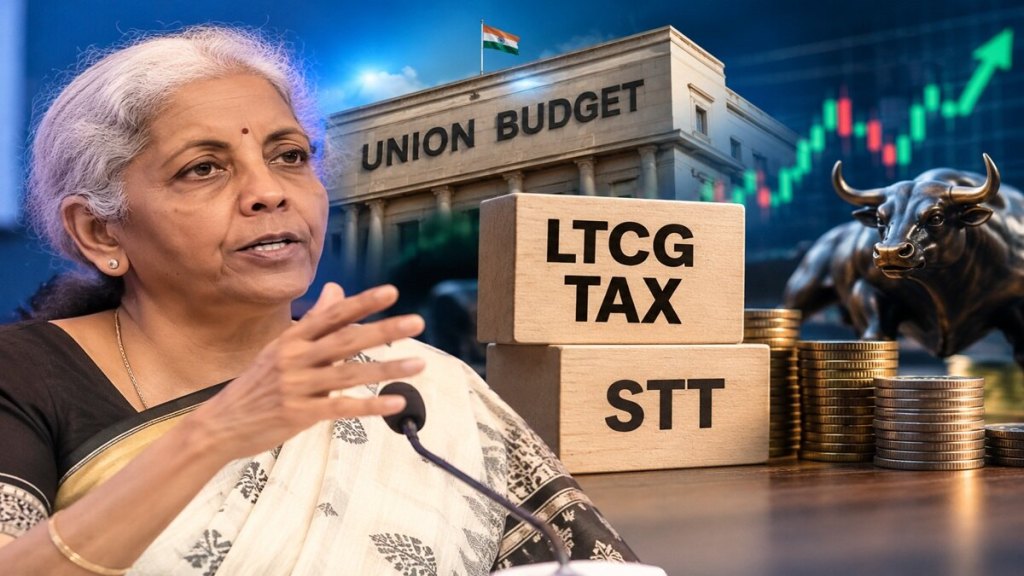

Union Finance Minister Nirmala Sitharaman has stopped short of giving any assurance on changes to long-term capital gains tax and securities transaction tax, even as investors continue to debate how different asset classes should be taxed.
Speaking at the Bloomberg New Economy Forum 2026, Sitharaman said it would be premature to comment on possible tax measures with preparations for the next Union Budget already under way. She also acknowledged that capital gains tax, STT and the taxation of different asset classes remained important subjects of discussion among investors in India and abroad.
“We are very close to the budget and the preparation for the budget has started, and it may not be the best time for me to say what I will or what I will not consider,” she said, according to ANI.
Her remarks come at a time when investors are seeking clarity on the tax treatment of equity investments, while market participants have also called for changes to the levies imposed on stock market transactions. The debate covers not just the rate of tax on investment gains but also how long investors must hold an asset to qualify for long-term treatment and whether different investments should face more consistent tax rules.
What are investors asking for on LTCG tax?
Long-term capital gains tax is the tax investors pay on profits from selling assets held for a specified period. The holding period and tax rate depend on the type of asset.
For listed equity shares and equity-oriented mutual funds, long-term capital gains above Rs 1.25 lakh in a financial year are currently taxed at 12.5%, provided the applicable conditions are met. The rate applies to transfers made on or after July 23, 2024. Short-term capital gains on specified listed equity transactions are taxed at 20% if the required securities transaction tax conditions are met.
The rules changed significantly in the July 2024 Budget. The government raised the LTCG tax rate on specified listed equity investments from 10% to 12.5% and increased the annual exemption threshold from Rs 1 lakh to Rs 1.25 lakh. The short-term capital gains tax rate on specified financial assets, including listed equity shares and equity-oriented mutual funds, was raised from 15% to 20%.
The government said the changes were aimed at simplifying and rationalising capital gains taxation. It also introduced a more uniform 12.5% LTCG rate for several other asset classes, while removing indexation for most assets transferred on or after July 23, 2024. Special transition relief was provided for certain properties acquired before that date.
The changes have made the tax treatment of investment gains a key issue for investors deciding where to put their money and how long to remain invested.
One demand is to reduce or remove LTCG tax on equity investments. Supporters argue that a lower tax burden could encourage long-term investing and make Indian equities more attractive to domestic and overseas investors. SBI Research has recently recommended abolishing LTCG tax on equity, arguing that this could help attract and retain investment in Indian markets.
However, scrapping the tax would mean a potential loss of revenue for the government. The final decision would involve balancing investor demands, revenue considerations and the need to encourage long-term capital formation. The recommendation by SBI Research is a proposal, not a government commitment.
Why is STT also under discussion?
Securities transaction tax, or STT, is a levy charged on specified transactions in the securities market. Unlike capital gains tax, which is calculated on the profit made from an investment, STT is charged on the value of a specified transaction. This means an investor or trader may pay STT even when the transaction does not result in a profit.
STT was introduced in 2004. Since then, the tax system for equity investments has changed, including the introduction of LTCG tax on specified listed equity gains in 2018. This has led to calls for the government to reconsider the need for both levies.
The Association of Mutual Funds in India, or AMFI, has asked the government to remove STT on purchase and sale transactions in financial markets, including mutual fund units. In its Budget 2026-27 recommendations, AMFI argued that investors now pay capital gains tax on eligible profits as well as STT on the transaction value. It said removing STT could provide relief, particularly after the increase in capital gains tax rates in the 2024 Budget.
This is an industry demand. It does not mean the government has agreed to withdraw STT.
There is also a separate concern among active traders about the cost of derivatives trading. In the 2026-27 Budget, the government proposed raising STT on futures from 0.02% to 0.05%. STT on options premium was raised from 0.1% to 0.15%, while the rate on the exercise of options was raised from 0.125% to 0.15%.
These changes increased transaction costs for futures and options traders. The government has defended the move as a calibrated revision in a derivatives market that has grown substantially. Traders and market participants, meanwhile, will watch whether further changes are proposed in the next Budget.
The debate over STT therefore has two distinct parts. Long-term investors and mutual fund industry representatives want the levy reconsidered because capital gains are also taxed. Derivatives traders are concerned about the impact of higher transaction costs on trading activity.
Should different asset classes have similar tax treatment?
The third issue raised by Sitharaman was the taxation of different asset classes. This matters because investors can choose among equity shares, equity mutual funds, debt mutual funds, bonds, gold, property and other assets, but the tax rules are not identical.
The holding period required to qualify for long-term capital gains treatment, the applicable tax rate and the availability of indexation or other benefits can vary by asset class. As a result, two investments with similar returns may leave investors with different post-tax gains.
The 2024 Budget attempted to simplify the system by reducing the number of holding-period rules and making LTCG rates more uniform across several asset classes. But it also removed indexation for most assets, while providing specific relief for certain land and building transactions.
Debt mutual funds have faced a separate change. For specified debt-oriented mutual funds covered by the rules introduced in 2023, gains are generally taxed at the investor’s applicable income-tax slab rate, regardless of the holding period. This removed the earlier long-term capital gains tax benefit for those funds.
The mutual fund industry has sought a differentiated tax structure for equity investments based on how long an investor holds them. AMFI’s Budget 2026-27 recommendations included a proposal to tax eligible equity investments held for more than one year and up to three years at 12.5% on gains exceeding Rs 2 lakh in a financial year. Under the existing rules for specified listed equity investments, the exemption threshold is Rs 1.25 lakh for long-term gains, with a 12.5% tax rate above that limit.
Such proposals seek to encourage investors to stay invested for longer. But any change would need to be assessed against the government’s broader tax policy and the need to avoid creating fresh differences between products that serve similar investment needs.
For retail investors, the practical question is not just whether a tax rate goes up or down. It is whether the tax system is easy to understand and allows them to compare investments on a like-for-like basis after tax.
What has changed in recent Budgets?
Capital gains taxation has seen several major changes in recent years.
In 2018, the government reintroduced LTCG tax on specified listed equity shares and equity-oriented mutual fund units under Section 112A. Gains above Rs 1 lakh in a financial year were taxed at 10%, subject to the applicable conditions.
In the July 2024 Budget, the government raised the LTCG rate on specified listed equity investments to 12.5% and increased the annual exemption threshold to Rs 1.25 lakh. The short-term capital gains rate on specified financial assets was raised to 20%. The Budget also revised the taxation of several other asset classes and removed indexation for most assets transferred on or after July 23, 2024, with specific transition relief for certain properties.
The 2025-26 Budget focused on personal income-tax relief under the new tax regime and did not announce a rollback of the 2024 changes to equity LTCG tax.
The 2026-27 Budget brought another change to the cost of trading by raising STT rates on futures and options. It also proposed changes to buyback taxation, under which share buyback proceeds would be taxed as capital gains for all types of shareholders.
These changes show that capital gains tax and market transaction levies remain separate policy questions. A change to one does not automatically mean the other will change.
What did Sitharaman say about other economic issues?
Apart from taxation, Sitharaman spoke about the rupee, infrastructure and India’s investment prospects at the Bloomberg New Economy Forum 2026.
On the rupee, she said the Reserve Bank of India was focused on managing excessive volatility rather than keeping the currency at a fixed level. She acknowledged the rupee’s depreciation over the past 18 to 24 months and attributed much of the pressure to external factors. She also pointed to India’s economic fundamentals and foreign exchange reserves, while reiterating the government’s commitment to fiscal discipline and macroeconomic stability.
Sitharaman said the government would continue to exercise fiscal prudence while keeping welfare, education and healthcare spending a priority.
She also defended India’s semiconductor strategy, saying chips used in refrigerators, automobiles, industrial machinery and Internet of Things devices would continue to see demand alongside more advanced technologies. She highlighted investment opportunities in power infrastructure, renewable energy, data centres and AI-related infrastructure.
On infrastructure, she said the National Infrastructure Pipeline had grown to more than USD 4.5 trillion. She also highlighted the roles of the National Bank for Financing Infrastructure and Development and the National Investment and Infrastructure Fund in mobilising long-term capital.
ANI reported these remarks as part of Sitharaman’s wider discussion on India’s economic outlook and investment opportunities.
Will investors get relief in the next Budget?
For now, there is no assurance that LTCG tax or STT will be reduced. Sitharaman has acknowledged that investors are debating these issues, but has not committed to any change.
Investors and the mutual fund industry are likely to continue seeking a lower tax burden, a higher exemption threshold and simpler rules across asset classes. Traders will also watch the impact of the recent increase in STT on derivatives.
The government, however, will have to weigh these demands against revenue requirements and its wider objectives for financial markets. Until the next Budget proposals are announced, any expectation of a tax cut or rollback remains speculation.
Disclaimer: This article is based on remarks made by Union Finance Minister Nirmala Sitharaman at the Bloomberg New Economy Forum 2026 and related reports by ANI. The demands for changes in LTCG tax and STT reflect proposals and recommendations from market participants and industry bodies. No changes to these taxes have been announced or assured by the government. The applicable tax rules and rates may change subject to official notifications and Budget announcements.