


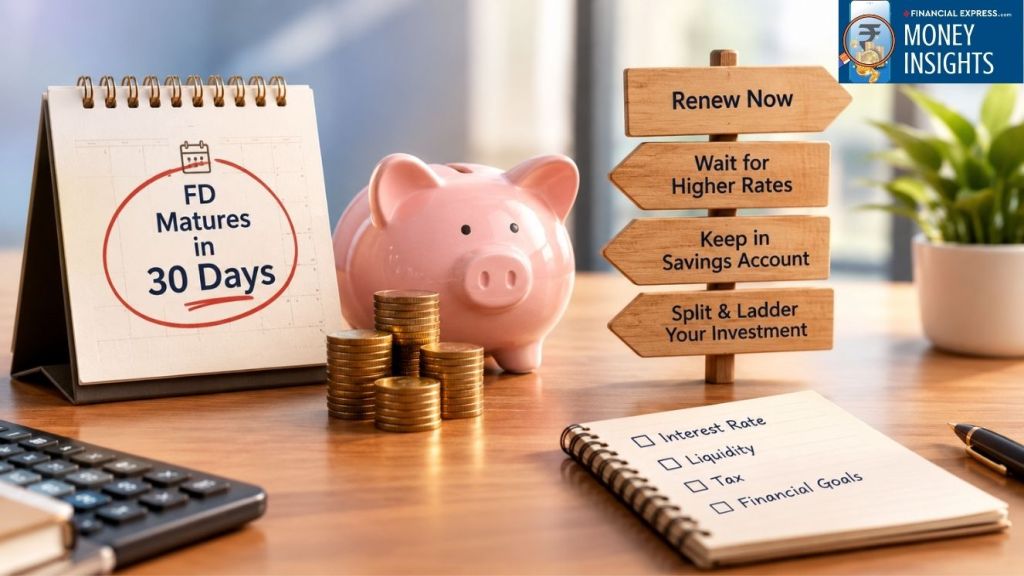

Your ₹10 lakh FD is due to mature next month. The bank has sent a reminder, and renewing it would take just a few clicks. But suppose you might need some of the money soon. Or what if the bank offers a better interest rate a month after you renew? Would you be better off waiting?
There is a cost to that decision. For instance, ₹10 lakh kept in a savings account paying an illustrative 2.5% annually would earn around ₹6,250 over three months, assuming simple interest. At an illustrative FD rate of 6.5%, the same amount would earn roughly ₹16,250 over that period. That’s a difference of ₹10,000 before tax, although actual returns depend on the bank, deposit tenure and compounding.
But locking the full amount into another FD is not necessarily the answer either. You could need the money unexpectedly, rates could change, or the return may look less attractive once taxes are taken into account.
So, with 30 days left before maturity, what should you do? Banking and wealth management experts explain how to approach the decision before renewing your deposit.
1. Do You Need The Money Soon, Or Can You Afford To Lock It Away?
Before looking at interest rates, work out how much of your maturity amount you can actually leave untouched. Suppose your ₹10 lakh FD matures next month, but you need ₹3 lakh for home renovations in four months. Renewing the entire amount for another year could mean withdrawing part of it early and potentially facing a penalty.
Alok Kashyap, ED and Head of Liabilities Product, Payments & Digital Business – Consumer Banking Group, DBS Bank India, says investors should consider their liquidity requirements, expectations around interest rates and broader financial goals before deciding. If funds are likely to be needed soon, temporarily keeping them in a savings account provides easier access while they consider their options.
You could therefore set aside ₹3 lakh for the upcoming expense and consider reinvesting the remaining ₹7 lakh. But if this FD represents most of your savings, it may be worth keeping a larger amount accessible for emergencies. The first decision isn’t whether to renew the FD, but how much of the money you can afford to invest again.
2. If You Do Not Need The Money Now, Should You Renew Or Wait For Higher Rates?
Suppose your ₹10 lakh FD is maturing and the bank is offering 6.5% for another year. You could renew it immediately or wait a month, hoping the rate increases to 7%. At first glance, the higher rate looks attractive. On ₹10 lakh, the difference between 6.5% and 7% works out to ₹5,000 in additional interest over a full year, before tax, assuming simple interest.
But waiting has a cost too. If you leave ₹10 lakh in a savings account earning 2.5% for 30 days, you would earn approximately ₹2,055. At an annual FD rate of 6.5%, the same amount would earn around ₹5,342 over 30 days, on a simple-interest basis. That’s a difference of about ₹3,288. So, even if rates rise later, the additional interest may not fully make up for what you missed while waiting, depending on how long the higher rate applies.
Mukesh Kumawat, Executive Director, Anand Rathi Wealth Limited, suggests that investors expecting rates to remain elevated or rise further should avoid locking their entire maturity amount into a long-tenure FD. This would leave them room to benefit from higher rates if they become available. However, rates could also fall instead. Rather than keeping the entire amount in savings while waiting for an increase, investors could consider renewing a portion now and reviewing the rest later.
3. How Should You Reinvest To Balance Returns, Liquidity And Tax?
Once you know how much you can invest, consider whether the entire amount needs to mature on the same date. Say you have ₹8 lakh available after setting aside money for upcoming expenses. Instead of renewing it in one deposit, you could put ₹2 lakh in a six-month FD, ₹3 lakh in a one-year FD and ₹3 lakh in a two-year FD. That gives you access to portions of the money at different times.
Kashyap explains that this approach, known as FD laddering, allows investors to access funds periodically and reinvest at prevailing interest rates. For example, when the six-month deposit matures, you can decide whether to use the ₹2 lakh or reinvest it, depending on your requirements and the rates then available. The remaining deposits continue until their respective maturity dates.
There is also the question of where the money is being deposited. Under [Deposit Insurance and Credit Guarantee Corporation (DICGC)](https://www.dicgc.org.in/FAQs) rules, eligible deposits are insured up to ₹5 lakh per depositor per bank, including principal and interest, subject to the applicable conditions. Splitting ₹8 lakh into multiple FDs at the same bank does not increase that insurance limit. Investors placing larger amounts may therefore also want to consider how their deposits are spread across insured banks.
4. How Much Of Your FD Return Will You Actually Keep After Tax?
Dividing your money across different FDs is one part of the decision. But before choosing where to reinvest, it is worth checking how much of the advertised return you will actually keep.
Suppose you invest Rs 5 lakh in an FD offering 7% annual interest. You would earn Rs 35,000 in a year before tax, assuming simple interest. For someone whose marginal tax rate is 30%, the tax on this interest would be Rs 10,920, including 4% health and education cess. This assumes there is no surcharge or other applicable adjustment. The post-tax interest would be Rs 24,080, translating into an effective return of about 4.82%.
Mukesh Kumawat, Executive Director at Anand Rathi Wealth Limited, says investors should look at the post-tax return rather than focus only on the advertised FD rate. Depending on their tax bracket, investment horizon and risk appetite, they may also compare FDs with alternatives such as debt or arbitrage mutual funds.
However, these products carry different risks and do not offer guaranteed returns like a fixed deposit held to maturity under its terms. Their taxation also differs. Before switching, investors should compare the expected post-tax return, liquidity and risk involved.
The key is to assess how much you will actually earn from the deposit before deciding whether to renew it or consider other options.
Summing up: How to make the most of your FD maturity amount
If your FD is maturing, don’t rush into renewing the entire amount or leave it sitting in a savings account while waiting for better rates. First, work out how much money you may need in the coming months. Then compare the rates available, the tenure you are comfortable with and the interest you will actually keep after tax. You could renew part of the money and spread the rest across different tenures. The idea is simple: make your FD work for you without locking away money you may need soon.
Disclaimer
This article is for informational purposes only and does not constitute financial advice. Please consult a qualified professional before making investment decisions.
Every financial journey has a turning point. What’s yours?
Financial Express is launching a new series highlighting real experiences with money, investments, and the taxman. Did a sudden tax rule catch you off guard? Did a piece of financial advice change your life? Your story could provide invaluable, practical lessons for thousands of fellow taxpayers. Share your experience with us. We respect your privacy: no stories will be featured without a direct conversation and your full consent. Thank you.