




Have you ever opened Instagram for “just five minutes”, but then later realised where 40 minutes disappeared? Have you ever clicked on an advertisement about sales, or a product you were interested in, only to find yourself purchasing items you did not really need? We all do it – without realising it or thinking twice about it. These minute digital behaviours are shaping our financial futures, more so than we can imagine.
Millions of Indians today dream of retiring early, being financially independent, and having financial peace. The same individual, however, spends countless hours each day looking at their phones, social media, and other online platforms. They compare, consume, shop and unknowingly sabotage the very retirement they are dreaming of. The growing gap between what we want and how we live is the basis of a quiet crisis.
This is the era of the Screen Trap — a world where screens control our impulses, time, and money. Retirement dreams become reality only when we stop living in the scroll, spend, repeat cycle.
The Scroll Culture Is Destroying Your Long-Term Thinking
We exist in an environment with 10 second video clips, rapid “likes” and infinite “scrolling.” As we are consistently rewarded instantly (through these technologies) we start training our brain to anticipate immediate results.
Retirement planning is based on long-term patience and discipline. However when your brain has become accustomed to instant gratification, it can be boring or difficult to stay invested through SIPs, or remain patient for 20-30 years.
Therefore, that’s why some people abandon their SIP plans when the market falls; panic-sell, or avoid investing at all. Not only does scrolling take up a lot of time but it also quietly changes the way of thinking required to generate lasting wealth.
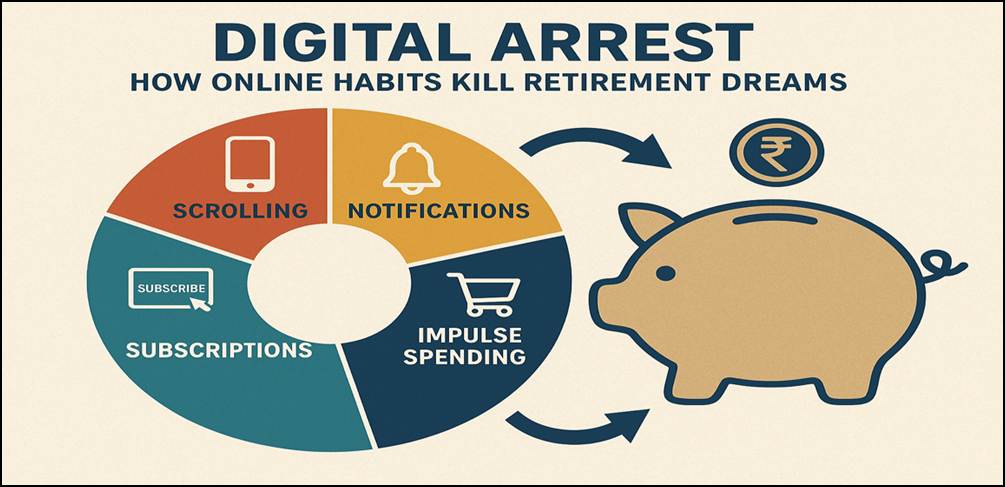
Notifications Are Silently Stealing Your Focus
Every notification is a subtle hijacker of your attention. The act of glancing at a notification will also break your focus. In the long run, these distractions are not merely stealing 1 minute here and there.
When your mind is constantly reacting to notifications, your productivity will suffer, your career advancement will slow, and your earning potential will be reduced. Because the creation of retirement wealth is dependent upon consistent savings and long-term compounding, it is possible for small day-to-day distractions to quietly reduce your future corpus.
While notifications may appear to be harmless, there is no doubt that they have a significant cumulative impact; they are stealing the focus and time you need to create a financially secure future.
Online Spending Triggers Are Designed to Make You Overspend
These sites are designed to get you to spend fast, with minimal thought. Each one of these ‘nudges’ – whether it’s an “exclusive” deal, a limited-time sale, or a “you deserve this” offer, are made to prompt you to spend now, as opposed to think about how you want to use your money.
While these nudges may seem small at first glance, they can build-up over time and create large financial holes. If you’re spending a little extra on impulse buys every month, those hundreds or thousands of rupees could add up to be lakhs over time, and that money would otherwise be used towards building a larger corpus (or fund) for retirement.
The risk here isn’t simply that you will spend too much money, but also that these online platforms will train your brain to prioritise short term satisfaction over long term goals, such as saving and investing for retirement. When instant rewards seem more desirable than putting in the discipline needed to invest for your future, it’s easy for your long term savings goals to take a back seat.
Subscription Traps Are Slowly Draining Your Wealth
Subscription charges to streaming services, educational apps, and upgrades on your favourite social media sites all may seem like insignificant amounts but over time they collectively add up to be a large part of your disposable income which is better spent as a long-term investment.
As they automatically renew each month it’s easy to overlook how much money you’ve paid out in total over the course of several years. The “hidden” monthly payments have likely replaced the money that you would have otherwise used for a systematic investment plan (SIP), retirement fund or another type of long term savings.
It’s not really about the individual subscription, it’s about the behaviour of allowing many small, recurring, digital expenses to go un-monitored. If left un-checked, they will continue to slowly diminish your available cash reserves and will slow down your ability to achieve a financially secure retirement.
Comparing Yourself Online Is Costing You Your Future
With each swipe of social media, you are subconsciously changing what you believe you need.
Friends’ vacation photos, gadgets that an influencer purchased, or “lifestyle” post photos, which depict a life you do not have, create a sense that your everyday purchases are required.
You will be forced into lifestyle inflation when you compare yourself to others continuously. Even small increases in your purchases, such as purchasing a newer phone or multiple premium subscriptions, add up over time and can leave you with less money to save for retirement.
While the actual cost of a purchase is not the purchase price, it is the mind-set that comes along with it. If you are always raising your standard, based on how much you see in social media, you will always put your short-term savings and long-term financial goals at risk.
Easy Digital Credit Is Trapping You in Debt
Apps like buy-now-pay-later services, instant loan services, etc., are now available to borrow funds from the comfort of your home via digital means. These apps appear to be convenient, however, the real danger lies in the fact that all forms of digital easy credit encourages impulse purchasing, which creates a never-ending cycle of debt, thereby delaying an individual’s ability to accumulate wealth.
Even though the loans may be very low, over many years they can quietly consume what would have been your retirement corpus, if you had invested the funds, rather than borrowing them, using discipline.
In addition to robbing individuals of their time and focus, digital easy credit also promotes behaviours that can create serious long-term setbacks to an individual’s financial well-being, ultimately placing an individual’s retirement goals at risk.
Breaking the Scroll–Spend Loop Is the Only Way Forward
The biggest problem with all the distractions, impulses and digital habits we have looked at so far is that they cause you to be reactive, distracted and focused on the immediate short term. The only way to save your retirement is to take back control of your life.
Establish boundaries around your devices. Turn off or limit notifications, schedule time for scrolling, set up automatic investment transfers, track how much money you are wasting on digital habits. Small actions taken consistently create a large amount of long-term financial awareness.
Breaking the “screen trap” and getting over the “scroll-spend” cycle does not mean abandoning technology – it means using technology to help you achieve your goals. It’s only when you break this cycle that you will be able to get your time, attention and money back and provide your retirement with the future you want.
Disclaimer: This article is for informational purposes only and does not constitute financial advice. Please consult a qualified professional before making investment decisions.