



Investing across the market capitalisation spectrum is a meaningful way to avoid missing out on wealth-creation opportunities. As Howard Marks, the Co-Founder of Oaktree Capital Management, puts it: “Flexibility is the key to surviving and thriving in financial markets. If you bind yourself to rigid rules, you miss the unexpected opportunities that market dislocations always create.“
The fact is, when you approach market cap segments dynamically – without any upper or lower limit – it becomes even more versatile. Large-caps, or blue-chips, add stability to the portfolio, while small- and mid-caps (SMIDS) act as velocity engines, helping accelerate the overall portfolio returns. This is why flexi-cap funds have consistently been a preferred choice among the equity mutual fund sub-categories.
In this article, let’s look at the performance of two relatively new flexi-cap funds from fund houses founded by asset management industry veterans — Samir Arora of Helios Mutual Fund and Utpal Sheth of TRUST Mutual Fund.
But before we discuss the performance of the flexi-cap funds of Helios Mutual Fund and Trust Mutual Fund (which are the first equity schemes launched by these fund houses), here’s a bit about their founders and their investment philosophies, which ultimately drive the schemes’ performance.
Arora, after a decade-long successful stint with Alliance as Chief Investment Officer (CIO) and equity fund manager, co-founded Helios Capital in January 2005, based in Singapore, fired up and excited. In March 2020, he made his India comeback by launching portfolio management services (PMS) for high-net-worth and ultra-high-net-worth individuals. Later, in August 2023, he officially launched India’s mutual fund business with Helios Mutual Fund for retail and other investors.
Speaking of Sheth, he is often referred to as Rakesh Jhunjhunwala’s right-hand man, having worked alongside him as Senior Partner and CEO for over a decade, managing billions of dollars in assets for RARE Enterprises. Even today, after Jhunjhunwala’s passing (in August 2022), he continues to lead and manage RARE Enterprises’ portfolio as the trusted lieutenant. He co-founded the TRUST Group in 2001, a multi-line financial services platform operating across wealth management, equity and debt, and alternative assets. In 2019, Sheth launched TRUST Mutual Fund, offering retail investors the taste of his recipe for investment success.
Investment Philosophies: Elimination Framework vs Terminal Value
Both Arora’s Helios and Sheth’s TRUST mutual fund are built on distinct investment philosophies:
Helios Mutual Fund uses Arora’s “Elimination Investing” (EI) framework, which focuses on reducing the risk of selecting poorly performing companies by skilfully eliminating companies that do not convincingly meet the selection criteria. The process navigates through a comprehensive framework comprising eight pivotal factors:
- Size of Opportunity
- Favourable Industry Dynamics
- Low Potential for Disruption
- Strong Management/Background/Strategy
- Good Corporate Governance
- Clean Accounting
- Medium-Term Positive Triggers
- Reasonable Valuations
This framework is applied rigorously to eliminate investments with red flags, leaving the fund house with a universe of “not bad” companies. It significantly improves the odds of arriving at a universe of companies with better prospects, aligning with the aim of outperforming the market over time.
The core principle of the EI framework is that it does not predict which companies will be at the top, but rather which companies are more likely to underperform. This framework is applied diligently and consistently to give long-term advantage to investors.
Sheth’s TRUST Mutual Fund has its own approach, which it calls the “Terminal Value and Gorilla Investing Framework.” It focuses on five parameters when selecting stocks:
- Differentiated insights: The fund house looks for and projects long-term growth opportunities, where the greatest wealth-creation opportunity lies.
- Terminal Value Investing: TRUST Mutual Fund believes that for high-growth stocks, much of the value creation happens beyond the short term. The impact of compounding, the “hockey-stick” or “exponential growth”, kicks in over the longer term and creates immense value, this value is the Terminal Value (TV), i.e., the value beyond the foreseeable horizon. The fund house sees TV as the magic at the intersection of intangibles, leadership and megatrends, and overall, follows a growth at a reasonable valuation (GARV) approach to pick stocks.
- Spotting Gorilla businesses: TV investing seeks gorilla companies, or outsized dominant leaders in their industries.
- Megatrends: These refer to major macroeconomic, geopolitical, structural, or environmental trends, which are structural shifts and long-term in nature and have consequences for investments.
- Intangibles: The investment process also considers fast-growing companies with no physical assets but rising intangible and less visible assets, such as intellectual property, human capital, technology, and software, among others.
Now, let’s look at these funds’ portfolio characteristics in detail to understand whether they are walking the talk and what’s driving performance.
Portfolio Attributes: Helios Flexi Cap v/s TRUST MF Flexi Cap Fund
| No. of Stocks | Top 10 Stock (%) | Top 3 Sectors (%) | |
| Helios Flexi Cap Fund | 71 | 34.3 | 56.1 |
| TRUST MF Flexi Cap Fund | 66 | 31.0 | 72.4 |
Source: Value Research, Fund Factsheet
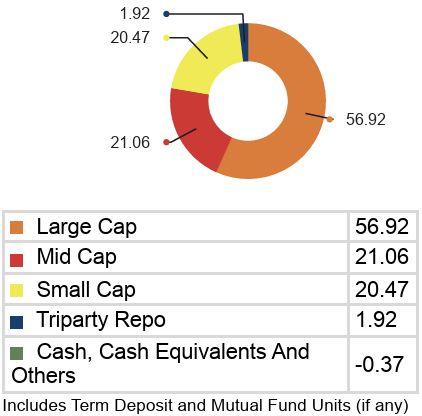
Helios Flexi Cap Fund, since its inception in November 2023, has allocated roughly 50-58% to large-caps and the remaining in SMIDs. That said, unlike other flexi-cap funds that often stay locked in large-cap allocations, Helios Flexi Cap Fund has actively shifted its tactical weights to capitalise on the 2024–2026 small- and mid-cap rally and avoid missing out on opportunities.
The latest factsheet as of 30 September 2026 reveals that the fund holds nearly 57% of its portfolio in large-caps. This allocation is perhaps recognising the current market environment of intense volatility due to the West Asia war, higher oil prices, inflation risk, higher yields, a weak Indian rupee, and tightening of policy rates, which can serve as a defensive anchor against the downside risk. The mid-caps and small-caps are currently around 21% and 20%, respectively, not wanting to miss out on the upside potential as well. Cash and cash equivalents currently account for 1.5% of total assets, which means the fund is almost fully invested.
Market Cap Allocation of Helios Flexi Cap Fund
Source: Fund Factsheet
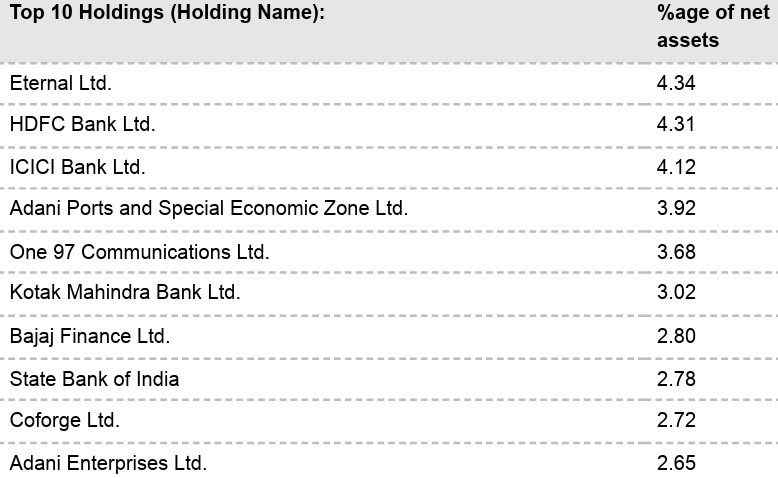
The fund has typically held 40-70 stocks in its portfolio since its launch. During the launch phase, Helios Flexi Cap held a relatively compact portfolio of around 40 stocks, and as assets expanded (to over Rs 8,783 crore as at present), Samir Arora and his team of fund managers increased the total number of stocks to around 70. Currently, the fund holds 71 stocks; the top 10 account for 34.3% of the total portfolio and include names such as Eternal, HDFC Bank, ICICI Bank, Adani Ports and SEZ, and One97 Communications, among others.
Top Holdings of Helios Flexi Cap Fund
Data as of 30 September 2026
Source: Fund Factsheet
Overall, the portfolio is well-diversified and robust. That said, there has been a strong divergence between high-flying growth/fintech names and traditional banking giants. For example, Eternal has outperformed with stellar returns, driven by explosive quick-commerce growth. On the other hand, banks such as HDFC Bank, after its merger with HDFC Ltd., have been a modest compounder. Even Bajaj Finance has shown muted performance due to margin pressures. Among the banks, only ICICI Bank and SBI, supported by strong credit growth and decent net interest margins, have fared well.
As for sector exposure, the top 3 sectors are financial services (36.1%), consumer services (10.2%), and capital goods (9.8%), comprising 56.1% of the portfolio, as per its latest factsheet (as of 30 September 2026), which indicates the fund is overweight in sectors where it sees wealth-creation potential.
Helios has consistently gone overweight on quick commerce, food delivery platform tech, and retail/hospitality relative to traditional broad market indices. Likewise, to capitalise on Indian capex and manufacturing, the fund has taken active positions in capital goods, engineering, and infrastructure. It has preferred to remain underweight in traditional IT services exporters, preferring selective mid-cap tech and niche digital platforms over large-cap IT legacy giants.
Overall, the portfolio has been constructed with a blend of value and growth-style investing, depending on the opportunities available. They are identified through a bottom-up approach at its foundation, along with a top-down overlay when the investment team is looking at tailwinds. Samir Arora and his team follow a medium-to-long-term holding approach rather than high-frequency tactical trading. The portfolio turnover ratio, as per the latest portfolio, is 47%.
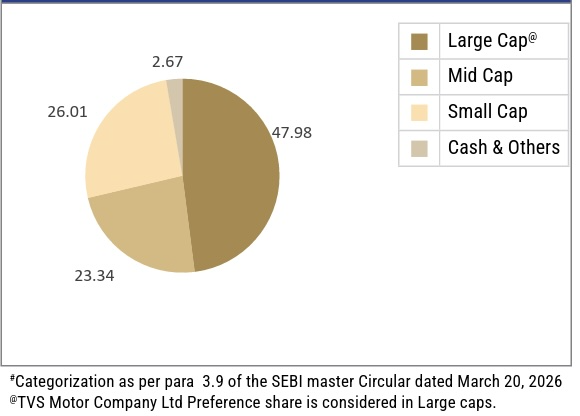
TRUST MF Flexi Cap Fund, on the other hand, has maintained a 45-50% allocation to large-caps since its inception in April 2024, with the remainder in SMIDs. Overall, it has maintained an almost 50:50 split between large-caps and SMIDs. As per its latest portfolio, the fund has a 48% allocation to large-caps, while mid-caps and small-caps account for 23% and 26%, respectively.
Market Cap Allocation of TRUST MF Flexi Cap Fund
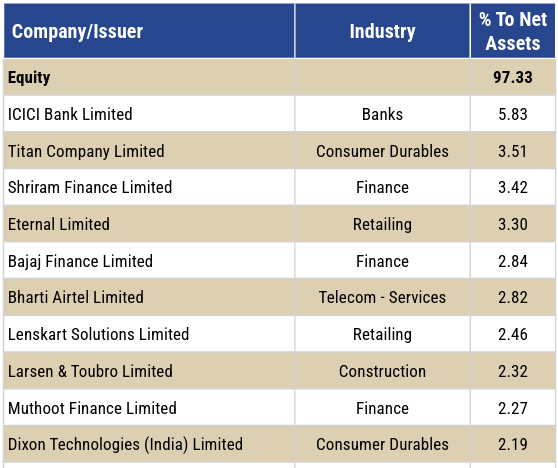
The fund has typically held between 55 and 67 stocks in its portfolio. As the fund’s total assets grew to over Rs 1,041 crore, the stock count ranged between 60 and 67. It currently holds 66 stocks; the top 10 account for 31.0% and include Titan, Shriram Finance, Eternal (Zomato), and Bajaj Finance.
Nearly 22 stocks are common between Trust MF Flexi Cap and Helios Flexi Cap Fund, with nearly 43% of the portfolio common. The three stocks common to these funds are Eternal, ICICI Bank, and Bajaj Finance, even though their weights differ.
Top Holdings of TRUST MF Flexi Cap Fund
Source: Fund Factsheet
A number of TRUST MF Flexi Cap Fund’s portfolio holdings have rewarded well. For instance, Shriram Finance, backed by strong commercial vehicle credit demand and margin expansion, has witnessed multi-year compounding. Similarly, Bharti Airtel benefited from strong ARPU (Average Revenue Per User) growth following tariff hikes and expanding 5G subscriber conversion. Dixon Technologies has also seen strong compounding, as it is a primary beneficiary of the electronics manufacturing boom in smartphones and consumer appliances.
As for sector exposure, the top 3 sectors in the latest portfolio are financial services (31.6%), consumer discretionary (25.8%), and industrials (15.0%), making up 72.4%—quite concentrated compared to Helios Flexi Cap.
Rather than hugging its benchmark index (Nifty 500 TRI), TRUST MF Flexi Cap allocates heavily toward secular growth opportunities with high visibility of long-term terminal value. This results in overweight and underweight positions in certain stocks. Typically, the fund has been overweight in consumer discretionary, retail tech platforms, non-banking finance companies (NBFCs), engineering and power, while being underweight in IT service exporters (like its peer, Helios Flexi Cap).
Industrials, capital goods, telecommunications, banking and financial services, and consumer-driven tech platforms have helped the fund generate wealth for its investors.
Overall, TRUST MF Flexi Cap follows a growth style in its portfolio construction, predominantly using a bottom-up approach, but also taking a top-down approach to identify macro trends and value migration.
To manage the portfolio, the fund manager & CIO, Mihir Vora, often churns it. According to the latest factsheet, the portfolio turnover ratio is 276%, which means the fund manager bought and sold the portfolio more than 2.76 times over the past 12 months. This contradicts the long-term value-creation model TRUST MF describes in its investment philosophy.
Portfolio Valuation Ratios: Helios Flexi Cap v/s TRUST MF Flexi Cap Fund
| PB Ratio | PE Ratio | |
| Helios Flexi Cap Fund | 4.2 | 33.0 |
| TRUST MF Flexi Cap Fund | 5.0 | 34.9 |
Arora-led Helios Flexi Cap Fund has clocked a decent 16.8% CAGR in 2 years and 10 months since its inception. Over the past 2 years, the fund’s returns are nearly 5.8 times the category median.
Even over the past 6 months and 1 year, the fund has outperformed the category median as well as the benchmark, the BSE 500 – TRI. Over the past 3 months, the fund has registered negative -3.2% returns mainly due to the short-term correction in high PE and high beta consumer tech stocks, which it owns in its portfolio. Moreover, mid-cap and small-caps, in general, witnessed higher volatility (than large-caps), which weighed on its portfolio. That said, the fund’s double-digit compounded annualised returns since inception are appealing and cannot be ignored.
While the level of risk taken by the fund (as denoted by the standard deviation) and the risk-adjusted returns (as denoted by Sharpe and Sortino ratios) are not available, as the fund has completed less than 3 years since its launch, the returns seem to be well justified by the alpha generated by the fund.
Sheth-led TRUST MF Flexi Cap, on the other hand, has clocked 9.9% CAGR in 2 years and 5 months. Over the last 2 years, its compounded annualised returns have exceeded the category median and the BSE 500 – TRI, driven by active stock selection, targeted thematic bets, and an unconstrained market-cap structure.
The returns over the past 3 months, 6 months and 1 year are way better than the category median and the benchmark, as the underlying portfolio, particularly banks, commercial vehicle finance and gold loan companies, power infrastructure companies, capital goods and engineering companies, telecom, and high-growth digital consumption platforms, have fared well. Moreover, the outperformance is due to a strategic tilt toward mid- and small-cap equities and a high-conviction growth-stock selection style. By comparison, many peers, including Helios Flexi Cap, have maintained a higher allocation to large-caps and have turned conservative over the last two years. In other words, it is the aggressive tactical bets and high portfolio churn that are behind the better performance.
What is the level of risk TRUST MF Flexi Cap exposes its investors to can’t be estimated given the limited track record of less than three years; it is likely to be higher than peers and the benchmark. That said, the fund seems to justify the risk it is taking on a risk-adjusted returns basis.
Which Flexi Cap Fund Should You Add to Your Portfolio?
Both flexi-cap funds come from fund houses with robust, unique investment processes & systems. However, TRUST MF Flexi Cap is slightly more aggressive than Helios Flexi Cap Fund. Helios Flexi is a bit value-conscious and offers better risk management via strict negative screening, while the TRUST MF Flexi Cap Fund focuses on high-growth stocks with a terminal value and a gorilla investment framework.
Whichever flexi-cap mutual fund scheme you consider for your investment portfolio, make sure your investment horizon is at least 5 years. Also, make sure the fund aligns with your personal risk profile, investment objective, and the financial goals you plan to address. Don’t just pick funds looking at historical returns.
Invest sensibly; be a thoughtful investor.
Happy investing!
Note: We have relied on data from www.valueresearchonline.com, www.financialexpress.com, and the factsheets published by the respective fund houses throughout this article. Only in cases where the data was not available have we used an alternate but widely used and accepted source of information.
Returns data as of 7 October 2026. Direct Plan and Growth Option Considered.
Standard deviation measures the fund’s total volatility. The Sharpe Ratio measures risk-adjusted return and shows how much excess return an investment generates for each unit of risk taken.
Portfolio data as of 30 September 2026. The average price-to-book value ratio and price-to-equity ratio of all underlying stock holdings, weighted by their portfolio weights, are considered.
Disclaimer
The above content is for informational purposes only. Mutual Fund investments are subject to market risks. Past returns are not indicative of future returns. Please consult your financial advisor before investing.
Rounaq Neroy has over 20 years of experience in the financial markets and investments. He is a close observer of the Indian economy and writes deeply on the capital markets, mutual funds, stocks, precious metals, asset allocation, wealth management, and investment strategy. His editorials provide interesting, actionable investment ideas to guide readers in the journey of wealth creation and make wise decisions. Rounaq was the Head of Content at PersonalFN (Quantum Information Services Pvt. Ltd.), which also owns Equitymaster.com – India’s oldest and trusted equity research house.