


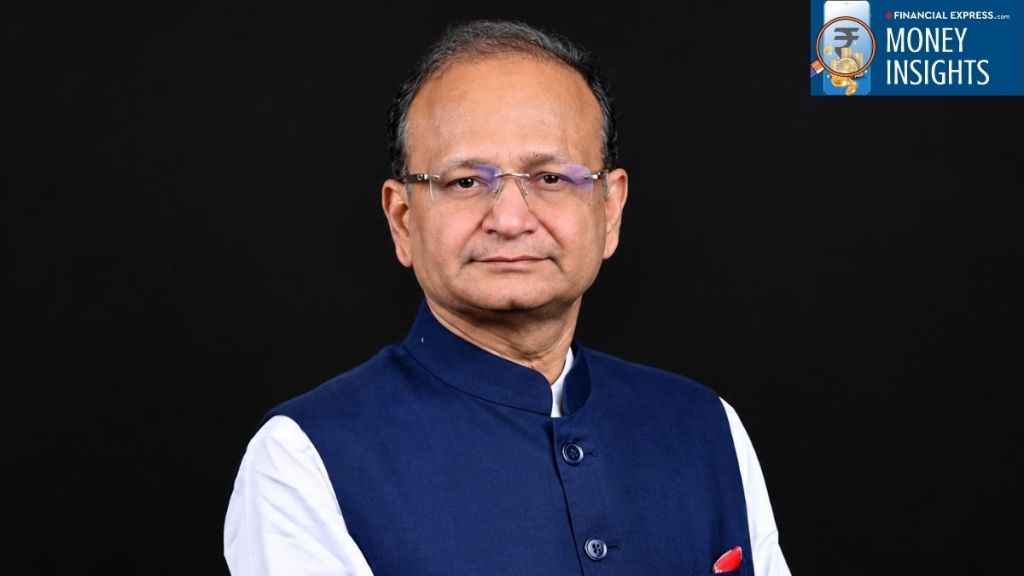

We all know the late Rakesh Jhunjhunwala, widely regarded as India’s Warren Buffett. But do you know the man he trusted most for an analytical mindset to pick stocks for Jhunjhunwala’s RARE Enterprises?
Often referred to as Jhunjhunwala’s right-hand man, he worked alongside him as Senior Partner and CEO for over a decade, managing billions of dollars in assets for RARE Enterprises. He is said to be the man behind the selection of companies such as Titan, Praj Industries, Lupin, Radico Khaitan, and many others that went on to become multibaggers over the years, creating enormous wealth for Jhunjhunwala.
While Jhunjhunwala was known for his investment instincts, grit, conviction, and larger-than-life image, this man, a calm yet analytical powerhouse working behind the curtain, brought a robust investment process with financial models and investment discipline at RARE Enterprises and was instrumental in executing the strategies.
His name? Utpal Sheth.
A commerce graduate, a qualified Cost & Works Accountant, and an all-India CFA gold medallist, Sheth honed many of his analytical skills working in investment banking firms such as Enam Financial Consultants and Insights Assets Management.
As widely reported, Jhunjhunwala and Sheth’s association began with a serendipitous, unanticipated meeting in 1997. Sheth was then working with Enam Financial Consultants (an investment banking firm) and visited ASK Financials for professional reasons. He was waiting in the reception area, where he met Jhunjhunwala, who was also there waiting for his turn to meet Asit Kotecha (the founder of ASK Financials).
Sheth overheard Jhunjhunwala discussing his stock positions in alcohol/liquor stocks, which led to their famous impromptu conversation. As a young analyst, Sheth debated price targets and argued that, instead of looking for a quick exit price, Jhunjhunwala should hold liquor stocks for the long haul. That’s how a brief, intellectual conversation sparked a deep mutual respect between the two. And in 2003, right before India entered an unprecedented five-year bull run, Jhunjhunwala brought Sheth on board at RARE Enterprises, who laid the structural foundation for stock picking.
In later years, Jhunjhunwala described his dynamic relationship with Utpal Sheth as, “Utpal and I complement each other perfectly… we are a 1+1=11 partnership.”
Even after Jhunjhunwala’s passing (in August 2022), Sheth continues to lead and manage RARE Enterprises’ portfolio as the trusted lieutenant with an institutionalised approach and prudent risk management.
With over 30 years in capital markets, Sheth crafted an investment philosophy spanning corporate advisory, fundraising, and private equity.
He continues to practice his sound investment philosophy at TRUST Group too, an organisation Sheth co-founded in 2001 with his wife, Nipa Sheth (CA and CFA from ICFAI Hyderabad and currently the Managing Director of TRUST Group of Companies), which is a multi-line financial services platform operating across wealth management, equity and debt portfolio management, alternative investments, and debt capital markets.
In 2019, offering retail investors a taste of his recipe for investment success, Sheth launched TRUST Mutual Fund, where the equity scheme portfolios are approached based on the long-term Terminal Value and Gorilla Investing frameworks, which he formulated when working alongside Jhunjhunwala.
What is Sheth’s Terminal Value and Gorilla Investing Framework?
The investment philosophy focuses on the following five parameters when selecting stocks:
- Differentiated insights: Often many of us miss much of long-term value creation by focusing on the short-term forecast period. But Sheth’s Trust Mutual Fund looks for and projects long-term growth opportunities where the maximum wealth-creation opportunity lies.
- Terminal Value Investing: A growth at a reasonable valuation (GARV) methodology is followed, centred on a Terminal Value lens. It believes that the impact of compounding, the “hockey-stick” or “exponential growth”, kicks in over the longer term to create immense value. This value is the Terminal Value (TV), i.e. the value beyond the foreseeable horizon. TV is the magic at the intersection of intangibles, leadership and megatrends.
- Spotting Gorilla businesses: It means seeking out rare, dominant companies that can drive structural megatrends and outlast their peers because of strong intangibles (like IP, human capital, or tech infrastructure). The attempt to find gorilla companies, or outsized dominant leaders in their industries, is approached through TV investing.
- Megatrends: These refer to major macroeconomic, geopolitical, structural, or environmental trends, which are structural shifts and long-term in nature and have consequences for investments.
- Intangibles: The investment process also considers fast-growing companies with no physical assets but rising intangible and less visible assets, such as intellectual property, human capital, technology, and software, among others.
This portfolio construction approach is described as “LimitedACTIV Methodology” – an approach that emphasises systematic, process-driven investment decisions rather than high-conviction, high-discretion fund manager calls.
In other words, Sheth has a sound investment process & systems that drive the performance of equity schemes rather than relying on the whims of fund managers.
Are investors being rewarded?
If we look at the performance of the flagship scheme, TRUST MF Flexi Cap launched in April 2024 (having an AUM of Rs 1,042 crore currently), as well as the TRUST Small Cap Fund launched in November 2024 (having an AUM of Rs 3,429 crore at present), their compounded annualised returns since inception are appealing: 10.9% and 19.8%, respectively, as of 21 September 2026.
Let’s look at these schemes individually…
- TRUST MF Flexi Cap Fund
This fund, with a versatile investment mandate to invest dynamically across large-caps, mid-caps, and small-caps – without any upper or lower limits– and is sector- and style-agnostic, clocking a 10.9% CAGR since its inception in April 2024, has fared better than the category average (6.60%) and the benchmark, BSE 500 TRI (4.3%), as of 21 September 2026.
Report Card of TRUST MF Flexi Cap Fund
| Absolute Returns (%) | CAGR (%) | ||
| 6 Mths | 1 Yr | Since Inception | |
| TRUSTMF Flexi Cap Fund | 18.4 | 7.8 | 10.9 |
| Category Median | 12.1 | 0.4 | — |
| BSE 500 TRI | 4.4 | -2.7 | — |
The returns data is as of 21 September 2026.
Source: Value Research
Moreover, TRUST Flexi Cap Fund since its inception from 26 April 2024 until date (i.e. 21 September 2026) has outperformed Parag Parikh Flexi Cap Fund (AUM of Rs 1,47,405 crore) and HDFC Flexi Cap (AUM of Rs 1,13,606 crore), the two behemoths in the flexi-cap funds category, which, during the same time period, in comparison, have clocked 6.8% and 9.8%, respectively. The fund has also outperformed a similar-sized fund, the LIC MF Flexi Cap (AUM of Rs 1,125 crore), which clocked 8.5% CAGR.
Over the past year, TRUST Flexi Cap Fund has also posted a decent 7.8% absolute return compared to the category median (0.4%) and outperformed the BSE 500 TRI by a good 10.4%.
While 2026 has been a challenging year for the Indian equity markets due to the West Asia war, oil on the boil, Trump 2.0’s tariff tantrums and a vulnerable Indian rupee, among other factors, TRUST MF Flexi Cap has stood tall with a decent 7.8% on a year-to-date basis (as of 21 September 2026).
YTD Returns of TRUST MF Flexi Cap Fund vs. Peers in Challenging Times of 2026
| AUM (Rs in Cr.) | Absolute Returns | |
| 1-Jan-26 to 21-Sep-26 (%) | ||
| TRUST MF Flexi Cap Fund | 1,042 | 7.8 |
| LIC MF Flexi Cap Fund | 1,125 | 3.9 |
| HDFC Flexi Cap Fund | 113,606 | -1.3 |
| Parag Parikh Flexi Cap Fund | 147,405 | -4.6 |
| BSE 500 TRI | – | -3.9 |
Source: Value Research
The returns are higher than Parag Parikh Flexi Cap Fund (-4.6%), HDFC Flexi Cap (-1.3%) – the large-sized funds in the flexi-cap fund category – and LIC MF Flexi Cap (3.9%). TRUST MF Flexi Cap has also outdone the overall flexi-cap funds category average (0.4%).
TRUST MF Flexi’s outperformance since its April 2024 launch is directly tied to its strategic tilt toward mid- and small-cap equities and a high-conviction growth-stock selection style. By comparison, many peers have maintained a higher allocation to large-caps, turning conservative over the last two years.
Even in the challenging times of 2026, TRUST MF’s agility and structural rotation into higher-beta and structural-growth themes have helped it outperform. Moreover, it has remained almost fully invested in equities with around 97% allocation.
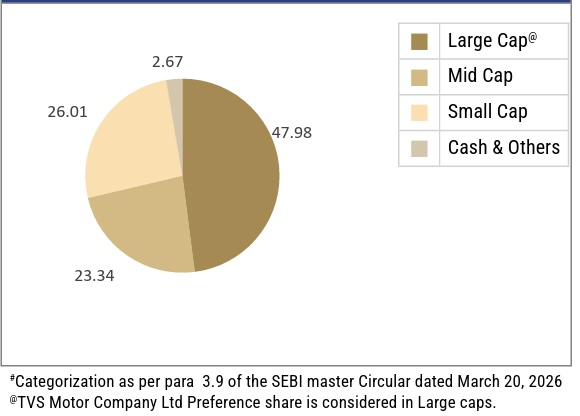
The fund has also kept its portfolio decently diversified with around 60-70 stocks. Even in its latest portfolio as of August 2026, the fund has 66 stocks, of which the cumulative exposure to small and mid-caps (SMIDs) is around 49%, and to large-caps 48%.
Market Capitalisation of TRUST MF Flexi Cap Fund
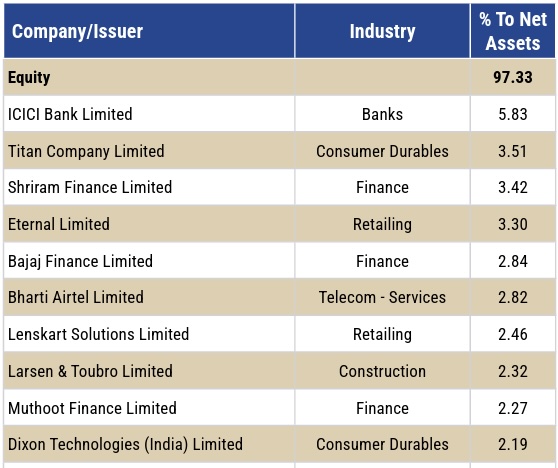
The top 10 stocks are 30.9% of the portfolio and include names such as ICICI Bank, Titan, Shriram Finance, Eternal (Zomato), Bajaj Finance, etc.
Top Holdings of TRUST MF Flexi Cap Fund
Source: Fund Factsheet
The top 3 sectors make up around 72% of the portfolio, making it concentrated, and include financial services (32%), consumer discretionary (25%), and industrials (15%).
While the investment framework speaks about holding stocks for the long term, the TRUST MF Flexi Cap’s fund manager and CIO, Mihir Vora, and his team often churn the portfolio with an active, agile, opportunistic approach. As per the latest factsheet, the portfolio turnover ratio is 276%, which means the fund manager bought and sold the portfolio over 2.7 times.
The portfolio valuation ratios of price-to-book (PB) and price-to-equity (PE) of nearly 5x and 35x, respectively, as of 31 August 2026, clearly reveal the fund’s growth-oriented approach with predominant mid- and small-cap holdings.
- TRUST Small Cap Fund
This scheme, launched in November 2024, has clocked a 19.8% CAGR since its inception as of 21 September 2026. This outperforms the small-cap category average of 5.1% CAGR and the benchmark, BSE 250 SmallCap TRI (1.2), during this period.
Report Card of TRUST MF Small Cap Fund
| Absolute Returns (%) | CAGR (%) | ||
| 6 Mths | 1 Yr | Since Inception | |
| TRUST MF Small Cap Fund | 38.6 | 29.0 | 19.8 |
| Category Median | 28.2 | 11.5 | — |
| BSE 250 SmallCap TRI | 23.4 | 3.7 | — |
The returns data is as of 21 September 2026.
Source: Value Research
TRUST MF Small Cap Fund in the period since its launch, i.e. from 4 November 2024 up to 21 September 2026, has also outperformed large-sized small cap funds such as Nippon India Small Cap (AUM of Rs 82,580 crore) and SBI Small Cap (AUM of Rs 42,631 crore), which have clocked CAGRs of 3.5% and 2.5%, respectively. Moreover, it has outstripped its similarly sized peer, the Bank of India Small Cap Fund (AUM of Rs 3,307 crore), which clocked an 11.1% CAGR during this period.
Over the last year, TRUST MF Small Cap is also the best-performing scheme in its category with 29.0% absolute returns (as of 21 September 2026). Even in the challenging times of 2026, the fund has posted a respectable 28.7% absolute return.
YTD Returns of TRUST MF Small Cap Fund vs. Peers in Challenging Times of 2026
| AUM (Rs in Cr.) | Absolute Returns | |
| 1-Jan-26 to 21-Sep-26 (%) | ||
| Bank of India Small Cap Fund | 3,307 | 31.1 |
| TRUST MF Small Cap Fund | 3,439 | 28.7 |
| Nippon India Small Cap Fund | 82,580 | 12.0 |
| SBI Small Cap Fund | 42,631 | 10.2 |
| BSE 250 SmallCap TRI | – | 8.5 |
Source: Value Research
Returns are higher than large-sized small-cap funds such as Nippon India Small Cap (12.0%) and SBI Cap (10.2%) on a YTD basis, plus TRUST Small Cap has outperformed the BSE 250 SmallCap TRI by a significant margin of 20.2%.
The key reason behind this is that, with its growth style, TRUST MF Small Cap invests in unique themes and sectors within small-caps and, to an extent, mid-caps.
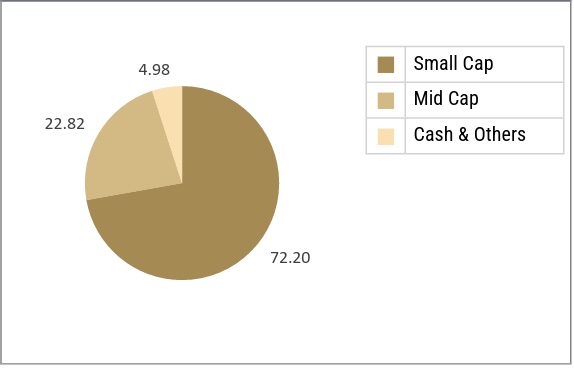
Market Capitalisation of TRUST MF Small Cap Fund
Source: Fund Factsheet
A primary source of TRUSTMF’s outperformance has been due to heavy exposure to the power capex cycle, electrical manufacturing, auto, and capital goods. Its agile asset size, full deployment, high-conviction positions in fast-growing smaller companies, and, at times, momentum plays also aided the outperformance.
In the challenging period of 2026, keeping substantial cash or money-market buffers dilutive, i.e. remaining almost fully invested, has helped the fund during sharp, sector-specific stock rallies. For example, Welspun Corp, TD Power Systems, Sky Gold & Diamonds, MCX, Ather Energy, etc., are some stocks in the TRUST MF Small Cap Fund’s portfolio that have rallied remarkably so far this year.
In its latest portfolio as of August 2026, the fund holds 71 stocks; the top 10 account for 21.0% and include Welspun Corp, Karur Vysya Bank, Ather Energy, Sansera Engineering, and Sky Gold & Diamonds, among others.
Top Holdings of TRUST MF Small Cap Fund
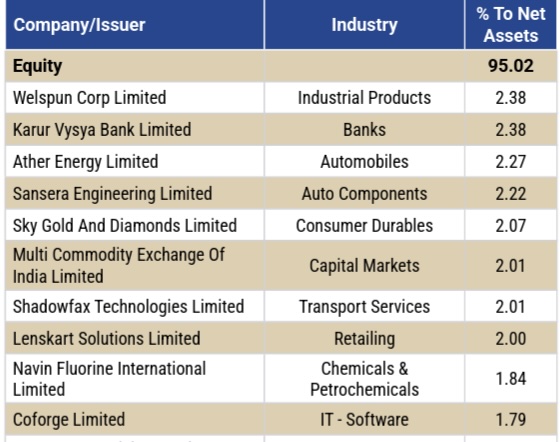
The top 3 sectors make up around 63% of the portfolio, making it a bit concentrated, and include consumer discretionary (22%), industrials (21%), and financial services (20%).
To manage the portfolio, the fund manager & CIO, Mihir Vora, churns it often, which contradicts its long-term value-creation model. As per the latest factsheet, the portfolio turnover ratio is 202%, which means the fund manager bought and sold the portfolio over 2.0 times over the past 12 months.
The PB and PE of nearly 6x and 44x, respectively, as of 31 August 2026, clearly reveal the fund’s growth-oriented approach with active stock and sector rotation.
Will the schemes from Sheth’s TRUST Mutual Fund continue to deliver attractive returns?
Sheth has set the investment framework and processes at RARE Enterprises while managing Jhunjhunwala’s portfolio and has proved his prowess. To generate wealth for mutual fund investors, Sheth, along with his CIO, Mihir Vora, also follows a robust investment process. To enable a clear, credible, and consistent investment approach, the portfolio is constructed using the LimitedACTIV methodology (based on limited deviation from the model portfolio).
That said, to generate returns while managing risks, certain schemes also use active stock selection, sector rotation, and momentum plays. While the level of risk the equity funds expose investors to can’t be estimated given the limited track record of less than three years, it is likely to be higher than peers and the benchmark. Nevertheless, given the returns clocked so far, TRUST Mutual Fund, led by Sheth and his team, also seems to be justifying the risk taken on a risk-adjusted returns basis.
You may consider adding schemes from TRUST Mutual Fund to your 2026 watchlist. But when adding them to your portfolio, make sure they align well with your personal risk profile, investment objective, the financial goals you’re addressing and the time in hand to achieve those goals. Investing in equity schemes such as flexi-cap and small-caps requires at least a five-year investment horizon and a very high-risk appetite.
Invest sensibly; be a thoughtful investor.
Happy investing.
Note: We have relied on data from www.valueresearchonline.com, www.financialexpress.com, and the factsheets published by the respective fund houses throughout this article. Only in cases where the data was not available, have we used an alternate but widely used and accepted source of information.
Returns data as of 21 September 2026. Direct Plan and Growth Option Considered.
Standard deviation measures the fund’s total volatility. The Sharpe Ratio measures risk-adjusted return and shows how much excess return an investment generates for each unit of risk taken.
Portfolio data as of 31 August 2026. The average price-to-book value ratio and price-to-equity ratio of all underlying stock holdings, weighted by their portfolio weights, are considered.
Disclaimer
Disclaimer: The above content is for informational purposes only. Mutual Fund investments are subject to market risks. Past returns are not indicative of future returns. Please consult your financial advisor before investing.
Rounaq Neroy has over 20 years of experience in the financial markets and investments. He is a close observer of the Indian economy and writes deeply on the capital markets, mutual funds, stocks, precious metals, asset allocation, wealth management, and investment strategy. His editorials provide interesting, actionable investment ideas to guide readers in the journey of wealth creation and make wise decisions. Rounaq was the Head of Content at PersonalFN (Quantum Information Services Pvt. Ltd.), which also owns Equitymaster.com – India’s oldest and trusted equity research house.