




I am 28, earn Rs 70,000 a month and want to stop working at 40. My target is to retire with a Rs 2 crore corpus. So I asked ChatGPT a simple question: What are the best ways to reach my goal in 12 years?
I gave ChatGPT the prompt: “Act as an expert financial advisor and investment planner in India. I am a 28-year-old salaried professional earning Rs 70,000 per month in-hand. I want to retire with a corpus of Rs 2 crore at 40. I am expecting a minimum double-digit salary hike every year. I also want to increase my investment portfolio by at least 10%. I stay in Noida and 20% of my salary goes in paying the rent. Suggest me a diversified investment plan to reach the target corpus.”
The first question was not which stock or mutual fund I should buy. ChatGPT focused on how much I could realistically invest and how that amount would need to grow over the next 12 years.
ChatGPT said I need to invest Rs 25,000 a month
With a Rs 70,000 take-home salary and Rs 14,000 rent, ChatGPT calculated that I should initially target Rs 25,000 a month towards investment. That is about 36% of my current take-home salary.
For its calculations, it used a hypothetical long-term return of around 12% per annum, while making clear that this was an assumption and not a guaranteed return.
At a Rs 25,000 monthly SIP with a 10% annual increase, the calculation shows that I can have roughly Rs 1.7–Rs 1.8 crore over 12 years.
That was close to the target, but not quite enough. The AI therefore made an important distinction: “10% = minimum step-up. 15% = preferred step-up whenever your salary allows.”
The challenge, then, was not simply finding a high-return investment. It was increasing the amount I could invest as my income grew.
Rs 25,000 investment basket ChatGPT suggested
ChatGPT’s initial allocation put roughly 80% into growth assets and 20% into relatively safer investments.
The suggested Rs 25,000 monthly portfolio was:
- Rs 8,000 — Nifty 50 Index Fund
- Rs 4,000 — Flexi-cap Fund
- Rs 3,000 — Nifty Next 50 Index Fund
- Rs 2,500 — Mid-cap Fund
- Rs 2,500 — International Equity
- Rs 5,000 — Debt/EPF/PPF
For someone aged 28 with a 12-year investment horizon, ChatGPT considered this aggressive but reasonable, assuming I could tolerate significant market falls.
But there was a reason it did not recommend putting everything into equity.
Why ChatGPT did not recommend 100% equity
My age makes a strong equity allocation logical. But I also have a fixed retirement deadline: 40.
ChatGPT gave me a hypothetical example. If I reached Rs 1.8 crore at age 39 and the equity market then fell 30%, my retirement plan could suddenly be pushed off track.
So the portfolio needed to become progressively safer as I approached 40.
Its suggested allocation was:
- Age 28–32: 80% equity / 20% debt
- Age 33–35: 75% equity / 25% debt
- Age 36–37: 70% equity / 30% debt
- Age 38: 65% equity / 35% debt
- Age 39–40: 60% equity / 40% debt
The basic idea was to build aggressively early and protect the corpus later.
The investment amount has to rise every year
Starting with Rs 25,000 a month and increasing the investment by 10% every year would take my monthly SIP to:
- Age 28: Rs 25,000
- Age 29: Rs 27,500
- Age 30: Rs 30,250
- Age 31: Rs 33,275
- Age 32: Rs 36,603
- Age 33: Rs 40,263
- Age 34: Rs 44,289
- Age 35: Rs 48,718
- Age 36: Rs 53,590
- Age 37: Rs 58,949
- Age 38: Rs 64,844
- Age 39: Rs 71,328
By 39, I would theoretically be investing more than Rs 71,000 every month, more than my current salary.
That made clear that the investment increase has to come from salary growth.
My salary hikes become the engine of the plan
This is where my expected double-digit salary growth becomes important.
ChatGPT suggested increasing investments whenever my salary rises, before allowing lifestyle expenses to rise.
For example, if my salary increases from Rs 70,000 to Rs 77,000, the Rs 7,000 increase could be divided roughly as:
- Rs 5,000 — investment
- Rs 2,000 — lifestyle or cash goals
That would take my investment from Rs 25,000 to around Rs 30,000 instead of simply increasing it to Rs 27,500.
ChatGPT therefore suggested a rule: “10% automatic annual increase + 50–70% of every salary increment.”
This was more practical than mechanically increasing my SIP regardless of what happened to my income.
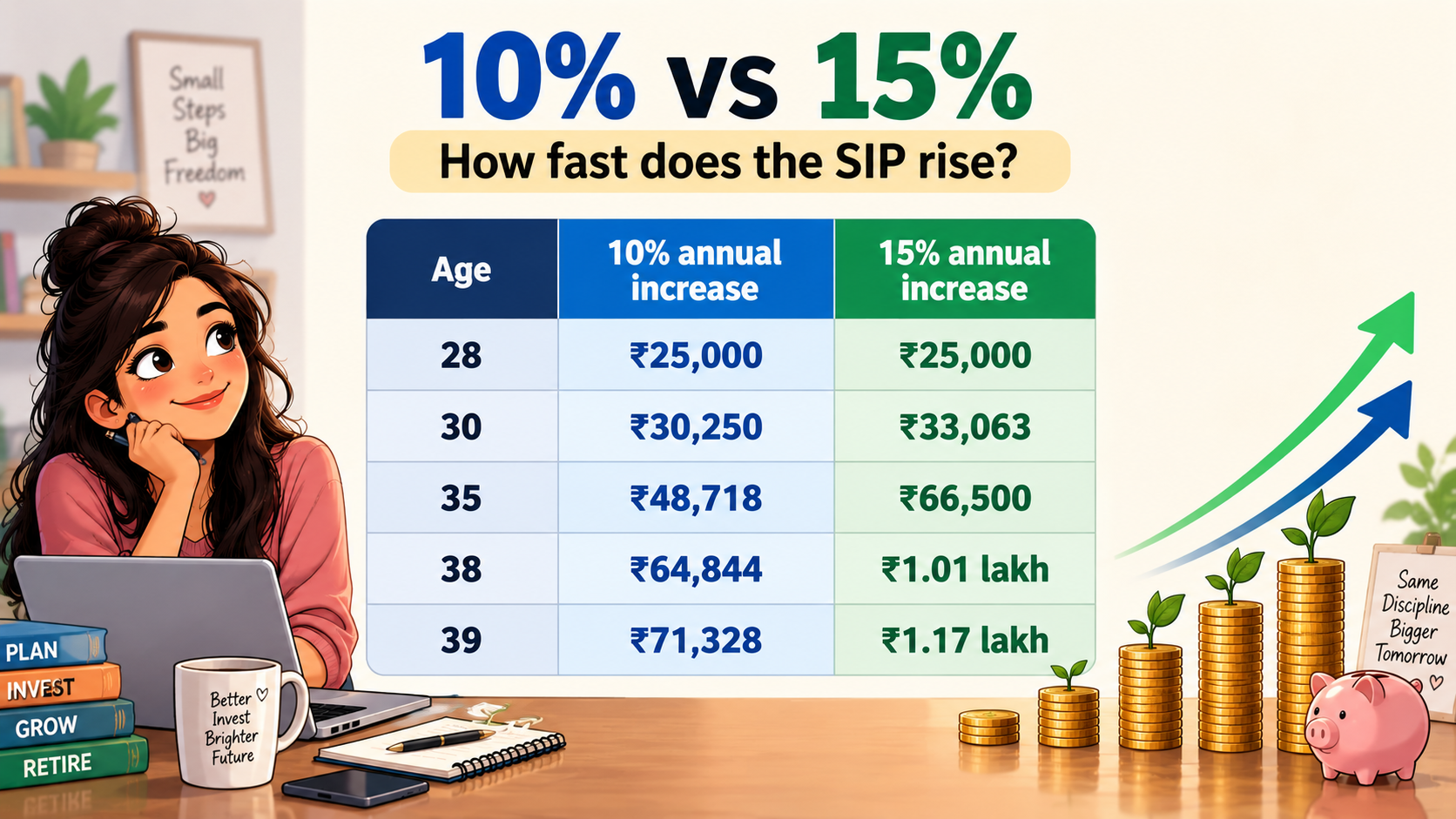
What if I try 15% annual increase?
ChatGPT also showed me what a 15% SIP step-up would look like.
Starting at Rs 25,000, it would become:
- Age 28: Rs 25,000
- Age 29: Rs 28,750
- Age 30: Rs 33,063
- Age 31: Rs 38,021
- Age 32: Rs 43,724
- Age 33: Rs 50,283
- Age 34: Rs 57,826
- Age 35: Rs 66,500
- Age 36: Rs 76,475
- Age 37: Rs 87,946
- Age 38: Rs 1.01 lakh
- Age 39: Rs 1.17 lakh
That becomes unrealistic unless my salary rises sharply.
So ChatGPT did not recommend blindly following the 15% schedule. Instead, it kept 10% as the floor and suggested using a large portion of salary increments to push the investment higher.
I don’t need 15 mutual funds
ChatGPT also warned me against overcomplicating the portfolio.
It suggested six core components:
- Nifty 50 Index Fund — 30–35%: The core Indian equity holding.
- Flexi-cap fund — 15–20%: Active management and exposure across market capitalisations.
- Nifty Next 50 — 10–15%: A higher-growth satellite allocation.
- Mid-cap — around 10%: Additional growth potential, but controlled.
- International equity — 10%: Geographical diversification.
- Debt/EPF/PPF — 20%: Stability and a retirement buffer.
ChatGPT also said I did not need individual stocks to achieve this goal.
The idea was to keep the portfolio diversified without making it unnecessarily difficult to monitor.
What should I do with my Rs 14,000 rent?
I also wanted ChatGPT to factor in my Noida rent. The AI did not tell me to immediately move to a cheaper house. Rs 14,000 is around 20% of my current take-home salary, which ChatGPT considered manageable.
Its advice was to keep housing around 20–25% of take-home income as my salary grows.
More importantly, it warned me against lifestyle inflation.
If my salary eventually reaches Rs 1 lakh, I shouldn’t automatically decide that I can now afford a Rs 25,000–Rs 30,000 rental.
The additional income should increasingly flow towards investments. That made my rent less of a problem than what I do with future salary increases.
Emergency fund comes before the Rs 2 crore race
There was another bucket outside the main investment portfolio – the emergency fund.
ChatGPT suggested keeping six to nine months of essential expenses in an emergency fund and eventually targeting nine to 12 months, given that I want to retire unusually early.
The money could be kept in a savings account, sweep FD, short-term FD or another low-risk liquid instrument.
It should remain separate from the Rs 2 crore FIRE portfolio and act as a buffer against unexpected expenses, rather than being counted towards the retirement target.
The plan doesn’t assume I will earn 12% every year
One of the most important warnings from ChatGPT was about return assumptions.
For the Rs 2 crore calculations, it used roughly 12% annualised returns as a planning assumption.
But it specifically warned me not to expect: 12%, 12%, 12%, 12%…
Markets could instead deliver something like: +18%, -12%, +25%, +7%, -8%, +20%…
The advice was to plan around 10–12%, rather than constructing my retirement around 15–18% annual returns.
What happens if the market crashes at 31?
ChatGPT gave me another hypothetical scenario. Suppose I am 31 and my portfolio has reached Rs 40 lakh. Then a major market correction reduces it to Rs 30 lakh.
The AI’s advice was not to stop investing. My SIP should continue. Falling prices would mean I am buying more units with the same monthly contribution.
The dangerous cycle would be: Market falls → stop SIP → wait for recovery → restart after market rises.
With a 12-year horizon, ChatGPT said I have enough time to go through multiple market cycles.
But at 35, strategy should start changing
ChatGPT suggested that around age 35, I should stop thinking only about growth.
- At 28: The priority is growth.
- At 35: It becomes growth plus protection.
- At 38: It becomes protection.
- At 40: The focus shifts to retirement sustainability.
That means moving some accumulated equity gains into debt as retirement gets closer instead of waiting until my 40th birthday to suddenly make the portfolio safer.
What should Rs 2 crore look like at 40?
ChatGPT specifically warned against putting the entire Rs 2 crore into an FD when I retire.
Instead, it suggested that a possible retirement portfolio could look roughly like:
- Rs 1.1–Rs 1.2 crore — equity
- Rs 80–Rs 90 lakh — debt, cash and safer assets
The exact allocation would depend on my expenses and risk tolerance at age 40.
But reaching Rs 2 crore would not automatically mean I could afford to stop working.
ChatGPT gave me three financial buckets
The strategy eventually came down to three separate buckets.
Bucket 1 — Safety
Emergency fund and insurance.
This protects me from emergencies without forcing me to sell investments.
Bucket 2 — Rs 2 crore FIRE portfolio
Equity and debt investments designed to build my age-40 corpus.
Bucket 3 — Short-term goals
Travel, gadgets, family expenses and other near-term needs.
The purpose is to make sure I don’t raid the retirement portfolio every time I need money for something else.
The 10 rules ChatGPT wants me to follow
The AI’s plan came with a fairly strict rulebook for the next 12 years:
- Invest immediately after receiving my salary.
- Treat a 10% annual SIP increase as the minimum.
- Put 50–70% of every salary increment into investments.
- Invest 70% of bonuses or windfalls.
- Don’t increase rent and lifestyle in proportion to salary.
- Don’t use F&O or intraday trading to accelerate FIRE.
- Don’t chase small-cap “multibaggers”.
- Rebalance once a year.
- Never stop SIPs simply because the market is falling.
- Recalculate my FIRE number every year.
The advice was less about finding one perfect investment and more about building a financial system that becomes stronger as my income rises.
My 12-year roadmap
ChatGPT then reduced the plan into milestones:
- Age 28: Invest Rs 25,000 a month, build the emergency fund and start the diversified portfolio.
- Age 29: Take the salary increment and push investment above Rs 27,500 wherever possible.
- Age 30: Aim for roughly Rs 30,000–Rs 33,000 a month.
- Age 32: Reach around Rs 35,000–Rs 40,000 and start seriously tracking the Rs 2 crore target against the actual corpus.
- Age 35: Aim for Rs 45,000–Rs 55,000-plus while moving from pure accumulation towards accumulation plus protection.
- Age 37: Target Rs 55,000–Rs 70,000-plus and start building the retirement cash/debt bucket.
- Age 38–39: Focus increasingly on protecting accumulated gains.
- Age 40: Target Rs 2 crore-plus, but don’t automatically retire.
The final test would be whether my actual age-40 expenses could be supported by the corpus.
Disclaimer: Financial Express Digital does not encourage or discourage readers from investing in any particular mutual fund, stock, asset class or financial product. The investment strategy described in this story was generated by ChatGPT for a specific individual’s circumstances and is presented as an experiment, not as personalised financial advice. The return assumptions and corpus projections mentioned in the story are illustrative and are not guaranteed. Readers should assess their own financial goals, risk tolerance, tax position and circumstances and consult a qualified financial adviser before making investment decisions. Financial Express Digital is not responsible for any investment decisions or financial outcomes based on this experiment.
Every financial journey has a turning point. What’s yours?
Financial Express is launching a new series highlighting real experiences with money, investments, and the taxman. Did a sudden tax rule catch you off guard? Did a piece of financial advice change your life? Your story could provide invaluable, practical lessons for thousands of fellow taxpayers. Share your experience with us. We respect your privacy: no stories will be featured without a direct conversation and your full consent. Thank you.