




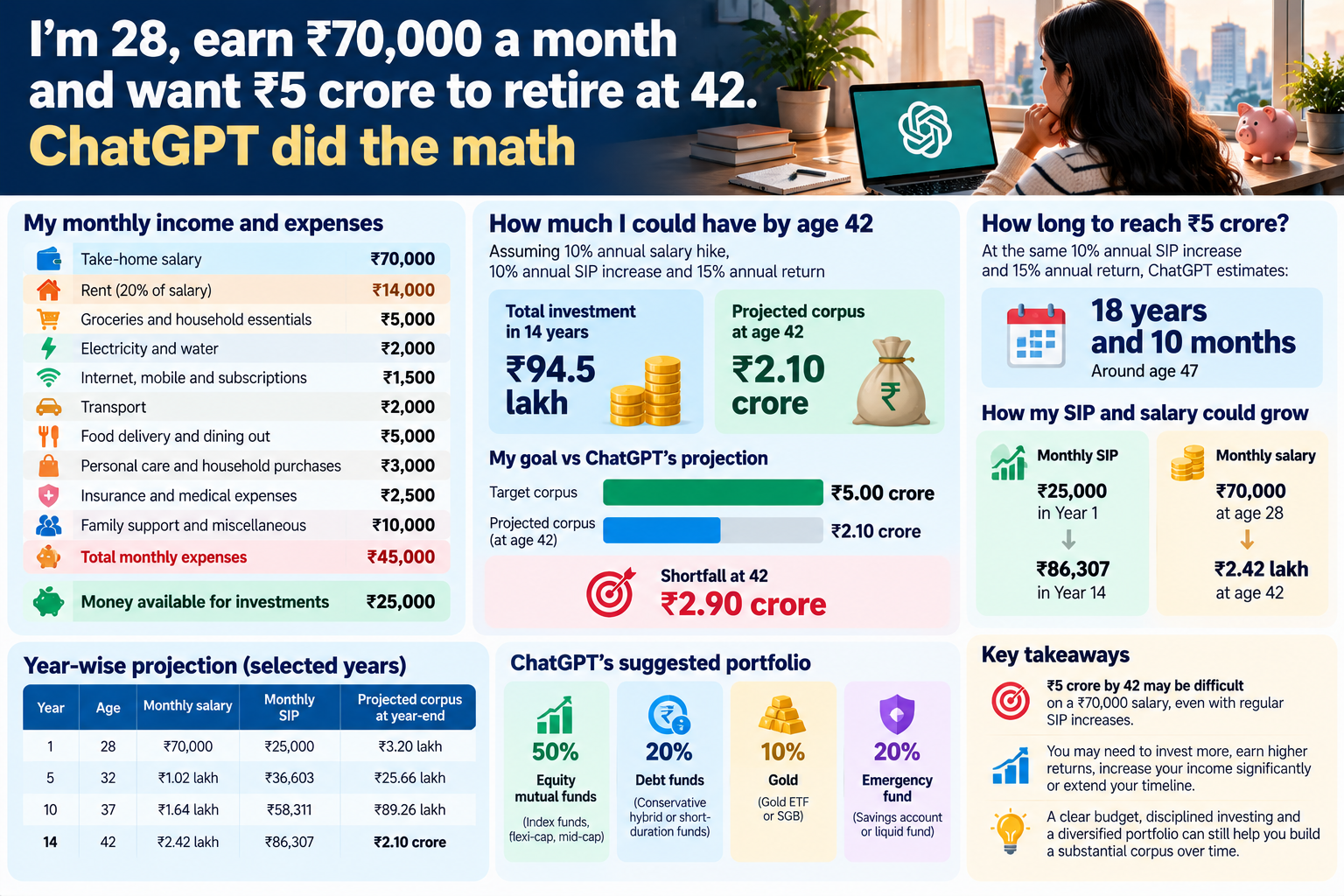
I am 28, earn Rs 70,000 a month in take-home pay and live in Noida, where Rs 14,000, or 20% of my salary, goes towards rent. I expect my salary to rise by at least 10% every year and plan to increase my investments by the same percentage as my annual salary hike. But can I accumulate Rs 5 crore in 14 years and stop working completely at 42?
I had earlier asked ChatGPT how I could build a Rs 2 crore retirement corpus by the age of 40 on a monthly take-home salary of Rs 70,000. This time, I raised the target to Rs 5 crore and extended my retirement timeline to age 42.
ChatGPT’s projection suggested that I could reach the Rs 5 crore milestone in approximately 18 years and 10 months, around age 47, assuming a 10% annual increase in my SIP and a 15% effective annual return. That is roughly five years beyond my target retirement age of 42
I wanted a diversified investment plan that accounted for my salary, rent, expected annual hikes and the need to increase investments over time. I also wanted to know how much I would need to invest every month, how to allocate my portfolio and whether my expected salary growth would be enough to help me reach the Rs 5 crore target by the age 42.
I gave ChatGPT this prompt: “Act as an expert financial advisor and investment planner in India. I am a 28-year-old salaried professional earning Rs 70,000 per month in take-home pay. I want to retire with a corpus of Rs 5 crore at 42. I am expecting a minimum double-digit salary hike every year. I also want to increase my investment portfolio by at least 10%. I am expecting a 15% annual return from investments. I stay in Noida and 20% of my salary goes in paying the rent. Suggest me a diversified investment plan to reach the target corpus.”
How much of my Rs 70,000 salary can I invest?
Before deciding how much to invest, I needed to calculate how much money remained after my monthly expenses.
My budget is as follows:
| Monthly income and expenses | Amount |
| Take-home salary | Rs 70,000 |
| Rent | Rs 14,000 |
| Groceries and household essentials | Rs 5,000 |
| Electricity and water | Rs 2,000 |
| Internet, mobile and subscriptions | Rs 1,500 |
| Transport | Rs 2,000 |
| Food delivery and dining out | Rs 5,000 |
| Personal care and household purchases | Rs 3,000 |
| Insurance and medical expenses | Rs 2,500 |
| Family support and miscellaneous expenses | Rs 10,000 |
| Total monthly expenses | Rs 45,000 |
| Money available before investments | Rs 25,000 |
My listed expenses total Rs 45,000, leaving Rs 25,000 a month for investments and any additional financial needs. This represents about 35.7% of my take-home salary.
ChatGPT’s plan starts with a Rs 25,000 monthly systematic investment plan (SIP), or a fixed amount invested regularly. This would mean investing the entire amount left after the listed expenses.
How do salary hikes and SIP increases affect the corpus?
ChatGPT’s plan uses three assumptions throughout the calculation – my salary increases by 10% annually, my monthly SIP increases by 10% annually, and my investments earn an assumed 15% effective annual return.
The salary hike and SIP increase are planned assumptions. The investment return is uncertain and is not a promise of what the market or any mutual fund will deliver.
Under this model, my monthly SIP would rise from Rs 25,000 in the first year to about Rs 86,307 in the 14th year. My salary would also rise from Rs 70,000 to about Rs 2.42 lakh a month at the beginning of that final investment year.
The projection assumes month-end SIP contributions over 14 full years, no existing investment corpus and a 10% increase in the SIP every 12 months.
| Investment year | Age at start | Monthly salary | Monthly SIP | Projected corpus at year-end |
| Year 1 | 28 | Rs 70,000 | Rs 25,000 | Rs 3.20 lakh |
| Year 2 | 29 | Rs 77,000 | Rs 27,500 | Rs 7.20 lakh |
| Year 3 | 30 | Rs 84,700 | Rs 30,250 | Rs 12.16 lakh |
| Year 4 | 31 | Rs 93,170 | Rs 33,275 | Rs 18.24 lakh |
| Year 5 | 32 | Rs 1.02 lakh | Rs 36,603 | Rs 25.66 lakh |
| Year 6 | 33 | Rs 1.13 lakh | Rs 40,263 | Rs 34.67 lakh |
| Year 7 | 34 | Rs 1.24 lakh | Rs 44,289 | Rs 45.54 lakh |
| Year 8 | 35 | Rs 1.36 lakh | Rs 48,718 | Rs 58.61 lakh |
| Year 9 | 36 | Rs 1.50 lakh | Rs 53,590 | Rs 74.26 lakh |
| Year 10 | 37 | Rs 1.65 lakh | Rs 58,949 | Rs 92.95 lakh |
| Year 11 | 38 | Rs 1.82 lakh | Rs 64,844 | Rs 1.15 crore |
| Year 12 | 39 | Rs 2.00 lakh | Rs 71,328 | Rs 1.42 crore |
| Year 13 | 40 | Rs 2.20 lakh | Rs 78,461 | Rs 1.73 crore |
| Year 14 | 41 | Rs 2.42 lakh | Rs 86,307 | Rs 2.10 crore |
The figures are rounded. The corpus is measured at the end of each investment year. The final row represents the end of 14 full years, around age 42.
If my salary increases by 10% every year for 14 consecutive years, it could reach approximately Rs 2.66 lakh a month after the 14th annual increase. The corresponding monthly SIP would rise to about Rs 94,937. That higher SIP would apply after the 14-year projection and is not included in the corpus calculated at age 42.
How much could I have at 42?
Under the revised assumptions, my projected corpus at age 42 would be approximately Rs 2.10 crore, against my target of Rs 5 crore.
| Investment metric | Projection |
| Starting monthly SIP | Rs 25,000 |
| Annual SIP increase | 10% |
| Assumed effective annual return | 15% |
| Total contributions over 14 years | Rs 83.92 lakh |
| Projected corpus at age 42 | Rs 2.10 crore |
| Retirement corpus target | Rs 5 crore |
| Shortfall at age 42 | Rs 2.90 crore |
Of the projected Rs 2.10 crore, about Rs 83.92 lakh would come from my contributions, while approximately Rs 1.26 crore would represent investment growth under the assumed return.
The calculation shows that increasing my SIP in line with my salary hikes would help me build a substantial corpus. But it would not, by itself, take me to Rs 5 crore by age 42 under these assumptions.
To close the gap, I would need some combination of additional investments, existing assets, extra income or a longer investment horizon. I should not rely on earning unusually high returns to make up the difference.
How many years will it take to reach Rs 5 crore?
ChatGPT also calculated how long it could take to reach the Rs 5 crore milestone if I continued with the same investment schedule beyond age 42.
Starting with a Rs 25,000 monthly SIP, increasing it by 10% every year and assuming a constant 15% effective annual return, the projection reaches Rs 5 crore in approximately 18 years and 10 months.
| Milestone | Projection |
| Current age | 28 |
| Starting monthly SIP | Rs 25,000 |
| Annual SIP increase | 10% |
| Assumed effective annual return | 15% |
| Time to reach Rs 5 crore | About 18 years and 10 months |
| Approximate age at the milestone | 47 |
| Monthly SIP in the final investment year | About Rs 1.39 lakh |
This means I could reach the Rs 5 crore target around age 47 under the model, roughly five years later than my original retirement goal. The monthly SIP would have risen substantially by then because of the annual increases.
The estimate assumes uninterrupted monthly investments, a 10% SIP step-up every 12 months and a constant 15% effective annual return. It excludes taxes, fees, withdrawals and any existing investments. Actual market returns will fluctuate, so the milestone could arrive earlier or later.
The 15% return assumption is an optimistic planning scenario, not a guaranteed outcome. If returns are lower, the corpus could take longer to reach Rs 5 crore. If I want to retire at 42, I would need to improve the plan through additional contributions, other sources of wealth or a change in the retirement target or timeline.
How should I use my salary increments?
ChatGPT recommended linking my investment increases to salary growth rather than allowing spending to rise automatically with income.
The plan would involve increasing my SIP by 10% every year, provided I receive the expected salary hike and can afford the higher contribution. I could also direct part of any bonus or additional income towards investments after accounting for debt repayments, family commitments and upcoming expenses.

Another approach would be to invest a portion of each salary increment beyond the planned SIP increase. This could help accelerate the accumulation of wealth, although the additional amount would depend on how much my expenses rise.
Automation could help maintain discipline. Scheduling the SIP shortly after salary credit would reduce the temptation to spend money earmarked for investments.
I would also need to review my progress annually. If my salary increases by less than expected, expenses rise sharply or investment returns disappoint, I would need to recalculate the plan instead of assuming the original projection would hold.
How should I diversify my investment portfolio?
ChatGPT recommended spreading the Rs 25,000 monthly investment across equity mutual funds, debt and gold. The proposed allocation is designed to balance long-term growth with diversification, rather than depending entirely on equities.
| Investment | Allocation | Monthly investment |
| Nifty 50 index mutual fund | 50% | Rs 12,500 |
| Flexi-cap mutual fund | 16% | Rs 4,000 |
| Mid-cap mutual fund | 9% | Rs 2,250 |
| Debt and fixed income | 20% | Rs 5,000 |
| Gold ETF or suitable gold investment | 5% | Rs 1,250 |
| Total | 100% | Rs 25,000 |
A Nifty 50 index fund provides exposure to large Indian companies. A flexi-cap fund can invest across companies of different market capitalisations, while a mid-cap fund offers exposure to mid-sized companies, which can experience greater volatility.
Gold can diversify a portfolio beyond equities and bonds, although its price can also fall. Debt and fixed-income investments may provide greater stability, depending on the instruments selected.
ChatGPT recommended keeping the portfolio simple and avoiding funds with substantially overlapping holdings. The allocation should be reviewed periodically and adjusted to show my financial circumstances, risk tolerance and retirement timeline. The proposed mix is an illustration, not a guarantee of a 15% return.
Why do I need an emergency fund before investing aggressively?
An unexpected medical bill, job loss or major expense could force me to sell investments during a market downturn. ChatGPT recommended maintaining emergency savings equivalent to six to nine months of expenses.
Based on my current monthly expenses of Rs 45,000, that would mean an emergency fund of approximately Rs 2.7 lakh to Rs 4.05 lakh. This money should remain separate from the retirement portfolio and be held in accessible, relatively low-risk instruments.
Appropriate health insurance and term life insurance should also be considered, particularly if anyone depends on my income.
The investment plan is only sustainable if I can continue contributing through unexpected expenses without repeatedly withdrawing money from the retirement corpus.
Will Rs 5 crore be enough to retire at 42?
Building a Rs 5 crore corpus is only one part of early retirement planning. The amount must also support my living expenses for several decades without a regular salary.
Inflation will reduce the purchasing power of the target. Assuming annual inflation of 6%, Rs 5 crore received 14 years from now would have purchasing power equivalent to approximately Rs 2.22 crore today. To match the purchasing power of Rs 5 crore today, the future target would be around Rs 11.3 crore.
The amount I would need at retirement would also depend on housing costs, healthcare, family responsibilities, taxes and the lifestyle I want to maintain.
For illustration, an initial withdrawal of 3% from a Rs 5 crore corpus would amount to Rs 15 lakh a year, or Rs 1.25 lakh a month before taxes. A 4% withdrawal would amount to Rs 20 lakh a year, or about Rs 1.67 lakh a month. These are arithmetic illustrations, not guaranteed safe withdrawal rates.
Retiring at 42 could mean funding 45 to 50 years of expenses or longer. Market declines, rising living costs and poor investment returns early in retirement could increase the risk of running out of money.
I would therefore need to estimate my retirement spending, review the portfolio regularly and gradually protect the money required for the first few years after leaving work.
Disclaimer: This article is based on an experiment with an AI tool and is intended for informational purposes only. Financial Express Digital neither encourages nor discourages the use of AI tools for personal financial planning. AI-generated suggestions may not be suitable for everyone and should not be treated as financial advice. Readers should assess their own financial circumstances and consult a qualified financial professional before making investment or financial decisions.
Every financial journey has a turning point. What’s yours?
Financial Express is launching a new series highlighting real experiences with money, investments, and the taxman. Did a sudden tax rule catch you off guard? Did a piece of financial advice change your life? Your story could provide invaluable, practical lessons for thousands of fellow taxpayers. Share your experience with us. We respect your privacy: no stories will be featured without a direct conversation and your full consent. Thank you.