




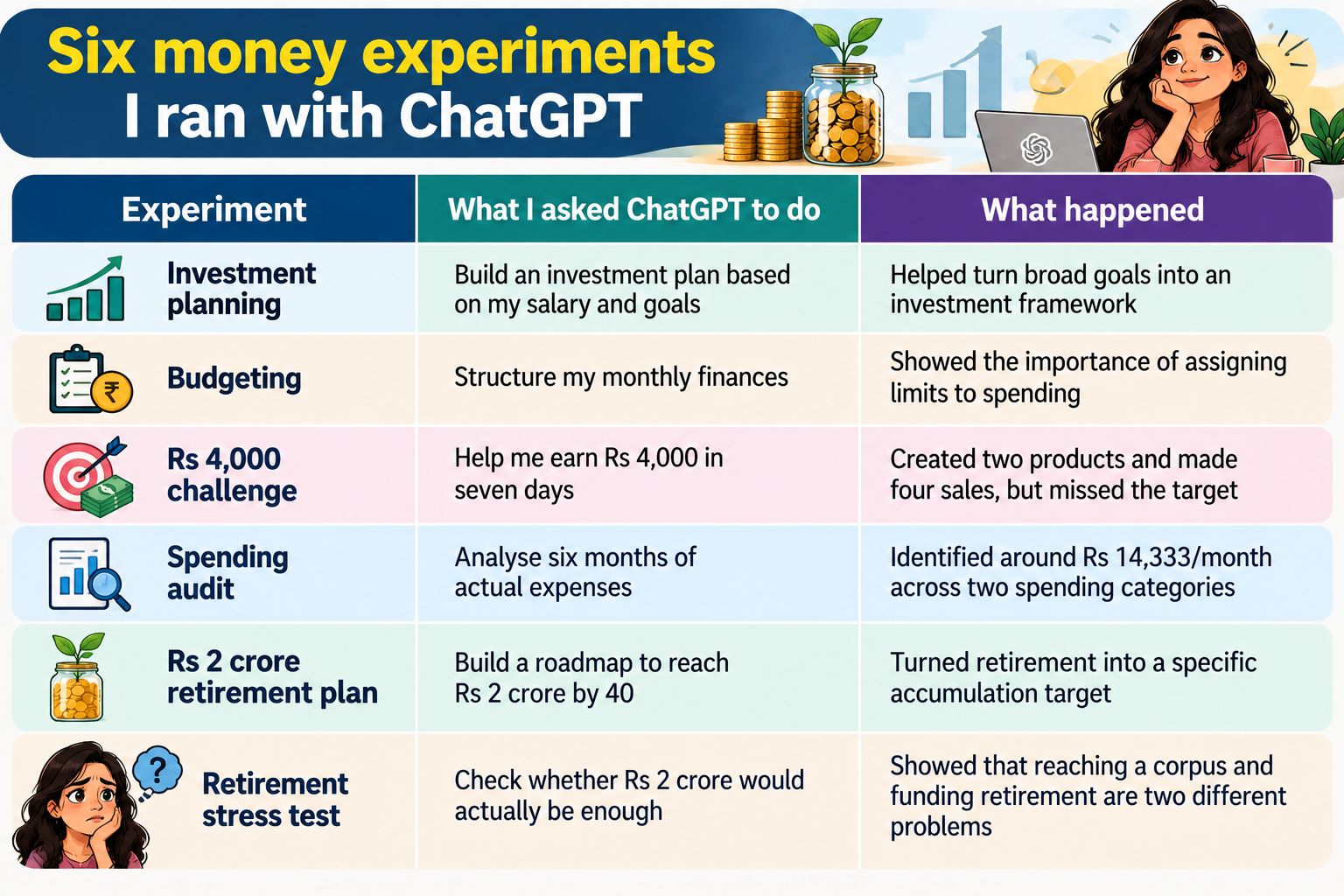
Over the past two months, I used ChatGPT to test different parts of my personal finances. I asked it to analyse my Rs 70,000 salary, find spending mistakes and help me make Rs 4,000 in seven days. I also used it to test whether a Rs 2 crore retirement corpus would actually be enough.
The experiments showed me that some of my biggest money problems were not individual expenses, but patterns I had not noticed.
In one experiment, I gave ChatGPT six months of my actual spending and asked it to identify financial mistakes rather than simply list unnecessary expenses. It found around Rs 7,000 a month in miscellaneous UPI spending and another Rs 7,333 on food delivery and dining out. Together, the two categories added up to about Rs 14,333 a month, or nearly Rs 1.72 lakh a year.
In another experiment, I asked ChatGPT to help me make Rs 4,000 in seven days. I created two digital products and made four sales, but still did not reach my Rs 4,000 target.
I also asked it to build an investment plan based on my income and goals, and later tested whether the Rs 2 crore retirement corpus I had previously planned for could actually fund my life if I stopped working at 40.
The experiments did not produce one perfect financial answer. Instead, they helped me identify where my assumptions were wrong, where my money was going and where an AI-generated plan could work on paper but behave differently in real life.
Here are the 10 money lessons I took away from the six experiments:
- My Rs 14,333 monthly spending pattern showed me why a budget needs limits
In one of my six experiments, I gave ChatGPT six months of my actual spending history and asked it to analyse where I was making financial mistakes. I did not want it to simply identify unnecessary expenses. I wanted it to find recurring spending patterns and suggest better alternatives.
The analysis identified two categories that stood out:
| Spending category | Approx. monthly amount |
| Miscellaneous UPI spending | Rs 7,000 |
| Food delivery + dining out | Rs 7,333 |
| Total | Rs 14,333 |
At first glance, neither category looked particularly alarming. A few hundred rupees spent through UPI here and there did not feel like a major financial decision. Similarly, ordering food or eating out occasionally did not seem problematic.
But looking at the combined monthly pattern changed the picture. Rs 14,333 a month works out to nearly Rs 1.72 lakh a year.
The spending audit also made me look differently at the money left after my monthly expenses. In another experiment, I asked ChatGPT to look at my salary and expenses and help me understand how much I could realistically save and invest.
At one point, my average monthly spending was around Rs 56,716 against my Rs 70,000 salary. That left an apparent surplus of Rs 13,284. But my regular SIP contribution was only around Rs 3,000.
What my monthly numbers looked like
| Particulars | Amount |
| Monthly salary | Rs 70,000 |
| Average monthly spending | Rs 56,716 |
| Apparent surplus | Rs 13,284 |
| Regular SIP | Nearly Rs 3,000 |
This showed me two sides of the same problem. I was spending money in small amounts without always noticing the monthly pattern, while the money left after expenses was not automatically becoming savings.
Before these experiments, I also associated budgeting with cutting expenses and giving up things I enjoyed. But ChatGPT’s approach was different. Instead of telling me to stop eating out completely, it suggested putting a fixed limit on discretionary spending.
That changes the question from “Can I afford to eat out today?” to “How much of my monthly dining budget have I already used?”
ChatGPT also suggested reversing the order in which I handle my salary:
Salary → savings/investments → fixed expenses → planned spending → discretionary spending
rather than:
Salary → expenses → whatever is left gets saved.
The difference sounds small, but it changes saving from something I do with leftover money into something I do first.
The experiment made me realise that a financial problem does not always appear as one large purchase. It can be a series of small transactions repeated every month. At the same time, a monthly surplus is useful only if I actually direct it towards a financial goal.
My takeaway: A sustainable budget is not necessarily about spending as little as possible. It is about identifying recurring spending patterns, setting limits for discretionary expenses and directing the money left over towards specific financial goals.
2. I was asking what to invest in before asking what I was investing for
In one of my experiments, I asked ChatGPT to build an investment plan based on my salary, financial commitments and long-term goals. The exercise made me realise that I was starting with investment products before clearly defining what the money was meant to achieve.
My initial instinct was to think about investment products – mutual funds, equity, debt and other options.
But the plan became more useful when I gave ChatGPT information about my income, financial commitments, goals, investment experience and time horizon.
Instead of beginning with a product, the process began with the purpose of the money.
That changed the question from: “Which mutual fund should I buy?” to: “What is this money for, when will I need it and how much risk can I afford to take?”
For example, money that I may need in the near term cannot be treated in exactly the same way as money meant for a goal several decades away.
The experiment made me realise that an investment product is only one part of an investment decision. The goal, time horizon and risk involved have to come first.
My takeaway: Start with the financial goal, not the investment product.
3. I don’t need perfect investment plan if I cannot follow it consistently
Another takeaway from the investment experiment was the importance of consistency. When I told ChatGPT that I was a beginner and had limited knowledge about stocks and mutual funds, the plan had to be practical enough for me to understand and follow.
That made me question my own tendency to look for the “best” investment rather than a system I could maintain.
For a salaried investor, regular investing and increasing contributions as income grows can be easier to execute than constantly trying to identify the next high-performing investment.
The point was not that a particular investment strategy is automatically right for everyone. It was that a complicated strategy is of little use if I cannot understand or follow it.
My takeaway: I would rather have a financial system I can follow for years than constantly change my investments looking for a perfect answer.
4. Reaching Rs 2 crore is not the same as having enough money to retire
This was probably the biggest change in my thinking. In an earlier experiment, I had asked ChatGPT to build a roadmap to accumulate Rs 2 crore by age 40.
The entire exercise focused on one question: How do I reach Rs 2 crore?
In the next experiment, I asked a different question: What happens after I reach Rs 2 crore?
I assumed I would retire at 40, which means the corpus would potentially have to support me for several decades without an active salary.
I also gave ChatGPT my current rent of Rs 14,000 a month, with an assumed 10% annual increase, along with 6% general inflation.
The result made me realise that a retirement target cannot be judged simply by whether the number sounds large.
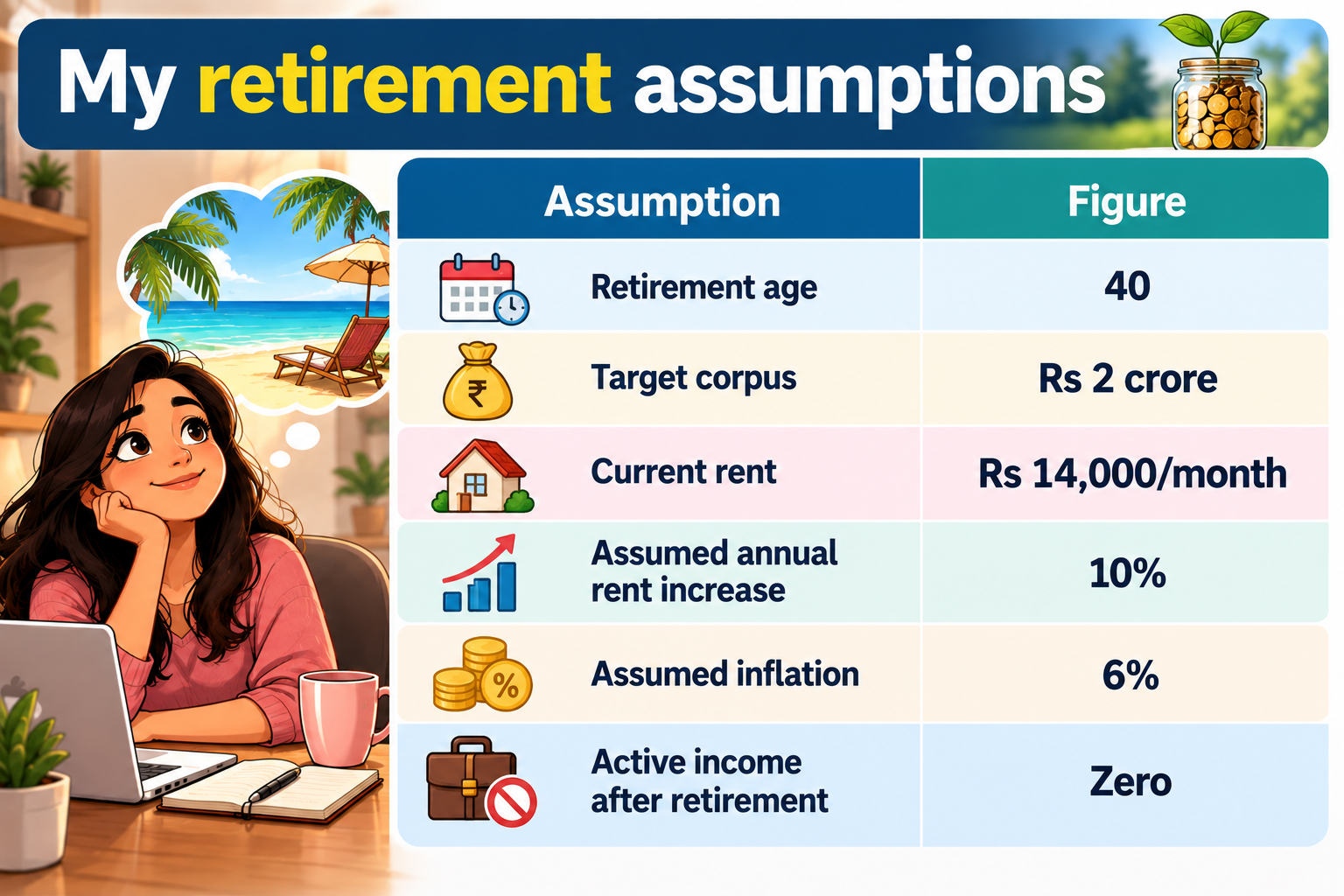
Under the assumptions used in the experiment, rent could become a very large expense over the following decades.
The important point was not the exact future rent number. It was that inflation and rising expenses can change the meaning of a retirement corpus over time.
I had been treating Rs 2 crore as the destination. The experiment made me ask whether it was actually enough to fund the journey after retirement.
My takeaway: A financial target is not a magic number. It needs to be stress-tested against inflation, expenses, longevity and unexpected costs.
5. My Rs 4,000 side-hustle target looked much easier on paper
In one experiment, I asked ChatGPT to help me make Rs 4,000 in just seven days. I followed its suggestions, created digital products and tried to sell them, which allowed me to compare the AI-generated plan with what actually happened.
The seven-day earning experiment gave me a completely different lesson. ChatGPT created a plan around digital products and suggested what I could create, how I could price the products and how I could approach potential customers.
The plan looked logical. But the real results were different.
My seven-day challenge
| Target | Actual result |
| Income target | Rs 4,000 |
| Time available | 7 days |
| Digital products created | 2 |
| Sales | 4 |
| Rs 4,000 target achieved? | No |
I did create products and make sales, but I did not reach the original Rs 4,000 target. Creating a product was something I could control. Getting customers to buy it was not.
My takeaway: A plan can tell me what actions to take, but it cannot guarantee the market response.
6. I realised I was sometimes measuring activity instead of results
The Rs 4,000 experiment also exposed another problem. Initially, I could look at my progress and say: I created two products. That sounds like progress.
But my actual goal was not to create two products. It was to make Rs 4,000.
So the relevant question was: How many sales did I make and how much money did I actually earn?
The experiment produced four sales, but the final income still fell short of the target. That made me think about other areas of personal finance.
An investment plan is not the same as actually investing. A budget is not the same as following it.
A retirement target is not the same as having enough money to sustain retirement.
My takeaway: Measure the outcome you actually want, not just the activities that lead towards it.
7. The more numbers I gave ChatGPT, the more useful the analysis became
One pattern appeared across almost all six experiments. Generic questions produced generic answers.
The results became more useful when I gave ChatGPT my actual numbers.
For example, instead of simply asking how to manage money, I could provide:
- Rs 70,000 monthly income
- Actual monthly expenses
- Existing EMIs or debt
- Current investments
- Financial goals
- Investment experience
- Retirement age
- Current rent
- Expected inflation
- Risk tolerance
The spending experiment was particularly clear.
If I had simply asked ChatGPT: “How can I reduce my expenses?”
I would probably have received a list of standard suggestions.
Instead, I gave it six months of actual transactions. That allowed it to identify Rs 14,333 a month across two spending categories that I had not been looking at as one pattern.
The same principle applied to retirement. Giving it Rs 2 crore, age 40, Rs 14,000 rent, 10% rent inflation and 6% general inflation allowed it to test a specific scenario rather than give me generic retirement advice.
But this also exposed an important limitation that better inputs do not guarantee a correct answer. The assumptions and calculations still need to be checked, particularly when the decision involves investments or retirement planning.
My takeaway: The quality of an AI-generated financial analysis depends heavily on the quality and completeness of the information I give it.
8. ChatGPT is a financial co-pilot, not final decision-maker
After six experiments, I don’t think ChatGPT gave me one perfect financial answer.
What it did was make me ask better questions. Where is my money actually going? Why am I not investing my entire apparent surplus? Is Rs 2 crore really enough to retire at 40? What happens if my expenses rise faster than expected? Can a side-hustle plan actually produce customers? What assumption am I making that I haven’t tested?
The numbers from the experiments helped make those questions more concrete.
What ChatGPT helped me do
| Financial problem | What the experiment showed |
| Spending | Nearly Rs 14,333/month across two categories needed attention |
| Saving | Rs 13,284 apparent monthly surplus was not translating into equivalent investments |
| Investing | Goals and time horizon needed to come before product selection |
| Side income | 4 sales did not translate into the Rs 4,000 target |
| Retirement | Rs 2 crore needed to be tested against decades of expenses |
| AI use | Specific personal data produced more useful analysis |
At the same time, the experiments showed where AI stopped being enough.
ChatGPT can analyse the numbers I give it. It can structure a budget, compare scenarios, create calculations and challenge assumptions. But it cannot guarantee investment returns, create customers for a side hustle or know whether an assumption about my future expenses will actually come true.
Disclaimer: This story is based on personal financial experiments conducted by the author using ChatGPT and is intended for informational purposes only. The financial suggestions, calculations and outcomes discussed are based on the assumptions, information and circumstances used in these experiments and should not be treated as personalised investment or financial advice. Readers should independently verify current information and consult a qualified financial adviser before making investment or other financial decisions. Financial Express Digital does not endorse or recommend any specific investment product or strategy discussed in the experiments. Financial Express does not encourage or discourage the use of AI for financial tips or decisions.
Every financial journey has a turning point. What’s yours?
Financial Express is launching a new series highlighting real experiences with money, investments, and the taxman. Did a sudden tax rule catch you off guard? Did a piece of financial advice change your life? Your story could provide invaluable, practical lessons for thousands of fellow taxpayers. Share your experience with us. We respect your privacy: no stories will be featured without a direct conversation and your full consent. Thank you.