




I’m a 28-year-old salaried professional living in a rented house in Delhi-NCR, earning Rs 70,000 a month in hand salary. Over six months, my average monthly spending came to around Rs 56,716. When I put those expenses through ChatGPT, the AI suggested a revised monthly budget of Rs 59,050 – including Rs 10,000 towards investments and another Rs 5,000 towards emergency or short-term savings.
The difference was not simply about spending less. ChatGPT identified three areas where I was losing control of my money – Rs 7,000 a month in miscellaneous UPI spending, around Rs 7,333 on food delivery and dining, and an inconsistent savings habit.
So, for this experiment, I shared my six-month spending history with ChatGPT and asked it not just to identify unnecessary expenses, but also to suggest specific and practical alternatives for each one.
Here’s the prompt I used: “Act like a professional financial planner. Here are 6 months of real expenses (April–September 2026) for a 28-year-old salaried woman professional living in a solo flat in Noida, earning Rs 70,000 per month in hand.”
Here is a breakdown of my average expenditure over the last 6 months across various segments:
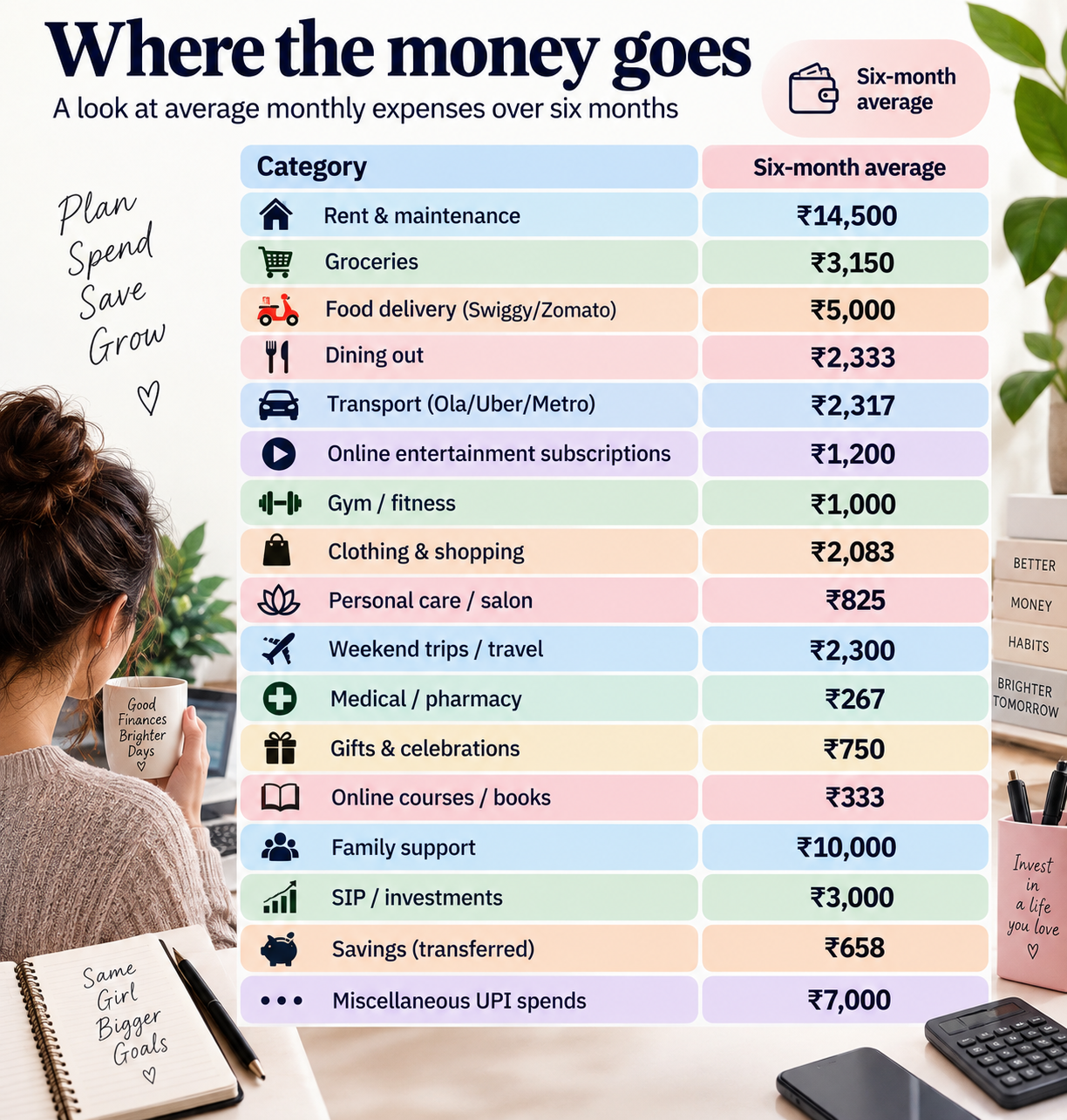
Monthly take-home salary: Rs 70,000
Average monthly spend: Rs 56,716
I added: “Please do the following:
- Identify every financial mistake or inefficiency you see.
- For each mistake, give a specific and actionable alternative available in India
- Prioritise the top 3 changes that would have the biggest impact on my financial outcome
- Be direct. Don’t sugarcoat. Treat this like a financial audit, not a compliment.”
Rs 7,000 ‘miscellaneous UPI spends’ was the main problem
The first thing that caught ChatGPT’s attention was not my rent, shopping or even food delivery. It was the Rs 7,000 sitting under “Miscellaneous UPI spends” every month.
Over six months, that meant Rs 42,000 had gone out of my account under a vague category. ChatGPT called it a “financial black box”. That description made me look at the number differently.
The problem wasn’t necessarily that all Rs 42,000 had been wasted. The bigger problem was that I couldn’t clearly tell what I had spent it on.
ChatGPT suggested eliminating the miscellaneous category for the next 60 days and assigning every UPI transaction to a specific category – food, transport, shopping, entertainment, personal care, social spending, household, medical or travel.
If a payment genuinely didn’t fit anywhere, I could put it under “other”, but the AI suggested capping that at Rs 1,000 a month.
That would potentially bring unexplained spending down from Rs 7,000 to Rs 1,000 a month – freeing up Rs 6,000 a month, or Rs 72,000 a year.
But the bigger issue wasn’t just the potential saving. I realised I had been tracking my spending without really understanding it.
Food was quietly eating up Rs 88,000 a year
The second problem was food. Over six months, I spent an average of Rs 5,000 a month on food delivery and another Rs 2,333 on dining out.
Together, that was roughly Rs 7,333 a month, or about Rs 88,000 a year if the pattern continued. My average grocery bill, meanwhile, was around Rs 3,150 a month.
I had been looking at food delivery and dining out as two separate expenses. ChatGPT combined them and showed me the bigger picture.
It did not tell me to stop ordering food or eating out altogether. Instead, it suggested a combined monthly limit of Rs 4,000 — Rs 2,500 for food delivery and Rs 1,500 for dining out.
That could potentially reduce my spending by about Rs 3,333 a month, or nearly Rs 40,000 a year.
I found this more practical than simply being told to “eat out less”. The idea was not to eliminate something I enjoyed, but to put a ceiling on it.
I wasn’t really following a savings system
The third problem was more fundamental. My six-month savings transfers were Rs 500, Rs 1,800, Rs 600, Rs 750, Rs 300 and nothing in September. That worked out to an average of only around Rs 658 a month.
My SIP was Rs 3,000 every month.
So while I was earning Rs 70,000 and my average monthly spending was Rs 56,716, I wasn’t systematically directing the remaining money towards financial goals. ChatGPT calculated that I had a theoretical monthly surplus of around Rs 13,284, but only Rs 3,000 was explicitly going into investments.
That was probably the most uncomfortable part of the audit.
I had been thinking:
Salary → expenses → save whatever is left
ChatGPT suggested reversing that:
Salary → savings/investments → fixed commitments → planned expenses → discretionary spending
Its recommendation was to automatically move Rs 10,000–Rs 12,000 on salary day towards investments, an emergency fund and short-term goals.
It also suggested gradually increasing my SIP:
Rs 3,000 → Rs 6,000 → Rs 8,000 → Rs 10,000
rather than making one sudden jump.
Other expenses weren’t necessarily the problem
The AI identified several other areas that could be optimised, but it did not treat all of them as major financial mistakes.
My Rs 14,500 rent was described as reasonable, although significant. My Rs 10,000 monthly family support was treated as a fixed financial commitment rather than something I should simply cut.
Groceries averaged around Rs 3,150 a month, which ChatGPT said was not a category worth aggressively attacking while Rs 7,000 was disappearing into unexplained UPI spending.
The same applied to my gym membership. Its six-month average was around Rs 1,000 because I had no charges in two months. The AI’s point was that if I actually use it, cancelling a Rs 1,000 expense while spending Rs 5,000 on food delivery would not make much sense.
Courses and books were even less of a concern, averaging only around Rs 333 a month.
Shopping was different. My spending ranged from Rs 700 to Rs 4,500 a month, so ChatGPT suggested keeping it around Rs 2,000 a month and allowing unused money to roll over for bigger purchases.
For travel, it suggested creating a dedicated Rs 2,500 monthly travel fund instead of treating trips as surprise expenses.
The broader lesson was that not every discretionary expense needs to be eliminated. Some simply need a limit and a plan.
The budget ChatGPT suggested
The AI’s proposed budget made the major changes particularly clear:
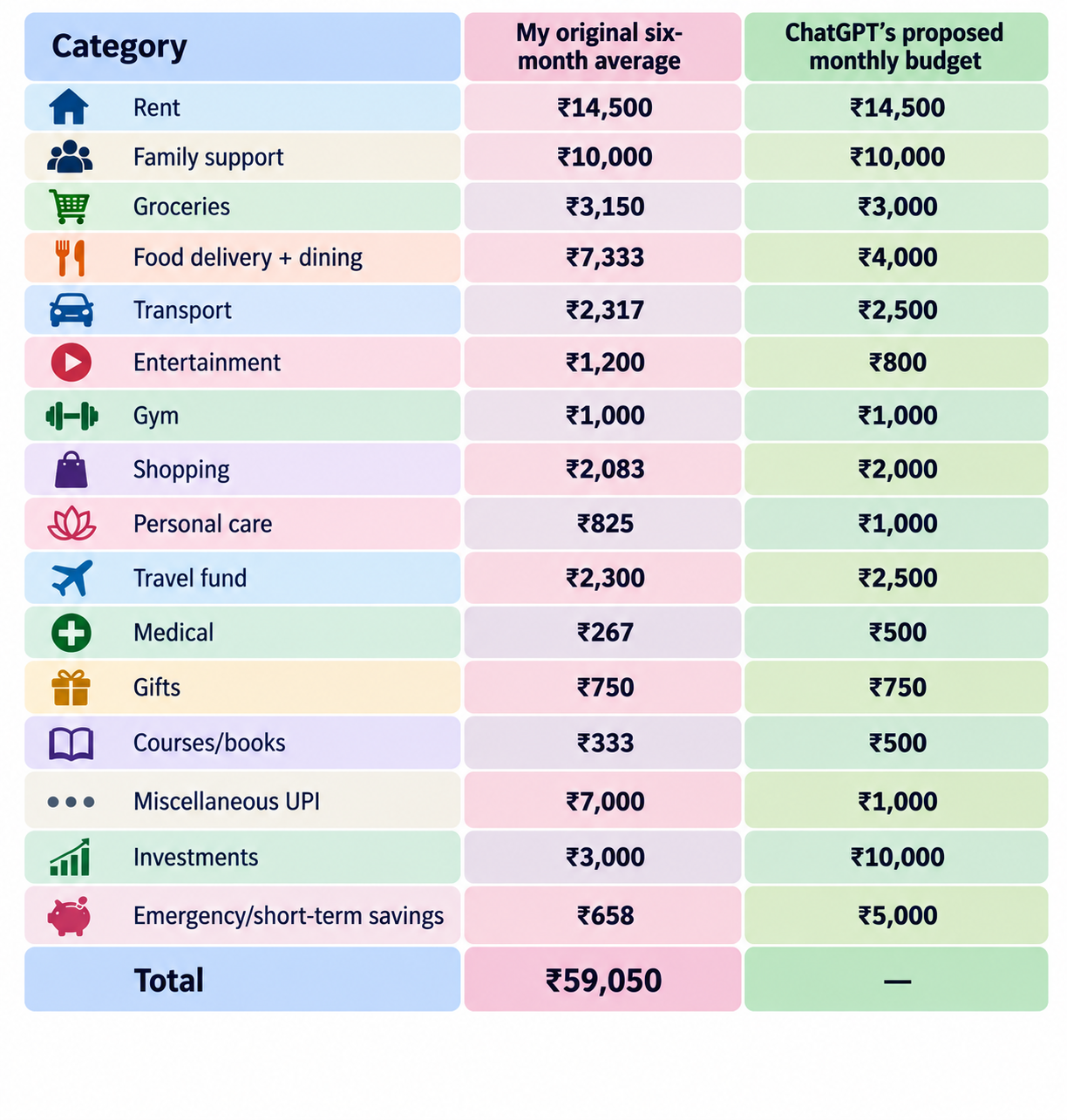
The proposed Rs 59,050 is the sum of the individual targets ChatGPT assigned to each category.
With a monthly take-home salary of Rs 70,000, that leaves Rs 10,950 as additional monthly flexibility.
ChatGPT specifically suggested not immediately assigning every rupee of that Rs 10,950. Instead, for the first two to three months, it recommended using the flexibility to understand where the unexplained UPI spending was actually going and establish the emergency fund. Once spending became more predictable, more of the surplus could be redirected towards investments.
This was also where I noticed an important difference between my old and proposed budgets.
The new budget wasn’t simply about cutting expenses. It was about giving the money a destination before I spent it.
What surprised me most
Before doing this experiment, I already had a feeling that food delivery, dining out and miscellaneous spending could be areas where I was spending more than I needed to. What I didn’t realise was how much I could potentially save simply by putting a limit on these expenses.
The revised budget ChatGPT suggested was actually quite sensible. It did not ask me to completely cut out the things I enjoy or make my lifestyle overly restrictive. Instead, it put reasonable limits on discretionary expenses while increasing the amount going towards savings and investments.
That was probably the biggest takeaway for me.
I had always associated budgeting with cutting back on the things I enjoy. This experiment showed me that it can also be about spending more deliberately, knowing what I can afford, setting a limit and making sure that I am saving enough before I start spending.
That felt much more realistic than trying to eliminate every expense I enjoy.
What I would actually change
If I had to take only three lessons from the six-month audit, they would be simple.
First, know where your money goes. A Rs 7,000 “miscellaneous” category can hide a significant amount of spending. Every major UPI transaction should have a clear purpose.
Second, control food spending rather than simply cutting it. Delivery and dining out can remain part of my lifestyle, but they need a monthly ceiling.
Third, build a proper savings system. Saving whatever is left at the end of the month is not the same as having a savings plan. Money meant for investments and savings should move out of the spending account first.
The biggest lesson from putting ChatGPT to work wasn’t that I needed to stop spending money. It was that I needed to know where my money was going and have a proper system for saving it.
For six months, I had been looking at individual expenses. The AI made me look at the pattern. This showed me that my biggest financial problem wasn’t necessarily one huge expense. It was the combination of unexplained spending, uncontrolled convenience spending and the absence of a system that made saving automatic.
Disclaimer: This experiment is based on the author’s personal financial data and her interaction with ChatGPT. The suggestions generated by AI are not personalised financial advice and should not be treated as a substitute for advice from a qualified financial professional. Readers should assess their own income, expenses, financial goals, risk tolerance and circumstances before making investment or other financial decisions. Financial Express Digital does not encourage or discourage any investment or financial decision based on this experiment and is not responsible for any financial outcomes.
Every financial journey has a turning point. What’s yours?
Financial Express is launching a new series highlighting real experiences with money, investments, and the taxman. Did a sudden tax rule catch you off guard? Did a piece of financial advice change your life? Your story could provide invaluable, practical lessons for thousands of fellow taxpayers. Share your experience with us. We respect your privacy: no stories will be featured without a direct conversation and your full consent. Thank you.