




I gave Claude a challenge to help me save as much money as possible in one week. I asked it to create a realistic “low-spend” plan based on my actual spending habits and then followed the plan for seven days.
I normally spend about Rs 8,300 a week on the discretionary and day-to-day expenses covered by the experiment. Claude created a target of Rs 3,600 for the week, allowing some essential and planned spending.
I did not hit that target. After seven days, I had spent Rs 5,600, which meant I saved Rs 2,700, or about 32.5%, compared with my normal week.
More importantly, the experiment showed me where I was actually overspending and which habits were easiest to change.
I gave Claude my normal spending pattern
Before creating the challenge, I asked Claude to understand how I normally spend money rather than give me a generic no-spend plan.
My prompt was: “For the next 7 days, act as my personal no-spend planner and spending tracker. I want you to create a realistic, practical and measurable seven-day no-spend challenge based on my actual spending habits, obligations and lifestyle.”
I then gave it a seven-step process:
- Interview me before creating a plan.
- Establish my normal weekly spending baseline.
- Design a seven-day no-spend challenge.
- Create clear rules.
- Create a daily plan.
- Create a daily spending tracker.
- Analyse the results after seven days.
Claude asked about my usual spending on food, transport, shopping, subscriptions, entertainment and personal care. It also asked about my fixed obligations, upcoming expenses and the spending habits I was most likely to regret, such as ordering food late at night or taking a cab when running late.
Once I answered those questions, Claude created my “Normal Week Baseline” and estimated that I would normally spend Rs 8,300 over seven days. That became the benchmark for the experiment.
Claude’s low-spend budget
| Category | Normal weekly spend | Claude’s low-spend budget |
| Food | Rs 3,500 | Rs 1,200 |
| Transport | Rs 400 | Rs 350 |
| Shopping/impulse | Rs 1,500 | Rs 0 |
| Subscriptions/digital | Rs 400 | Rs 0 |
| Entertainment | Rs 2,000 | Rs 1,500 |
| Personal care/health | Rs 500 | Rs 0 |
| Flex/unavoidable extras | — | Rs 550 |
| Total | Rs 8,300 | Rs 3,600 |
Claude’s rules were stricter than my normal routine
Claude did not simply tell me to “be disciplined”. It created specific rules around the areas where I was most likely to overspend.
Swiggy, Zomato and quick-commerce purchases were banned. Shopping apps were off-limits, with a 48-hour wishlist suggested instead. I was allowed one planned grocery trip.
For entertainment, Claude set a Rs 1,500 hard limit, including the ticket, travel and food. It suggested eating at home before leaving and avoiding expensive food purchases outside.
For cabs, it told me to leave 15 minutes earlier on workdays. If I still ran late and needed a cab, it had to come from the flex allowance and would count as a slip.
It also suggested a 10-minute pause before any unplanned purchase and removing saved payment methods from food and shopping apps.
What I actually spent during the seven-day challenge
I tracked my spending against the limits Claude had set for each day. The week had three clear overspending days — Days 2, 4 and 7 — while the other four days stayed within their respective limits.
| Day | Date | Food | Transport | Treat/entertainment | Other | Total | Daily cap | |
| Day 1 | Oct 1 | Rs 200 | Rs 0 | Rs 0 | Rs 0 | Rs 200 | Rs 250 | |
| Day 2 | Oct 2 | Rs 150 | Rs 500 | Rs 2,300 | Rs 500 | Rs 3,450 | Rs 1,500 | |
| Day 3 | Oct 3 | Rs 150 | Rs 40 | Rs 0 | Rs 0 | Rs 190 | Rs 1,000 | |
| Day 4 | Oct 4 | Rs 300 | Rs 120 | Rs 0 | Rs 0 | Rs 420 | Rs 100 | |
| Day 5 | Oct 5 | Rs 200 | Rs 40 | Rs 0 | Rs 0 | Rs 240 | Rs 250 | |
| Day 6 | Oct 6 | Rs 0 | Rs 0 | Rs 0 | Rs 0 | Rs 0 | Rs 250 | |
| Day 7 | Oct 7 | Rs 400 | Rs 200 | Rs 500 | Rs 0 | Rs 1,100 | Rs 250 | |
| Total | Rs 1,400 | Rs 900 | Rs 2,800 | Rs 500 | Rs 5,600 | Rs 3,600 |
Day 2 was the biggest setback
The biggest overspend came on Day 2. I spent Rs 3,450 against a Rs 1,500 limit, going Rs 1,950 over the day’s allowance.
The spending included Rs 150 on food, Rs 500 on transport, Rs 2,300 on a planned treat and another Rs 500 on shopping.
The shopping purchase was particularly revealing because shopping was one of the categories Claude had asked me to avoid during the challenge.
I also took the Rs 500 cab because I was running late, despite Claude’s instruction to leave 15 minutes earlier.
Days 4 and 7 were the other slips
Day 4 was supposed to be my zero-spend day, with a Rs 100 cap. Instead, I spent Rs 420 — Rs 300 on food and Rs 120 on transport.
On the final day, I spent Rs 1,100 against a Rs 250 limit. This included Rs 400 on food, Rs 200 on transport and a Rs 500 week-off treat.
The other four days were much better. I spent Rs 200 on Day 1, Rs 190 on Day 3 and Rs 240 on Day 5. On Day 6, I recorded zero discretionary spending.
Food was my biggest saving
Food turned out to be the category where I made the biggest improvement.
My normal weekly food spending was Rs 3,500, while I spent Rs 1,400 during the low-spend week. That meant I saved Rs 2,100 on food alone.
I also did not order from Swiggy or Zomato during the experiment. Once I removed food delivery from my routine, this was one category where the low-spend plan was relatively easy to follow.
Transport went in the opposite direction. I normally spent around Rs 400, but my actual spending reached Rs 900, mainly because of cabs.
Treat and entertainment spending was also much higher than Claude’s target – Rs 2,800 against Rs 1,500.
So, how much did I actually save?
By the end of seven days, I had spent Rs 5,600, compared with my normal weekly spending of Rs 8,300.
That meant I saved Rs 2,700, or about 32.5%, compared with my normal week.
I missed Claude’s Rs 3,600 low-spend target by Rs 2,000, but I still cut my discretionary spending by nearly one-third.
My fixed bills during the week were Rs 31,600, which were excluded from the low-spend calculation. Including those fixed payments, my total cash outflow for the week was Rs 37,200.
If I could repeat the full Rs 2,700 saving every week, that would work out to roughly Rs 1.40 lakh over a year. However, that is only a simple annualisation of one week’s result and should not be treated as a guaranteed saving.
What the experiment showed me
Looking at the categories separately gave me a better picture of where my money was going.
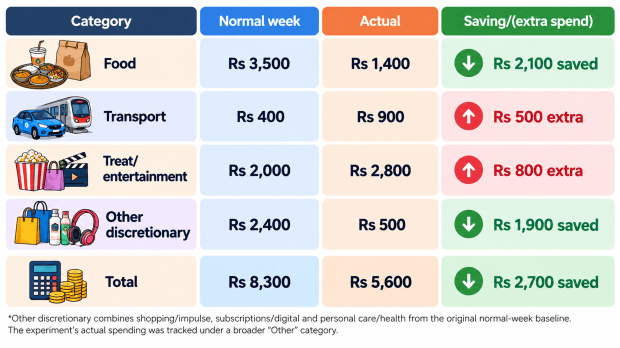
The numbers showed me that food was not necessarily my biggest problem. Once I removed delivery orders from the equation, I could bring that category down sharply.
The bigger leaks were treat spending and convenience spending, particularly cabs when I was running late.
My take: Claude’s low-spend plan worked, but only partially
Claude set a weekly low-spend target of Rs 3,600, while I ended up spending Rs 5,600. I therefore missed the target by Rs 2,000, but still reduced my discretionary spending by Rs 2,700, or 32.5%, compared with my normal week.
The experiment showed me that I could cut spending without completely changing my routine. Food was the easiest category to control, while cabs when I was running late and spending on treats and outings were harder to manage.
If I repeat the challenge, I would not simply make the rules stricter. For entertainment, I would decide the spending limit before leaving home and use a fixed UPI amount. For cabs, I would build Claude’s 15-minute buffer into my routine so that being late does not automatically become a spending decision.
The experiment also changed how I look at AI-based budgeting. Claude could analyse my spending, set limits, create a daily plan and identify where I went over budget. But it could not stop me from taking a cab when I was late or spending Rs 500 on shopping when I was supposed to avoid it.
Claude helped me save Rs 2,700 in seven days, but it could not make me stick to its Rs 3,600 target. For me, that was still a useful result because I came away with a clearer picture of where my money was actually leaking.
If I do this experiment again, I won’t ask AI simply to help me spend less. I’ll ask it to help me fix the specific habits that make me spend more.
Disclaimer: This article is based on the author’s personal experience and is intended for informational purposes only. Financial Express Digital neither encourages nor discourages the use of AI tools for personal financial planning. AI-generated suggestions may not be suitable for everyone and should not be treated as financial advice. Readers should assess their own financial circumstances and consult a qualified financial professional before making financial decisions.
Every financial journey has a turning point. What’s yours?
Financial Express is launching a new series highlighting real experiences with money, investments, and the taxman. Did a sudden tax rule catch you off guard? Did a piece of financial advice change your life? Your story could provide invaluable, practical lessons for thousands of fellow taxpayers. Share your experience with us. We respect your privacy: no stories will be featured without a direct conversation and your full consent. Thank you.