



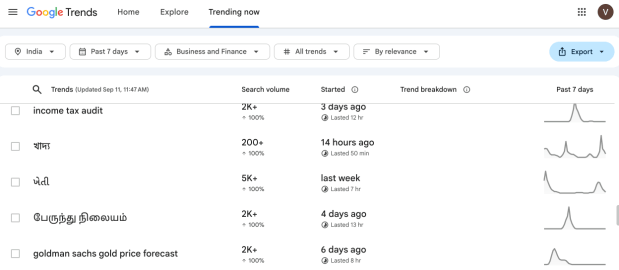
The term “income tax audit” has been trending on Google Trends for the past three days, indicating that people are actively looking for all the details about it. This is because of the approaching due date for taxpayers who must keep books of account and get them audited.
As per the Income Tax Department, an income tax audit involves an expression of the tax auditor’s opinion on the truth and correctness of certain factual details furnished by the assessee to the Income Tax Authorities to enable correct assessment of total income, considering all allowances, deductions, losses, adjustments, exemptions, etc., and determination of tax thereon.
Who is required for an income tax audit?
The following individuals are mandated under section 44AB to have their accounts audited as per the Income Tax Department:
A business owner whose annual sales, turnover, or gross receipts surpass Rs. 1 crore. A person who chooses the presumptive taxation scheme under section 44AD and whose total sales or turnover is below Rs. 2 crore is exempt from this provision. When cash receipts and payments made during the year do not surpass 5% of total receipts or payments, the threshold limit for an individual operating a business is increased to Rs. 10 crore from Rs 1 crore.
An income tax audit is required for professionals whose gross receipts for the year exceed Rs. 50 lakhs.
An assessee’s income exceeds the amount that is not subject to taxation if he declares profit for any prior year in accordance with section 44AD and minimises profit for any one of the five assessment years that are relevant to the subsequent previous year below the profit determined in accordance with section 44AD.
An eligible assessee cannot choose to return to the presumptive taxation scheme for five assessment years after opting out of it during the aforementioned period.
A person who fits for section 44ADA’s presumptive taxation scheme but asserts that his income exceeds the amount that is not subject to taxation and that his profit or gains for that profession are less than those determined under the presumptive taxation scheme.
A person who is eligible to use the presumptive taxation scheme of section 44AE but proposes that the profits or gains for that business are less than those determined utilising the presumptive taxation scheme of section 44AE.
A person who is eligible to opt for the taxation scheme stipulated under section 44BB or section 44BBB but states that the profits or gains for such business are lower than the profits and gains computed as per the taxation scheme of these sections.
Forms required
The process for reporting and providing the Report of Audit of Accounts required by Section 44AB is outlined in Rule 6G. A chartered accountant must audit a taxpayer’s books of accounts, and the audit reports must be filed using Forms 3CA and 3CB.
According to the Income Tax Department, Form 3CA-3CD is applicable when a person is required by law to have their accounts audited, while Form 3CB-3CD is applicable when a person is not one of the aforementioned individuals, meaning that their accounts are not required to be audited under any other law.
Tax audit due date: Know the deadline
For Assessment Year (AY) 2026–27, the due date for furnishing the tax audit report is one month before the due date for filing the income tax return (ITR). Accordingly, the tax audit report is due by September 30, 2026, while the ITR filing deadline is October 31, 2026. In transfer pricing cases, where the ITR filing deadline is November 30, 2026, the tax audit report is due by October 31, 2026.
The tax audit report must be electronically filed with the Income Tax Department by the chartered accountant. Once the report has been filed, the taxpayer is required to review and approve it through their e-filing account on the Income Tax Department’s portal.
Taxpayers should note that failure to get the accounts audited or furnish the audit report by the due date can attract a penalty under Section 271B. The penalty will be 0.5% of the total sales, turnover or gross receipts, as applicable, for the relevant previous year. However, the penalty is capped at Rs 1.5 lakh, meaning the lower of 0.5% of the relevant sales, turnover or gross receipts and Rs 1.5 lakh would apply.
Section 273B provides relief where the taxpayer can establish that there was a reasonable cause for the failure. The Income Tax Department’s guidance specifically states that no penalty under Section 271B would be imposed if the taxpayer proves reasonable cause for the delay or failure.
Disclaimer: This article is for informational purposes only and should not be construed as investment, financial, tax, or legal advice. Any illustrations, examples, or return projections used in this article are for explanatory purposes only and do not guarantee actual investment outcomes. The views and opinions expressed by experts quoted in this article are their own and should not be considered investment recommendations. Readers should consult a qualified professional before making any financial decisions.
Every financial journey has a turning point. What’s yours?
Financial Express is launching a new series highlighting real experiences with money, investments, and the taxman. Did a sudden tax rule catch you off guard? Did a piece of financial advice change your life? Your story could provide invaluable, practical lessons for thousands of fellow taxpayers. Share your experience with us. We respect your privacy: no stories will be featured without a direct conversation and your full consent. Thank you.