


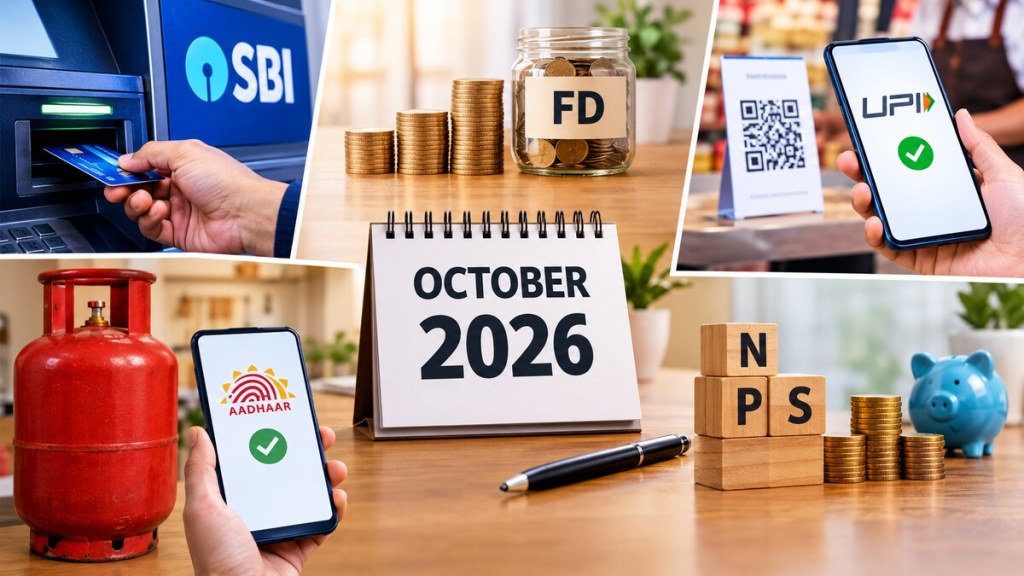

Starting next month, October 2026, several rules are changing, ranging from ATM rules to Aadhaar authentication to get Liquefied Petroleum Gas (LPG) subsidy.
As October is around the corner, getting familiar with the changes in advance will benefit the common citizens of the country and prevent them from losing benefits.
Here are the key financial and personal finance rule changes coming into effect from October 1, 2026, and what they mean for your money.
Fixed deposit rules from October 1
The Reserve Bank of India (RBI) has updated its guidelines on bulk fixed deposit (FD) interest rates.
The RBI’s amendment is essentially about pricing discipline and transparency. There are three changes.
First, banks can now price bulk deposits of Rs 3 crore and above differently depending on how ‘sticky’ that money is under the Liquidity Coverage Ratio framework, so stable funding gets rewarded.
Second, banks must publish their bulk deposit rates by 10 am every working day and honour those published rates.
Third, similar deposits booked on the same day must get the same rate across all branches. That ends the practice of branch-level or negotiated pricing.
The RBI states that all commercial, small finance, regional rural, payment, local area, and urban cooperative banks will be subject to the revised FD standards as of October 1, 2026.
SBI new ATM rules from October 1
State Bank of India (SBI) has announced new service charges for holders of Basic Savings Deposit Accounts (BSBDs).
These fees will take effect from October 1st, 2026. Beginning on the effective date, customers with SBI Basic Savings Deposit Accounts (BSBDs) who utilize the bank’s cash withdrawal service will be entitled to 4 free cash withdrawals each month. However, there will be charges of Rs 15 + GST (per transaction) for cash withdrawals made after the first four free withdrawals in a month.
Cash withdrawals from branches, ATMs, micro-ATMs, AEPS, and CASH@POS are all considered cash withdrawal transactions. The customer’s digital transfer transactions via UPI, IMPS, NEFT, RTGS, POS, etc. are still free of charge.
New UPI MDR rules
For Person-to-Merchant (P2M) UPI transactions above Rs 2,000, the National Payments Corporation of India (NPCI) has implemented a Merchant Discount Rate (MDR) of 0.4%. The MDR would be limited to Rs 300 per transaction for amounts over Rs 75,000. This implies that the merchant, not you, will be responsible for paying the MDR if you pay them more than Rs 2,000.
Therefore, small-value UPI transactions up to Rs 2,000 will not be subject to the MDR. Customers can continue utilizing UPI applications for all regular, everyday expenses without worrying about the MDR because they won’t be charged for making payments using UPI. Additionally, consumers should be aware that Person-to-Person (P2P) will remain free for both payer and beneficiary. Anyone utilizing UPI to send or receive money to or from another person, including self-transfers, will not be charged.
There are no fees if a customer transfers money to a relative, splits a bill with friends, or makes self-transfers between their own linked bank accounts. According to NPCI, citizens are free to transfer any amount that is allowed on UPI without paying charges.
Mandatory Aadhaar authentication for LPG connection
In order to schedule refills at the regulated Retail Selling Price (RSP) with the applicable subsidy, residential LPG customers will need to have completed Biometric Aadhaar Authentication (BAA) as of October 1, 2026. Customers do not need to repeat Aadhaar Authentication if they have already finished it. Their refills are still available, and customers who have not finished their Aadhaar authentication will be able to book refills at RSP with a subsidy once they complete the mandatory Aadhaar authentication requirement.
Customers who haven’t finished Biometric Aadhaar Authentication can do so during refill delivery by asking the delivery person to complete the process. They can also visit their LPG distributor and finish the process there, or they can finish it themselves from home using OMC mobile apps, such as IndianOil ONE for Indane customers, HelloBPCL for Bharatgas customers, and HP PAY for HP Gas customers.
Subject to local availability with the OMC, consumers who are unable or unwilling to complete the mandatory Aadhaar authentication procedure may still receive LPG in 5 kilogram or 10 kg cylinders at the applicable market price, but without any subsidies.
New NPS charges
The Pension Fund Regulatory and Development Authority (PFRDA) has revised Point of Presence (PoP) fees for all schemes under the National Pension System (NPS) and NPS Lite.
An amount equivalent to Rs. 50/- on a quarterly basis will be deducted through cancellation of units by CRA(s) and payable to PoP in the month subsequent to the quarter in which onboarding is completed, according to PFRDA.
Additionally, it should be noted that subscribers who were onboarded using e-NPS and who subsequently make contributions via e-NPS or D-Remit are not required to pay any PoP charges.
It should be noted that subscribers who were onboarded via a POP and who subsequently make contributions via e-NPS or D-Remit will be responsible for paying the above-mentioned PoP charges.
The Central Recordkeeping Agencies will use this charge structure for charge deductions beginning in Q3 of FY 2026–2027.
Disclaimer: This article is for informational purposes only and should not be construed as investment, financial, tax, or legal advice. Any illustrations, examples, or return projections used in this article are for explanatory purposes only and do not guarantee actual investment outcomes. The views and opinions expressed by experts quoted in this article are their own and should not be considered investment recommendations. Readers should consult a qualified professional before making any financial decisions.
Every financial journey has a turning point. What’s yours?
Financial Express is launching a new series highlighting real experiences with money, investments, and the taxman. Did a sudden tax rule catch you off guard? Did a piece of financial advice change your life? Your story could provide invaluable, practical lessons for thousands of fellow taxpayers. Share your experience with us. We respect your privacy: no stories will be featured without a direct conversation and your full consent. Thank you.