


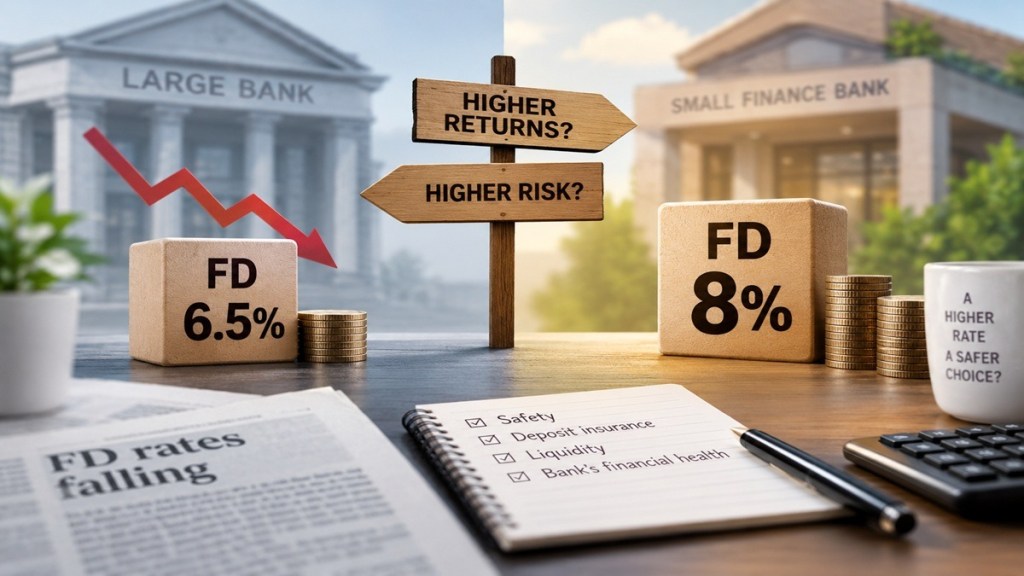

For fixed deposit investors, the direction of rates has changed. After a period of relatively high deposit rates, banks have been cutting what they pay on FDs as the interest rate cycle has turned.
The cuts have been more visible at large banks. Many major banks are now offering around 6% to 7% for several common tenures. But look beyond the biggest names and the picture changes. Some small finance banks are still offering close to 8%, and a few are above it. As of September 9, 2026, here is how the highest rates for general customers compare across the latest rate table.
| Bank | Highest FD Rate* | Tenure |
| Suryoday Small Finance Bank | 8.25% | 5 years |
| Utkarsh Small Finance Bank | 8.10% | 666 days |
| Equitas Small Finance Bank | 8.00% | 3 years and above |
| Jana Small Finance Bank | 8.00% | More than 2 years to 3 years |
| ESAF Small Finance Bank | 8.00% | Not specified |
| SBM Bank India | 7.65% | Not specified |
| DCB Bank | 7.50% | Not specified |
| HDFC Bank | 6.50% | Not specified |
| Axis Bank | 6.50% | Not specified |
| ICICI Bank | 6.50% | Not specified |
| State Bank of India | 6.45% | Not specified |
*Highest rate available for general customers, as per the latest Paisabazaar rate table.
That gap can be hard to ignore. For a depositor with Rs 10 lakh, a 1 percentage point difference in the FD rate means roughly Rs 10,000 more interest in a year before tax. For someone with a much larger corpus, the difference looks even more attractive.
But there is another way to look at it. What exactly are you being paid for when a bank offers you 1 percentage point more? The answer is not as simple as saying that the higher rate means the bank is riskier. But it is also not wise to look at 8% as free extra return. The real decision comes down to the bank’s funding needs, its financial strength, deposit insurance, liquidity and how much money you are willing to keep with one institution.
FD rates have already fallen. How much further can they go?
The first question for an FD investor is whether today’s rates are already close to the bottom. Bank FD rates have already adjusted lower as the interest rate cycle has turned. But there is no single level that all banks will move towards.
Adhil Shetty, CEO of BankBazaar, says deposit rates will depend on individual banks’ funding requirements, liquidity and competition for deposits.
“Rather than trying to predict the lowest possible FD rate, focus on the rate available for the tenure you need and the return you’re comfortable locking in,” he says.
That distinction is important because the next move in FD rates will not depend only on the RBI.
Thomas Stephen, Director and Head, Preferred, Anand Rathi Share and Stock Brokers, says the big banks have already brought FD rates down to roughly 6% to 6.75%, from 7% or more a couple of years ago. He expects rates to broadly move sideways if the RBI remains on hold, with only small cuts here and there.
If there is another 25 to 50 basis point cut in the policy rate, large bank FD rates could drift towards 6% or slightly below over the next few quarters, he says. But Stephen does not expect a sharp fall. Banks still need deposits to fund credit growth. That need can prevent deposit rates from falling too quickly.
For savers, that means waiting for the absolute bottom may not be the best strategy. The more relevant question is whether today’s rate is good enough for the period for which the money can be locked away.
And this is where the nearly 8% FD starts looking tempting.
Why are some small finance banks still paying close to 8%?
The gap between large banks and small finance banks is not accidental. A large bank has a wide customer base and a much bigger pool of relatively low cost deposits. Small finance banks do not have the same advantage.
“SFBs don’t have a big, well-established base of low-cost CASA deposits,” says Stephen. They also cannot rely as easily on large corporate deposits or wholesale funding at cheap rates.
So term deposits become more important for them. That means they may need to offer a higher rate to attract and retain depositors.
There is another side to the equation. Small finance banks tend to have loan books with greater exposure to microfinance, small businesses and retail borrowers. These loans can generate higher yields than the more diversified and secured loan books of large banks. That gives these banks some room to pay more for deposits.
Stephen describes the higher FD rate as the cost of building a stronger deposit franchise and funding growth from a smaller base.
A higher rate does not automatically mean that a bank is taking more risk. It could simply mean that the bank has to compete harder for deposits.
Shetty makes a similar point. Banks set FD rates based on funding requirements, liquidity and competition, so the difference in rates can reflect different funding strategies and market conditions. The rate tells you what the bank is willing to pay. It does not tell you whether the bank is financially strong enough for you to put a large amount of money there.
The question changes once you cross Rs 5 lakh
This is where the FD decision gets more serious. Bank deposits are covered by DICGC insurance up to ₹5 lakh per depositor per bank, including principal and interest. That protection applies to eligible deposits and is an important safety net for depositors.
For someone keeping Rs 2 lakh or Rs 3 lakh with a bank, the insurance cover is therefore a major part of the safety equation. But consider someone moving Rs 20 lakh from a large bank to a small finance bank because the latter is offering a much higher rate. The entire Rs 20 lakh does not get the same ₹5 lakh insurance protection. That changes the risk calculation.
Stephen argues that the difference matters more above the insured limit. Within the DICGC limit, much of the additional depositor risk is protected by insurance. Above it, the depositor is taking more direct exposure to the bank’s financial strength.
This is why the same 8% FD can make sense for one depositor and not for another. For a small deposit within the insurance limit, the rate premium may be relatively attractive. For a large corpus, the depositor needs to ask a different question: is the extra return enough to justify leaving a larger part of the money exposed to one bank?
Don’t judge the bank by the FD rate alone
Once the deposit goes beyond the insurance limit, the bank’s financial health becomes much more important. There are four broad things worth looking at.
Capital adequacy
Capital gives a bank a cushion to absorb unexpected losses. A stronger capital position provides more comfort because the bank has a larger buffer before losses start putting pressure on its financial position.
Shetty says capital adequacy indicates the cushion available to absorb losses. Stephen also suggests looking at the bank’s CRAR and comparing it with the regulatory requirement rather than simply looking at the FD rate. The important point is not to look at one year’s number in isolation. The trend matters too.
Asset quality
A bank ultimately has to recover the money it lends. This makes gross NPAs, net NPAs, slippages and provisioning important indicators. This becomes particularly relevant for small finance banks because their lending is more concentrated in areas such as microfinance, small businesses and retail lending. A change in the quality of these loans can affect the bank’s earnings and capital.
“A higher FD rate” therefore needs to be looked at alongside the health of the loan book, says Stephen.
Deposit growth and CASA
There is another clue in the way a bank is getting its deposits. A bank that is steadily building deposits has a different funding profile from one that has to rely heavily on expensive term deposits. CASA deposits are generally cheaper for banks than term deposits, so a stronger CASA franchise can support margins.
Stephen says steady deposit growth and a healthy CASA mix can point to a more stable and cost-efficient funding base. Heavy reliance on expensive term deposits can put pressure on margins. This does not mean that a bank with a high FD rate is automatically weak. It means the depositor should understand why the bank is paying that rate.
Liquidity
A bank may have a healthy loan book and adequate capital, but it also needs enough liquidity to meet its obligations. The Liquidity Coverage Ratio and the bank’s reliance on short-term or wholesale funding can provide clues about how it may handle a period of funding stress.
Shetty says liquidity and deposit growth help indicate the bank’s funding position and its ability to meet obligations. For an FD investor, this matters because the biggest concern is not simply the rate being paid today. It is whether the institution remains financially sound throughout the period for which the money is locked in.
The tenure can matter as much as the rate
There is another trap in comparing FD rates. The highest rate is often available only for a particular tenure, as the table above shows. Suryoday’s 8.25% is linked to a five year FD, Utkarsh’s 8.10% is for 666 days, and Equitas’ and Jana’s 8% rates are tied to specific tenures of two to three-plus years.
So the headline rate is not necessarily the rate you will get for the period you actually need. A depositor who may need the money in a year should not lock it away for several years simply because the longer FD pays more.
Shetty says the depositor should look at the FD tenure and premature withdrawal terms along with the headline rate. That is particularly relevant now because the rate difference between institutions may look large, while the difference between two tenures within the same bank can also be significant.
What happens if you need the money early?
An FD is meant to provide certainty, but it does not mean the money is completely liquid. Breaking an FD before maturity can involve a penalty or a lower rate of interest. The exact terms vary across banks.
So a depositor chasing an additional 50 or 100 basis points needs to ask whether the money can genuinely stay invested until maturity. Suppose one bank offers 7% and another offers 8%. If the second bank’s highest rate requires a much longer lock in, the comparison is not really between 7% and 8%. It is between 7% with one set of liquidity conditions and 8% with another.
Stephen’s advice is straightforward: do not lock money away for longer just to earn an additional 50 to 100 basis points if you may need it earlier.
How much extra return is actually worth chasing?
This is where the decision becomes personal. For a Rs 10 lakh FD, an additional 50 basis points works out to roughly Rs 5,000 more interest in a year before tax. A 100 basis point difference works out to roughly Rs 10,000. That may sound meaningful, but FD interest is taxable, so the actual benefit after tax is lower.
The higher rate also needs to be looked at against the amount that is uninsured and the inconvenience of spreading money across multiple institutions. If you are moving a large FD from a well established bank to another institution solely for an extra 50 basis points, the additional income may be relatively small compared with the amount of money being moved.
Stephen says the focus should ultimately be on the incremental post-tax return, rather than the headline rate.
There is a middle path between 6.5% and 8%
The choice does not have to be all or nothing. A depositor does not necessarily have to move the entire FD corpus to the bank offering the highest rate. For example, a person with a large FD corpus can keep the bulk of the money with stronger institutions and use smaller amounts across other banks, while staying within appropriate deposit insurance limits. This reduces concentration risk.
Shetty also recommends diversification for larger deposits rather than putting a large FD corpus into a single small finance bank for a slightly higher rate. That approach also gives the depositor some exposure to higher rates without making the entire FD portfolio dependent on one institution.
So, is chasing 8% worth it?
There is no universal answer. If the additional rate is only 25 or 50 basis points, moving a large amount of money solely for that difference may not be worthwhile. At 75 to 100 basis points, the additional income becomes more meaningful. But the decision should still depend on the bank’s financial strength, the amount invested and how much of the deposit falls outside the insurance limit.
If a bank is offering a rate that is substantially higher than the rest of the market, that should lead to more questions, not simply a rush to book the FD. The higher rate may be a result of the bank’s need to build deposits. It may also reflect a different business model. And in some cases, it can mean that the depositor is being asked to take more balance sheet risk.
Stephen puts it neatly: the higher rate is partly about funding needs and partly about risk, with the distinction becoming more important once deposits move beyond the Rs 5 lakh insurance limit.
Don’t ask only which bank is paying 8%. Ask why it is paying 8%, how much of your money will be protected by insurance, how strong the bank is and whether you can afford to keep the money locked in.
With FD rates already lower than they were a couple of years ago, the temptation to squeeze out the last 50 or 100 basis points will only grow. But for a conservative investor, the highest FD rate is not necessarily the best FD.
The better rate is the one that gives you enough return without asking you to take more risk than the extra income is worth.
Disclaimer: Fixed deposits offer relatively predictable returns, but they are not completely free of risk. Interest rates, premature withdrawal rules, deposit insurance coverage and other terms can vary across banks and financial institutions and may change over time. The FD rates mentioned in this article are based on the rates available as of September 9, 2026, as provided in the source table, and may change after publication. The article is intended for general information and educational purposes only and should not be treated as investment, financial, tax or legal advice.
Depositors should check the latest interest rates, tenure conditions, premature withdrawal penalties, eligibility criteria and other terms directly with the concerned bank or financial institution before investing. DICGC deposit insurance is subject to applicable rules and limits. Depositors should also consider the financial strength of the institution, the amount being deposited, liquidity requirements, tax implications and concentration risk before choosing an FD. Past financial performance or the current financial position of a bank does not guarantee its future financial health. Readers should make investment decisions based on their individual financial circumstances and risk requirements and, where necessary, seek advice from a qualified financial professional.
Every financial journey has a turning point. What’s yours?
Financial Express is launching a new series highlighting real experiences with money, investments, and the taxman. Did a sudden tax rule catch you off guard? Did a piece of financial advice change your life? Your story could provide invaluable, practical lessons for thousands of fellow taxpayers. Share your experience with us. We respect your privacy: no stories will be featured without a direct conversation and your full consent. Thank you.