



By, Maadhav Poddar
India’s equity taxation framework is once again in focus. Questions are being raised around the structure of capital gains tax & securities transaction tax, & whether the current regime requires further rationalisation. The main trade-off is between revenue, simplicity and encouraging long-term investing, writes Maadhav Poddar.
l How has capital gains taxation on equities evolved in India over the years?
INDIA’S TAXATION REGIME for listed equity gains has changed several times over the decades. Initially, after independence, gains from equity holdings were taxed as ordinary income. From the mid-1980s, short-term and long-term gains were separated.
In 2004, the securities transaction tax (STT) was introduced and where STT is paid, long-term equity gains were made exempt and short-term equity gains were made taxable at a concessional rate 10%. The short-term rate rose to 15% in 2008.
Budget 2018 brought back a 10% long-term tax on gains from equity above Rs 1 lakh, with gains before January 31, 2018 grandfathered.
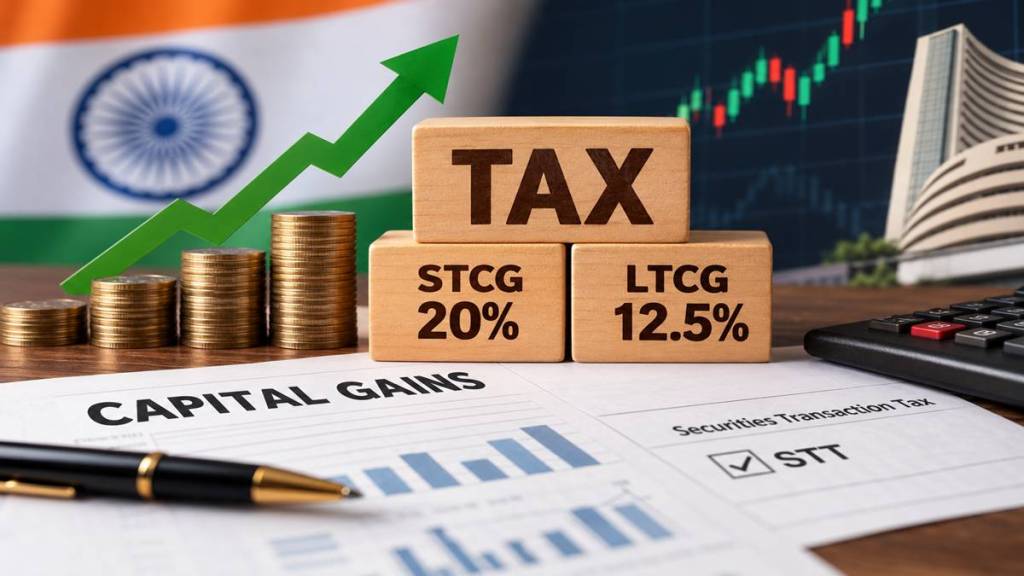
Budget 2024 raised short-term capital gains (STCG) tax to 20% from 15% and long-term capital gains (LTCG) tax to 12.5%, with equity gains up to Rs 1.25 lakh exempted from the latter.
Budget 2026 left these capital gains tax rates unchanged.
l How have changes in LTCG/ STCG rates influenced investors?
TAX CHANGES HAVE mostly caused short-lived reactions rather than lasting shifts in participation. The 2004 exemption plus STT encouraged long-term equity holding and broadened retail interest. The 2018 reintroduction of long-term tax triggered a brief market dip, but grandfathering softened the blow and flows continued. Budget 2024’s higher rates caused a sharp one-day fall, yet participation kept growing. Investors adapted instead: some harvest gains within the `1.25 lakh exemption, hold longer to avoid the 20% short-term rate, or trade derivatives, which are taxed as business income. Surging demat accounts and SIP inflows owe more to digital access, low costs and rising incomes than to tax.
l Has this affected the attractiveness of equity investing?
IT HAS DENTED attractiveness at the margin, but not decisively. The higher rates cut post-tax returns, especially for short-term traders and active investors, and pushed some toward longer holding periods. Foreign investors, already weighing stretched valuations and weaker earnings growth, have also pointed to the tax as one more drag. Even so, domestic participation held up, with systematic investment plan (SIP) inflows and new demat accounts staying strong, since long-term investors face a modest 12.5% rate and a `1.25 lakh exemption. Equity remains tax-competitive against debt funds, gold and property, so valuations, earnings and global flows also matter equally as tax.
l Does levying both raise concerns of double taxation?
LEGALLY THEY CAN coexist, because they tax different things. STT is a levy on the value of each transaction, paid whether you make a profit or a loss. LTCG is a tax on realised gains. India briefly treated them as alternatives: the 2004 STT replaced the long-term gains tax. The 2018 return of LTCG alongside STT is what triggered the double-taxation complaints. Investors argue that STT is not deductible against gains and is paid even on losing trades, so it adds a cost on top of the tax. The government counters that STT is a low-rate tax, easily collected levy on transactions, not on income. Market bodies have repeatedly asked for relief, but STT has stayed, and Budget 2024 raised it on futures and options.
l How could a more investor-friendly LTCG regime look like?
A MORE INVESTOR-FRIENDLY regime would probably combine several features that market participants often propose. First, a higher annual exemption than Rs 1.25 lakh, or a lower tax rate, ideally indexed to inflation so investors are not taxed on purely nominal gains. Second, relief for STT, either as a deduction or a credit against capital gains tax, to ease the double-taxation concern. Third, a tapering rate that falls the longer shares are held. Finally, rate stability, because frequent changes create uncertainty.
l How do other countries levy taxes on capital gains?
CHINA, INDONESIA, PHILIPPINES, South Korea, Malaysia, Taiwan, Thailand and Vietnam do not levy a capital gains tax on non-residents on sale of listed equity. Singapore and Hong Kong exempt gains on shares and rely on deep markets and other revenue, which shows that low or zero taxes can help attract capital. Most countries do not layer a transaction tax like STT on top of a gains tax. Stable, predictable rules matter everywhere. The main trade-off is between revenue, simplicity and encouraging long-term investing.
The writer is tax partner, EY India.