


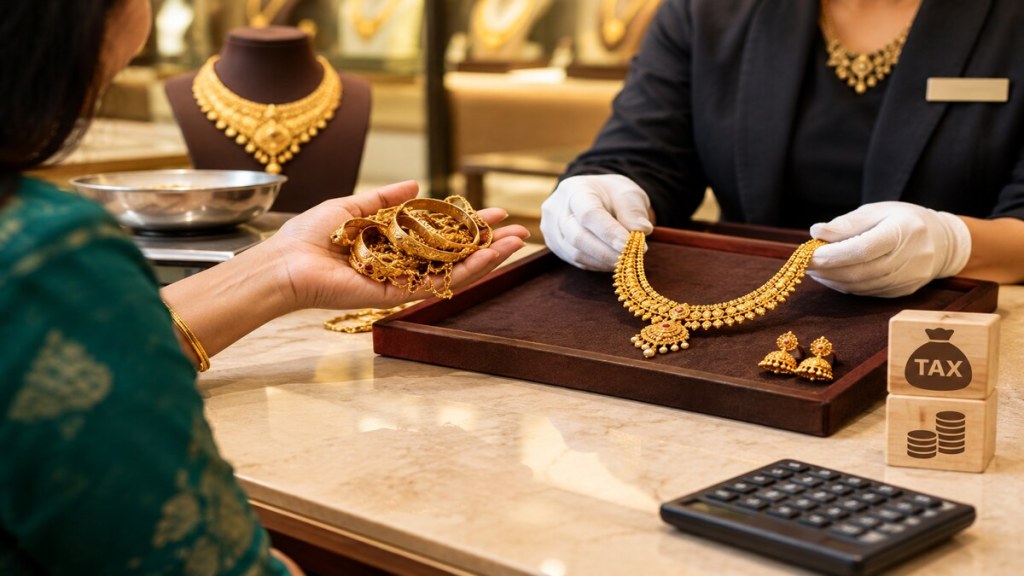

Exchanging your old gold jewellery to buy a new one can be a way to upgrade your ornaments, but the transaction could also have income-tax implications.
Under Section 67 of the Income Tax Act (ITA) 2025, a transaction involving the exchange of old gold jewelry for new jewelry may result in capital gains tax.
This is because exchanging old jewelry with a jeweler and adjusting its value against the purchase price of new ornaments is typically considered a transfer of a capital asset.
Such jewelry’s taxability would vary depending on how long you have held the gold.
You can therefore avoid an unforeseen tax liability when exchanging your old gold jewelry for a new one by being aware of the income-tax regulations, how capital gains are calculated, and what documents you should keep handy.
1. Exchanging old gold jewellery: When does capital gains tax apply?
Under the Income-tax Act (ITA), 1961, an exchange of old gold jewellery for new jewellery is generally regarded as a transfer of a capital asset. Section 2(109) of ITA 2025 specifically includes sale, exchange, or relinquishment of a capital asset within the meaning of transfer.
Accordingly, when old jewellery is exchanged with a jeweller and its value is adjusted against the purchase price of new ornaments, the transaction may give rise to capital gains tax.
Further, gold jewellery is treated as a capital asset, since jewellery is specifically excluded from the definition of “personal effects” under Section 2(22) of ITA 2025.
Accordingly, any profits or gains arising from its transfer are chargeable to tax under the head “Capital Gains” in terms of Section 67 of the ITA 2025. The fact that the entire exchange value is reinvested in new gold jewellery does not by itself provide any exemption from capital gains tax.
The Income-tax Act provides rollover relief only in specified cases, such as reinvestment in a residential house or certain notified assets under specific provisions. No corresponding exemption is available where the consideration from old jewellery is utilized for acquiring new jewellery.
The taxability of such jewellery would depend upon the period. Gold jewellery held for more than 24 months qualifies as a long-term capital asset, while jewellery held for 24 months or less is treated as a short-term capital asset.
Accordingly, the resultant gain would be taxable as either Long-Term Capital Gain (LTCG) or Short-Term Capital Gain (STCG), as the case may be.
Jewellery held for more than 24 months qualifies for long‑term capital gains treatment. Long-term capital gains are taxed at 12.5 percent without indexation, plus applicable surcharge and cess.
Short‑term gains are taxed at the slab rates that apply to the taxpayer. For jewellery acquired before 1 April 2001, taxpayers may opt for its fair market value as on 1 April 2001 instead of the original acquisition cost, subject to Section 90(9) of the Income‑tax Act, 2025.
2. How should taxpayers calculate capital gains on an exchange of old gold jewellery?
An exchange of old gold jewellery for new ornaments may constitute a transfer of the old jewellery for capital gains purposes. Jewellery is treated as a capital asset even when held for personal use.
“Under Section 72 of the Income‑tax Act 2025 capital gains are calculated by deducting the acquisition cost, the cost of any improvement and eligible transfer expenses from the consideration that is received for the jewellery,” said Sarthak Prashar, Director, Global People Solutions, Grant Thornton Bharat.
“The value attributed to the jewellery by the jeweller is generally considered the full value of consideration. Where the consideration cannot be ascertained or determined, the fair market value of the asset on the date of transfer is deemed to be the full value of consideration under Section 80,” Prashar further added.
Accordingly, the gain is generally calculated by deducting eligible transfer expenses, the cost of acquisition and any eligible improvement costs from the value credited for the old jewellery.
“The taxpayer should use the value assigned to the old jewellery in the exchange and retain the invoice showing its weight, purity and credited value. The price of the new ornaments should not be treated as the consideration for the old jewellery and any additional amount paid towards the new ornaments is a separate payment,” said CA (Dr.) Suresh Surana.
For jewellery purchased by the taxpayer, the cost of acquisition is generally its documented purchase cost. For jewellery received by gift or inheritance, the cost is generally based on the previous owner’s cost.
“The previous owner’s holding period is also generally included. Gold jewellery is generally a long-term capital asset if held for more than 24 months. Under the 1961 Act, the general threshold was 36 months for transfers before 23 July 2024 and 24 months for transfers on or after that date,” according to Surana.
It is pertinent to note that Indexation benefit is not available for transfers made on or after 23 July 2024.
Computation of capital gains on exchange of old gold jewellery
| Particulars | Amount (Rs.) |
| Value credited by the jeweller for the old jewellery (A) | XX |
| Less: Eligible expenses directly related to the exchange (B) | (XX) |
| Net consideration (A − B) | XX |
| Less: Cost of acquisition of the old jewellery (C) | (XX) |
| Less: Eligible cost of improvement, if any (D) | (XX) |
| Capital gain/(loss) (A − B − C − D) | XX |
3. Does the tax treatment differ when a jeweller offers an exchange, buys back old jewellery for cash, or adjusts its value against the purchase of new ornaments?
The determination for capital gains tax implications under the Income-tax Act, depends on whether there is a “transfer” of the old jewellery. Since jewellery is a capital asset and transfer includes a sale as well as an exchange, capital gains may arise as follows:
Exchange of Old Jewellery for New Jewellery: Where the taxpayer exchanges old jewellery and the jeweller credits a specified value towards the purchase of new ornaments, the transaction constitutes an exchange, which is expressly covered within the definition of transfer under Section 2(47) of ITA 1961 (corresponding to section 2(109) of ITA 2025).
Buyback of Old Jewellery for Cash: Where the jeweller purchases the old jewellery and pays cash or transfers the amount electronically, the transaction is an outright sale of a capital asset. The capital gain is computed with reference to the sale consideration received and the cost of acquisition of the jewellery.
Adjustment Against Purchase of New Ornaments: In retail transactions, the jeweller may first determine the value of the old jewellery and then adjust that amount against the price of new ornaments, with the customer paying only the balance. Although commercially presented as a purchase discount or exchange adjustment, the transaction is effectively a transfer of the old jewellery coupled with a separate purchase of new jewellery. Accordingly, the value credited or attributed to the old jewellery may still trigger capital gains taxation.
Whether the old jewellery is exchanged for new jewellery, sold back to the jeweller for cash, or adjusted against the purchase price of new ornaments, the old jewellery is considered to have been transferred and any gains arising therefrom are taxable in accordance with provisions of the Act.
However, the position may differ if the transaction is genuinely only a service to melt and remake the owner’s own gold, with no transfer of ownership to the jeweller.
4. Does the tax treatment differ if a customer exchanges inherited or gifted gold jewellery instead of jewellery purchased personally?
The capital gains implications of exchanging jewellery are generally the same whether the customer purchased it or received it as a gift or inheritance. However, the rules for determining its cost and holding period differ.
“For jewellery received by gift, will or inheritance, the cost is generally based on the amount paid by the previous owner, together with any eligible capital improvement costs under section 49(1) of the Income-tax Act, 1961 (corresponding to section 73(1), Table Sl. No. 1, of the Income-tax Act, 2025),” stated Surana.
Also, the period for which the previous owner held the jewellery is generally added to the recipient’s holding period. Gold jewellery is generally treated as a long-term capital asset if the combined holding period exceeds 24 months; otherwise, it is short-term.
“If the previous owner acquired the jewellery before 1 April 2001, the taxpayer may generally choose between the previous owner’s cost and the jewellery’s fair market value on that date. If the previous owner’s cost cannot be established, the fair market value on 1 April 2001 may be considered,” according to Surana.
Customers should retain available purchase records, valuation reports, gift or inheritance documents, and evidence of the previous owner’s acquisition date to support the cost and holding-period calculation.
5. What happens if the new jewellery costs more and the customer pays the difference?
Any additional amount paid when buying jewellery does not lower the capital gains arising from the transfer of the old jewellery.
By sharing an example Prashar said, if old jewellery is valued at Rs 5 lakh and its cost of acquisition is Rs 2 lakh, the capital gain would be Rs 3 lakh, assuming no deductible transfer expenses. This amount stays the same even if the customer buys jewellery worth Rs 7 lakh by adding Rs 2 lakh more.
“Under Section 72 of the Income-tax Act, 2025, the capital gain on the old jewellery is computed independently based on the full value of consideration for its transfer, less the eligible cost of acquisition, cost of improvement and transfer expenses,” Prashar added.
The cost of acquisition of the new jewellery would generally be determined based on the amount payable for acquiring the new jewellery, as reflected in the purchase documentation. This cost of acquisition would be relevant for computing capital gains when the new jewellery is subsequently transferred.
Taxpayers must keep records of both the exchange and the new purchase. The capital gain from the jewellery exchange must be reported in the income-tax return as per the applicable income-tax return form and reporting requirements. The purchase of new jewellery, by itself, does not give rise to capital gains in the hands of the purchaser.
Exchanging old gold? Keep these documents to avoid tax notices
Taxpayers should preserve the purchase invoice and available payment records for the jewellery, along with details identifying its weight, purity and description.
Where the jewellery was received by gift or inheritance, relevant supporting records may include a gift deed, will, probate or succession documents, and any available evidence of the previous owner’s acquisition date and cost.
A valuation report may also support the cost claimed where the law permits fair market value to be used or the previous owner’s cost cannot be established. The law does not prescribe an exhaustive list of documents; these records help substantiate the taxpayer’s position.
The exchange invoice should clearly identify the old jewellery and state its weight, purity and value credited. It should separately record the new ornaments and any additional amount paid. This documentation helps establish the consideration for the old jewellery and distinguish it from the purchase of the new ornaments.
Where the jewellery is held as a capital asset, the taxpayer should report the transaction in Schedule CG (Capital Gains) of the applicable income-tax return. The disclosure should include the relevant acquisition and transfer dates, value credited for the old jewellery, eligible transfer expenses, cost of acquisition, eligible improvement costs, and resulting capital gain or loss.
The gain should be classified as short-term or long-term under the applicable holding-period rules. Schedule CG requires details including the asset, dates, consideration, cost and transfer-related expenses.
Disclaimer: This article is for informational purposes only and should not be construed as investment, financial, tax, or legal advice. Any illustrations, examples, or return projections used in this article are for explanatory purposes only and do not guarantee actual investment outcomes. The views and opinions expressed by experts quoted in this article are their own and should not be considered investment recommendations. Readers should consult a qualified professional before making any financial decisions.
Every financial journey has a turning point. What’s yours?
Financial Express is launching a new series highlighting real experiences with money, investments, and the taxman. Did a sudden tax rule catch you off guard? Did a piece of financial advice change your life? Your story could provide invaluable, practical lessons for thousands of fellow taxpayers. Share your experience with us. We respect your privacy: no stories will be featured without a direct conversation and your full consent. Thank you.