


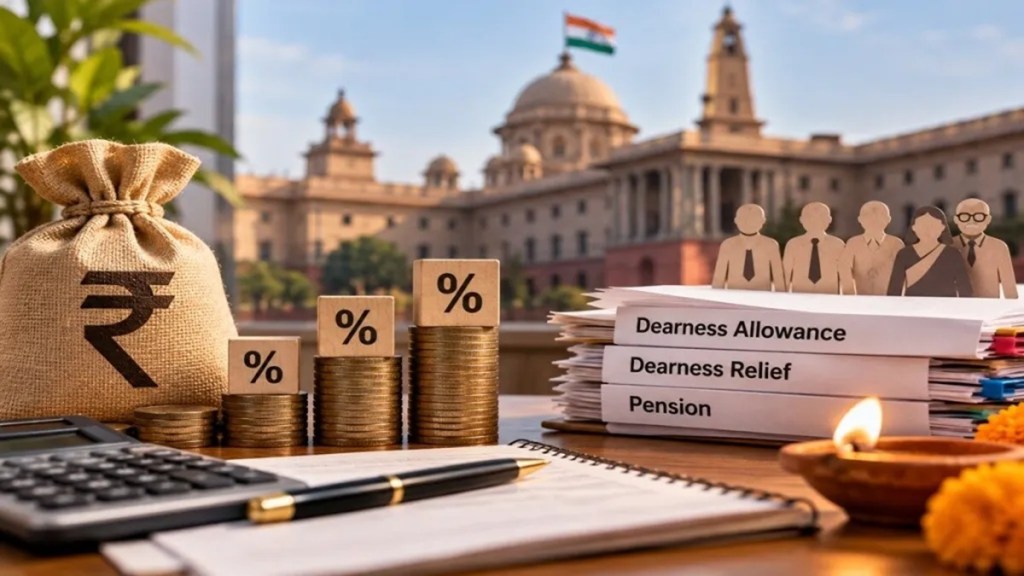

Central government employees and pensioners will have to wait longer for the next Dearness Allowance (DA) increase as the Union Cabinet did not hold its weekly meeting on Wednesday, October 21.
About 1.2 crore central government employees and pensioners have been waiting for the July 2026 DA and Dearness Relief, or DR, revision. The increase is expected to be 3 percentage points, taking DA from the current 60% to 63% of basic pay.
The delay means employees will have to wait for the formal announcement even though the inflation data needed to calculate the revised rate is already available. The government has not announced a confirmed date for the next decision.
DA is generally revised twice a year, with changes taking effect from January 1 and July 1. The allowance is linked to the Consumer Price Index for Industrial Workers, or CPI-IW, and is intended to help employees manage rising living costs.
When will the DA hike be announced?
There is no confirmed date for the next Cabinet decision on the July 2026 DA revision. The government may take up the proposal at a subsequent meeting, but employees should not treat any expected date as official until an announcement is made.
The delay does not necessarily change the effective date of the revision. If the government approves the expected increase with effect from July 1, 2026, eligible employees and pensioners would be entitled to arrears for the period from July until the revised payments begin.
However, the final rate, effective date and payment arrangements will depend on the government’s formal decision.
How much salary are employees waiting for?
The expected 3 percentage point increase would raise DA from 60% to 63% of basic pay.
For an employee drawing basic pay of Rs 18,000, the monthly DA component would increase from Rs 10,800 to Rs 11,340. The additional amount would be Rs 540 per month.
For an employee with basic pay of Rs 35,400, DA would increase from Rs 21,240 to Rs 22,302, giving an additional Rs 1,062 per month.
Pensioners would also benefit through a corresponding increase in Dearness Relief. The actual increase would depend on the pension amount used to calculate DR.
These figures are illustrative. The expected 63% rate will become applicable only after formal approval.
Second DA revision after the 7th Pay Commission’s tenure ended
The pending revision is the second DA hike due in 2026 after the 7th Pay Commission’s term ended on December 31, 2025.
The previous increase took DA from 58% to 60%, effective from January 1, 2026. The next revision is due from July 1, 2026, under the existing DA framework.
The end of the 7th Pay Commission’s term does not automatically stop DA revisions. The existing pay structure continues to apply while the government works on the next pay commission.
8th Pay Commission and employee demands
The 8th Central Pay Commission was constituted in November 2025 and has 18 months from its constitution to submit its recommendations on salaries, pensions and other service benefits.
The Commission is consulting stakeholders, including employee representatives, on the next pay structure. Its scheduled Mumbai consultations on October 22 and 23 are part of this process.
Employee organisations have raised several demands, including higher salaries, pension-related changes and the merger of DA with basic pay. These demands are part of the wider debate on the next pay structure and should not be confused with the pending DA revision.
For now, employees and pensioners are waiting for two separate developments: a formal announcement on the July 2026 DA and DR revision, and further progress on the 8th Pay Commission’s recommendations. Until the government announces a decision, the existing DA rate remains 60%.
Every financial journey has a turning point. What’s yours?
Financial Express is launching a new series highlighting real experiences with money, investments, and the taxman. Did a sudden tax rule catch you off guard? Did a piece of financial advice change your life? Your story could provide invaluable, practical lessons for thousands of fellow taxpayers. Share your experience with us. We respect your privacy: no stories will be featured without a direct conversation and your full consent. Thank you.