


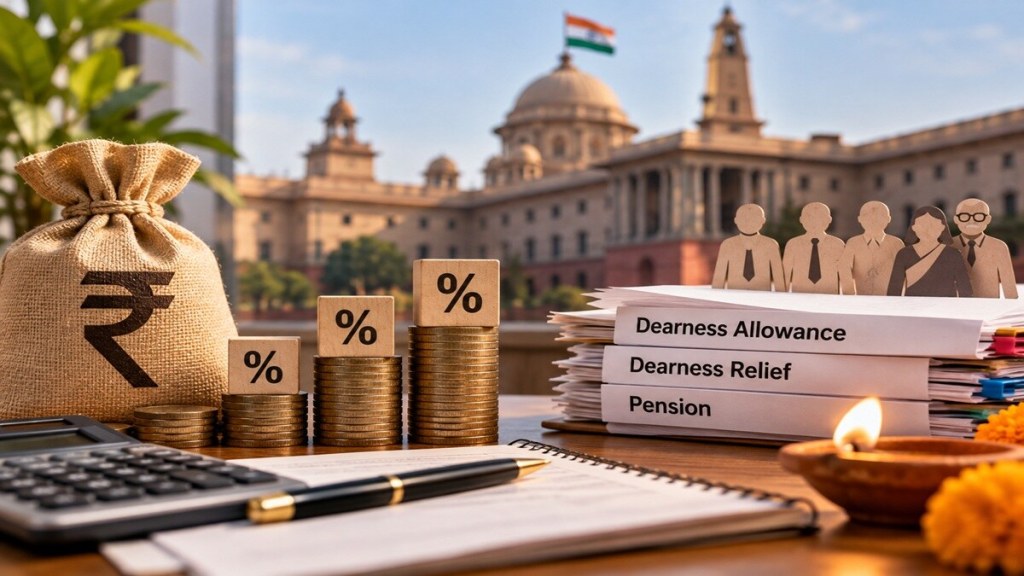

Nearly 1.2 crore central government employees and pensioners are waiting for the next Dearness Allowance (DA) and Dearness Relief (DR) hike, even as the festive season is underway. With Dussehra celebrations and Diwali approaching on November 8, the delay in announcing the July 2026 DA installment has become a concern for employees and pensioners.
The Centre usually revises DA twice a year. The first revision takes effect from January 1 and is generally announced around March, often close to Holi. The second revision takes effect from July 1 and is usually announced during the September-October festive season.
However, as of October 16, the government has yet to announce the second DA hike for 2026. Employees are expecting a 3% increase, which would take the current DA rate from 60% to 63% of basic pay. This is an expectation, and the final rate will be known only after the government formally approves it.
Meanwhile, the Confederation of Central Government Employees and Workers has stepped up pressure on the Centre to announce the pending DA and DR installment without further delay.
Central government employees demand immediate DA hike
In a letter dated October 14, 2026, addressed to the Cabinet Secretary, the Confederation of Central Government Employees and Workers announced a programme of lunch-hour demonstrations at workplaces across the country on Friday, October 16.
The employees’ body said members of its affiliated organisations would hold demonstrations and send resolutions demanding the immediate release of the pending DA and DR installment.
The letter, signed by Confederation Secretary General M.S. Vengatesan, stated: “The Single Demand in pursuant of which the employees will embark upon the above action program is ‘Immediate Declaration of Due installment of DA/DR w.e.f.1.7.2026 for Employees and Pensioners and announcement of Ad-hoc and PLB Bonus for the F.Y.2025-26’.”
The Confederation’s demand covers both serving employees and pensioners. While Dearness Allowance is paid to government employees, Dearness Relief is paid to pensioners to help offset the impact of rising prices.
The letter also sought the announcement of ad-hoc and productivity-linked bonuses for eligible employees during the festive season.
However, since the letter was issued, the government has already announced a 30-day non-productivity-linked bonus for eligible central government employees. It has also approved a separate productivity-linked bonus for railway employees.
When will the government announce the DA hike?
There is still no officially confirmed date for the announcement of the July 2026 DA and DR revision.
Traditionally, the government announces the second DA hike of the year ahead of major festivals such as Dussehra or Diwali. Since Diwali falls on November 8 this year, employees are hoping that the pending increase will be approved before the festival.
The last DA revision was announced in March 2026, when the Centre increased the rate by 2 percentage points to 60%.
If the government approves another 3 percentage point increase, the DA rate will rise to 63%.
The important point is that the revised DA will be effective from July 1, 2026, irrespective of the actual announcement date. This means eligible employees would also receive arrears for the period between the effective date and the implementation of the revised rate.
Pensioners would similarly receive the benefit of the revised Dearness Relief, along with applicable arrears.
How much salary increase can employees expect from a 3% DA hike?
DA is calculated as a percentage of an employee’s basic pay. It is not calculated on gross salary.
For example, a central government employee at Level 1 of the 7th Pay Commission pay matrix with a basic salary of Rs 18,000 currently receives Rs 10,800 per month as DA at 60%.
If the DA rate rises to 63%, the monthly allowance will increase to Rs 11,340.
Here is how the calculation works:
- Basic pay: Rs 18,000
- Current DA at 60%: Rs 10,800 per month
- Expected DA at 63%: Rs 11,340 per month
- Additional monthly DA: Rs 540
- Additional DA over 12 months: Rs 6,480
Here is how a 3 percentage point DA increase would affect employees at different basic pay levels.
| Basic monthly pay | Additional DA per month | Additional DA per year |
|---|---|---|
| Rs 18,000 | Rs 540 | Rs 6,480 |
| Rs 25,500 | Rs 765 | Rs 9,180 |
| Rs 35,400 | Rs 1,062 | Rs 12,744 |
| Rs 44,900 | Rs 1,347 | Rs 16,164 |
| Rs 56,100 | Rs 1,683 | Rs 20,196 |
These calculations assume a 3 percentage point DA increase. The actual benefit will depend on the employee’s basic pay and the rate finally approved by the government. The figures do not include any consequential changes in other allowances.
How is DA calculated?
The government revises DA and DR based on changes in the All India Consumer Price Index for Industrial Workers, commonly known as AICPI-IW.
The index measures changes in retail prices faced by industrial workers and is released by the Labour Bureau.
For employees covered by the 7th Pay Commission, the DA rate is calculated using the 12-month average of the AICPI-IW series with 2001 as the base year.
The formula is: DA percentage = [(12-month average AICPI-IW – 261.42) / 261.42] x 100
The index is currently published on the 2016 base series. For the 7th Pay Commission calculation, it is converted to the earlier base using the prescribed linking factor.
The final DA rate is subject to government approval.
What is the latest on the 8th Pay Commission?
The pending DA hike comes at a time when central government employees are also waiting for the recommendations of the 8th Central Pay Commission.
The 7th Pay Commission’s 10-year pay cycle ended on December 31, 2025. However, its pay structure continues to be used until the government implements a revised structure.
The 8th Pay Commission was formally constituted on November 3, 2025, and given 18 months to submit its recommendations. Based on this timeline, its report is expected around May 2027.
The commission is examining salaries, allowances, pensions and other service conditions of central government employees.
The government has indicated that the recommendations would normally be expected to take effect from January 1, 2026, following the usual 10-year cycle. However, the actual implementation date and financial benefits will depend on the government’s final decisions.
The July 2026 DA revision will be the second installment falling after the end of the 7th Pay Commission’s pay cycle.
The DA revision does not have to wait for the 8th Pay Commission’s report. The government can continue revising DA under the existing framework until the new pay structure is implemented.
Once the 8th Pay Commission’s recommendations are implemented, the treatment of accumulated DA will depend on the revised pay structure approved by the Centre.
Centre announces 30-day ad-hoc bonus for employees
While employees continue to wait for the DA announcement, the government has approved a non-productivity-linked ad-hoc bonus equivalent to 30 days’ emoluments for the financial year 2025-26.
According to an Office Memorandum issued by the Department of Expenditure on October 15, the bonus will cover all Group C central government employees and non-gazetted Group B employees who are not covered by any productivity-linked bonus scheme.
The government has fixed the monthly emoluments ceiling for calculating the bonus at Rs 7,000.
Based on this ceiling, the maximum bonus payable for 30 days works out to Rs 6,908.
Eligible personnel of the armed forces and central paramilitary forces will also be covered by the order.
The announcement addresses the Confederation’s demand for an ad-hoc bonus for eligible employees, although the DA and DR revision remains pending.
Railway employees get 78-day productivity-linked bonus
Earlier this week, the Union Cabinet also approved a productivity-linked bonus equivalent to 78 days’ wages for more than 11.4 lakh railway employees.
Information and Broadcasting Minister Ashwini Vaishnaw announced that the government had approved an expenditure of Rs 2,009.61 crore for the payout.
The maximum bonus payable to an eligible railway employee is Rs 17,951.
The bonus covers various categories of Group C railway employees, including track maintainers, loco pilots, train managers, station masters, supervisors, technicians, pointsmen and ministerial staff.
Unlike the 30-day ad-hoc bonus, which is not linked to productivity, the railway bonus is paid under a separate productivity-linked scheme.
With both bonus announcements now made, attention has shifted back to the pending DA and DR revision.
For employees and pensioners, the key question is whether the government will announce the expected increase before Diwali. Until the Centre issues a formal order, both the timing and the final percentage of the hike remain unconfirmed.
Every financial journey has a turning point. What’s yours?
Financial Express is launching a new series highlighting real experiences with money, investments, and the taxman. Did a sudden tax rule catch you off guard? Did a piece of financial advice change your life? Your story could provide invaluable, practical lessons for thousands of fellow taxpayers. Share your experience with us. We respect your privacy: no stories will be featured without a direct conversation and your full consent. Thank you.