


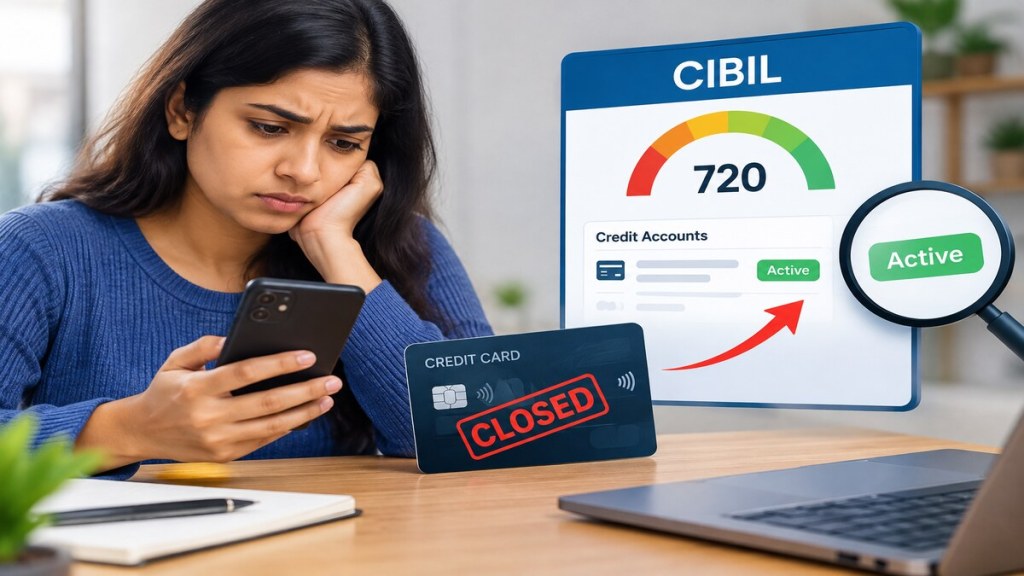

If you recently closed a credit card after paying off all outstanding balances, it could have been an easy task. However, if your CIBIL or Credit Information Report (CIR) still shows the card as active after closure, do you know who is responsible for that and what to do to resolve the problem?
Your credit profile may be impacted by this issue, especially if the account shows outstanding balances, late payments, etc.
A closed credit card may still appear as active on CIR because credit bureaus depend on the financial institutions to report status changes. If your lender has not submitted an updated report showing the closure, CIBIL will continue to display the old status.
The Reserve Bank of India (RBI) states that when you file a dispute, your lender has 21 calendar days to submit revised credit information, and the bureau has 30 days to settle the issue.
It’s not a simple issue when a closed credit card appears on your credit record as active. It can really lower your credit score and make applying for a new credit card more difficult in the future.
In the event that a credit card has previously been closed but still appears as active, credit cardholders should be aware of the instructions to pay attention to and the related documents required to correct their credit report.
Closed card still active on CIBIL? Know who is responsible
Credit bureaus can only report the data they receive. If a closed credit card continues to show as active, the issue often originates with the card issuer’s reporting.
“Once flagged, both the lender and the bureau must work to correct the record quickly, as credit-report accuracy is critical for consumers. A closed loan or credit card account should generally be reflected by credit bureaus within 30 days, and certainly within the next one or two reporting cycles,” said Ramkumar Subramanian, Partner, Grant Thornton Bharat.
If a complaint is not resolved within 30 days, customers receive Rs 100 for each calendar day of delay.
Delayed updates can adversely affect a consumer’s credit profile, making timely and accurate reporting by lenders essential.
Closed card showing active? Know the impact on CIBIL score
An incorrectly reported active credit card account can potentially affect a person’s credit profile, particularly if the account reflects outstanding dues, missed payments, high credit utilization or recent credit activity that does not belong to the individual.
“When a closed card is mistakenly shown as open, its credit limit remains part of your total available credit. Since you are not using this card, its outstanding balance is zero, which artificially lowers your overall credit utilization ratio,” said Adhil Shetty, CEO, BankBazaar.
While a lower ratio generally benefits your credit score, this incorrect reporting is not risk-free. Lenders reviewing your profile might hesitate, fearing you are over-leveraged with too much available credit. It also makes you vulnerable to identity theft or billing errors on an unmonitored account.
Lenders rely heavily on credit bureau data while assessing loan and credit card applications, so unresolved inaccuracies could influence both credit scores and underwriting decisions.
Consumers should regularly review their credit reports and promptly dispute any incorrect account information to prevent unintended impact on their borrowing eligibility.
Credit card wrongly active on CIBIL? Steps to fix it
Consumers should first preserve four key documents after closing a credit card: the closure confirmation, final zero-balance statement, proof of last payment, and any bank acknowledgment.
A No-Dues certificate, if available, is the most definitive proof that the card was closed without pending liabilities.
A wrongly active credit card should generally be corrected through the lender first, because the issuer is the source of data reported to credit bureaus.
Consumers should preserve closure confirmations, no-dues certificates and complaint references, escalate any unresolved cases through the credit bureau’s dispute mechanism, and verify the correction in a fresh credit report once the update is processed.
“A credit-report dispute should ordinarily be resolved within 30 days. If it remains pending beyond that, consumers should escalate the matter with both the lender and the credit bureau, supported by documentary evidence,” according to Subramanian.
Credit reporting is a shared responsibility between lenders and bureaus, and unresolved inaccuracies should not be allowed to linger as they can materially affect an individual’s credit profile.
If a bank repeatedly fails to correct erroneous credit bureau reporting despite formal complaints, the RBI Ombudsman mechanism provides an important escalation channel. The key is to preserve documentary evidence of account closure and all prior complaints to the bank.
Key takeaway
An inaccurately reported active credit card can also skew credit utilisation metrics and misrepresent a borrower’s credit profile, even if the card is no longer in use.
While the impact depends on how the account is reported, consumers should ensure closed cards are promptly updated in credit bureau records to avoid unintended consequences during loan or credit evaluations.
The most common mistake is failing to check credit reports regularly, meaning errors are only discovered during a fresh loan application. Once noticed, many consumers delay raising a formal dispute, assuming the error will resolve itself.
Another mistake is not raising the dispute with both the bank and the credit bureau simultaneously.
Further, consumers often fail to preserve essential documents, such as the official closure confirmation or No Dues Certificate. Without this paper trail, proving the closure and correcting your credit record becomes significantly harder.
Credit-report corrections are far easier when backed by documented evidence and early action.
Disclaimer: This article is for informational purposes only and should not be construed as investment, financial, tax, or legal advice. Any illustrations, examples, or return projections used in this article are for explanatory purposes only and do not guarantee actual investment outcomes. The views and opinions expressed by experts quoted in this article are their own and should not be considered investment recommendations. Readers should consult a qualified professional before making any financial decisions.
Every financial journey has a turning point. What’s yours?
Financial Express is launching a new series highlighting real experiences with money, investments, and the taxman. Did a sudden tax rule catch you off guard? Did a piece of financial advice change your life? Your story could provide invaluable, practical lessons for thousands of fellow taxpayers. Share your experience with us. We respect your privacy: no stories will be featured without a direct conversation and your full consent. Thank you.