


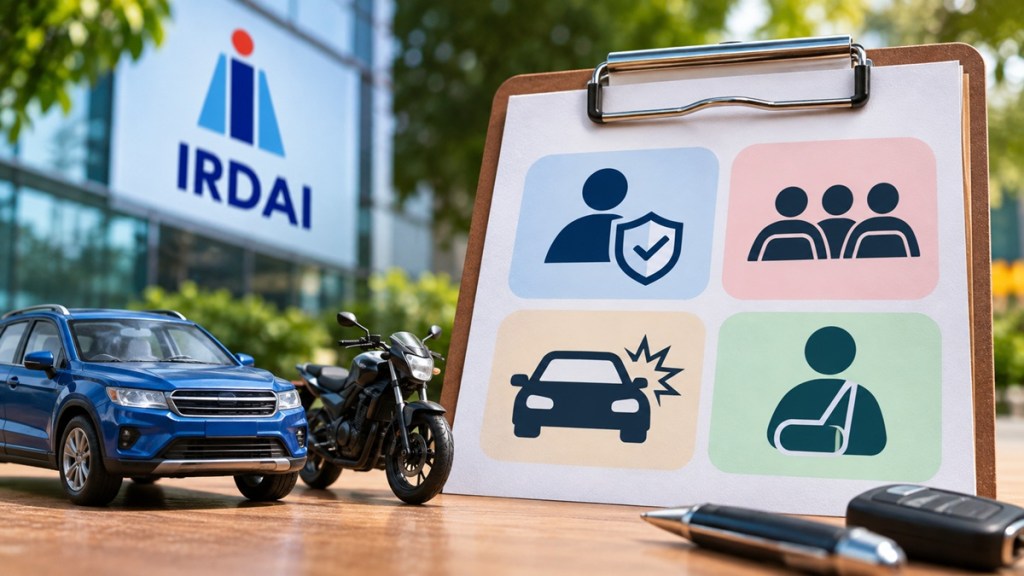

Buying or renewing motor insurance could become more transparent for car and two-wheeler owners from December 15. The Insurance Regulatory and Development Authority of India (IRDAI) has introduced a four-layer structure that will allow customers to understand what their policy covers, which additional protections they can choose and how much each cover costs.
Under the new framework, insurers will have to show four separate sections of motor insurance instead of leaving customers to figure out the different protections included in a policy. Third-party liability will remain compulsory. Legal liability towards passengers, additional personal accident protection and cover for damage to the insured vehicle will be available as optional covers, subject to the mandatory personal accident requirement for the owner-insured.
The change is important because many vehicle owners focus mainly on the total premium while buying or renewing insurance. They may not always know whether their policy covers passengers, provides personal accident protection or pays for damage to their own vehicle.
From December 15, insurers will have to provide a customer option form and a Customer Information Sheet at the time of purchase. They will also have to disclose the premium charged for each section separately.
Debashish Banerjee, Partner, Deloitte India, clarifies that the four-layer framework does not create new cover choices, rather it gives existing options a clearer structure. Separating mandatory and optional covers through option forms and section-wise premium disclosures should reduce ambiguity and support informed decisions, he adds.
“The main customer challenge remains easily knowing whether mandatory third-party cover is active under a prior multi-year policy. Structure creates clarity only when customers understand and is fully aware of the coverages etc., essential to preventing both duplication and underinsurance.”
The new framework follows a Supreme Court direction in the case of National Insurance Company Ltd versus Smt. Thungala Dhana Laxmi and others. IRDAI issued the circular on November 2, 2026, directing general insurers to adopt uniform policy wordings for private cars and two-wheelers.
What are the four types of motor insurance covers?
Under the new framework, motor insurance will be divided into four sections. However, all four are not compulsory. Third-party liability remains mandatory, while the owner-insured’s personal accident cover also continues to be mandatory under the applicable rules.
Here is what each section means:
| Insurance cover | What does it cover? | Mandatory or optional? |
|---|---|---|
| Third-party liability | Covers the vehicle owner’s legal liability for injury, death or property damage caused to another person in an accident. | Mandatory |
| Legal liability towards occupants | Covers legal liability towards passengers in a car, pillion riders on two-wheelers and employees of the insured travelling in the vehicle. | Optional |
| Personal accident cover | Provides personal accident protection for the owner-insured. Additional protection can be selected for occupants, pillion riders and drivers other than the owner-driver. | Owner-insured cover is mandatory. Additional cover is optional. |
| Own-damage cover | Protects the insured vehicle against loss or damage. | Optional |
The distinction between these covers is important. Third-party insurance protects the vehicle owner against legal liability towards another person. It does not automatically mean that every passenger travelling in the insured vehicle has the additional protection available under the occupant liability section.
Similarly, legal liability towards occupants and personal accident cover are two different protections. The former covers the insured’s legal liability towards specified occupants, while the latter provides personal accident protection to the persons covered under the policy.
Third-party insurance remains compulsory. What about the other covers?
The new structure does not make all four sections compulsory.
Third-party liability insurance will continue to be mandatory for vehicle owners. This cover protects them against legal liabilities arising from injury, death or property damage caused to a third party in an accident.
The second section, which covers legal liability towards occupants or pillion riders, will be optional. Vehicle owners can decide whether they want this additional protection.
The third section deals with personal accident insurance. Here, the distinction is important. Personal accident cover for the owner-insured remains mandatory, while additional personal accident cover for occupants, pillion riders and drivers other than the owner-driver is optional.
The fourth section covers loss of or damage to the insured vehicle. This is also optional.
Therefore, vehicle owners should not assume that they can opt out of every section other than third-party insurance. The mandatory personal accident requirement for the owner-insured continues to apply.
Insurers must show how much each insurance cover costs
One of the most useful changes for customers is the requirement to disclose the premium for each section separately.
Under the new rules, insurers will have to show the actual coverage offered and the premium charged against each section in a transparent manner in the policy schedule.
This will help customers understand how much they are paying for third-party liability, occupant protection, personal accident cover and own-damage insurance.
The circular states: “The schedule shall reflect the actual coverage offered along with premium charged against each section in a transparent manner.”
This could make it easier for customers to compare policies and understand the cost of additional protection instead of looking only at the final premium.
However, greater transparency does not necessarily mean lower premiums. IRDAI has allowed insurers to continue developing their own coverage options and determining the pricing of own-damage covers in line with market conditions.
Already have third-party insurance? You can add passenger cover
The new framework also provides an option for existing policyholders who want to add legal liability cover for passengers or pillion riders.
For instance, if you already have a third-party insurance policy for your car or two-wheeler and later decide that you want additional legal liability protection for occupants, you can approach your existing insurer during the policy period.
The insurer will have to make this cover available on payment of an additional premium.
However, there are two important conditions.
- You must purchase the additional cover from the same insurer that issued your existing third-party insurance policy.
- The additional protection will begin only from the date and time mentioned in the endorsement issued by the insurer.
Importantly, you do not have to cancel your existing third-party insurance policy to add this cover.
IRDAI has made this clear in its circular: “No existing Motor Third Party Insurance need to be cancelled by either the insurer or the insured for opting the additional covers.”
This provision specifically deals with adding Section II occupant liability cover during the policy period. It should not be confused with a general right to add every optional section to an existing policy.
What documents must insurers provide when selling motor insurance?
The new framework makes two documents important at the time of purchasing motor insurance.
1. Customer option form
Insurers will have to provide a customer option form explaining the four sections of motor insurance. Customers will have to select their preferred covers by ticking the relevant options.
This requirement will apply whether the policy is purchased online or offline.
The completed option form will become part of the insurance policy. Obtaining the duly completed form from customers will be mandatory for all policies covered by the new framework.
2. Customer Information Sheet
Insurers will also have to issue a Customer Information Sheet at the point of sale.
The document is intended to help customers understand the protection available under their policy and the covers they have selected.
These requirements are aimed at reducing confusion over what a motor insurance policy actually covers and making the purchase process more transparent.
Will motor insurance become cheaper after December 15?
Not necessarily. The new framework is primarily aimed at improving transparency and giving customers more clarity about their insurance choices. It does not guarantee a reduction in premiums.
IRDAI has prescribed uniform policy wordings and a common four-section structure. However, insurers will retain the flexibility to develop additional coverage options and determine the pricing of own-damage covers in line with market conditions.
This means the cost of own-damage insurance could differ across insurers even under the new framework.
Customers should therefore avoid choosing a policy only because it carries a lower premium. They should also check the extent of protection, exclusions and conditions attached to each cover.
The objective should be to get adequate protection rather than simply reduce the insurance cost.
When will the new motor insurance rules come into effect?
The four-layer motor insurance structure and standardised policy wordings will come into force on December 15, 2026. All policies issued from that date will have to follow the new framework.
IRDAI has also directed insurers to complete the integration of the four-layer structure with Bima Sugam by the same date. This will ensure that the policies are available through the platform from the date the new framework takes effect.
For car and bike owners, the key takeaway is to look beyond the total premium when buying or renewing motor insurance. Check whether the policy covers passengers, the owner-insured and damage to the vehicle. The new framework will make these choices clearer, but the responsibility to select suitable protection will still rest with the customer.
Disclaimer:
This article is based on IRDAI’s circular dated November 2, 2026. Insurance coverage, premiums, exclusions and claim settlements are subject to the terms and conditions of the respective policy. Vehicle owners should check policy documents carefully before purchasing or renewing motor insurance.