


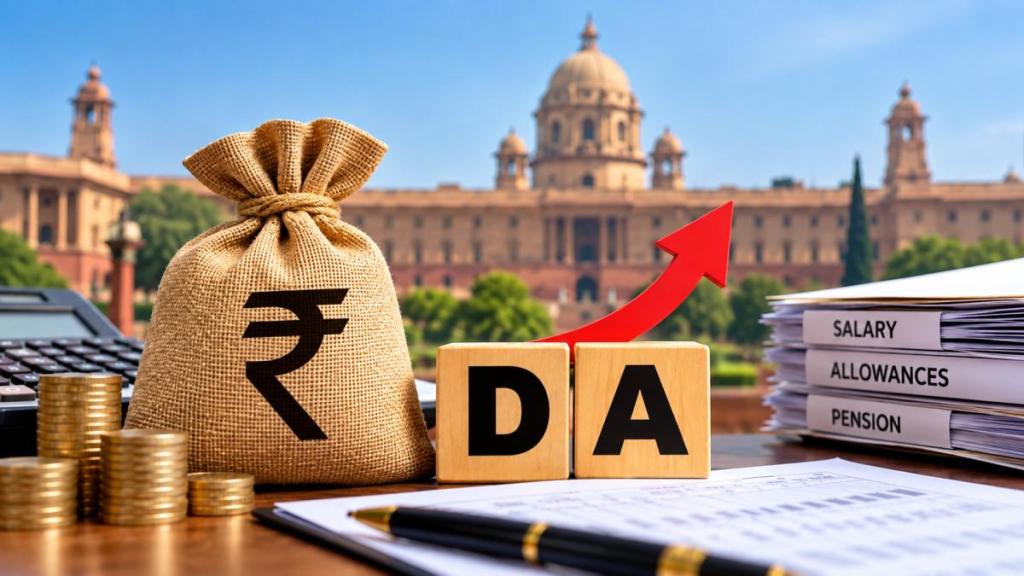

The Union Cabinet on Wednesday approved a 3% increase in Dearness Allowance (DA) for central government employees, effective July 1, 2026. The increase would take DA from the existing 60% to 63% of basic pay. The government had raised the allowance to 60% in its previous revision, effective January 1, 2026.
The revision raises DA from 60% to 63% of basic pay, with a corresponding increase in DR on basic pension.
The decision will benefit about 48 lakh central government employees and 68 lakh pensioners. The combined annual impact on the exchequer will be Rs 10,016 crore.
The increase follows the accepted formula based on the recommendations of the Seventh Central Pay Commission. The government had raised the allowance to 60% in its previous revision, effective January 1, 2026.
The Seventh Pay Commsion term ended on December 31, 2025 and DA at the time stood at 58%.
DA is revised periodically to help government employees cope with rising prices. For pensioners, the corresponding benefit is called Dearness Relief (DR). Both are linked to inflation and are revised twice a year, usually in January and July.
Revised rates under older pay scales
For those covered by the Sixth Central Pay Commission framework, DA and DR rates will rise by seven percentage points, from 262% to 269%.
Under the Fifth Central Pay Commission framework, the rates will increase by 14 percentage points, from 483% to 497%. Both revisions will also apply from July 1, 2026.
DA under the 7th Pay Commission
The 7th Pay Commission’s recommendations came into effect from January 1, 2016. Since then, DA has been revised periodically to reflect changes in the cost of living. The rate has moved up over the years as inflation has affected household expenses.
DA is calculated as a percentage of basic pay. This means the monetary benefit varies depending on an employee’s basic salary. For pensioners, DR is calculated on basic pension.
The latest hike is part of the existing mechanism for adjusting salaries and pensions for inflation. It is separate from any salary revision that may be recommended by a new pay commission.
What is the status of the 8th Pay Commission?
The government formally announced setting up the 8th Central Pay Commission on November 3, 2025, with former Supreme Court judge Justice Ranjana Prakash Desai as its chairperson. The panel has been given 18 months to submit its recommendations, putting the expected deadline around May 2027.
The commission will examine changes to salaries, allowances, pensions and other service benefits. The panel has been consulting stakeholders and inviting submissions from employee associations, pensioners and other groups.
Its recommendations will need to be considered and accepted by the government before revised pay rules can be implemented. The final fitment factor, revised salary structure and implementation timeline have not yet been announced.
Demand for a merger of DA with basic pay
Employee unions have been demanding that DA and DR be merged with basic pay, arguing that this will give some relief to central government employees and pensioners as the 8th Pay Commission recommendations are still some time away. Their argument is that merging the allowance would increase the basic pay or pension on which certain other benefits are calculated, potentially improving retirement benefits and other salary-linked payments.
There is a precedent for such a move. In 2004, the government merged 50% of DA with basic pay as Dearness Pay under the 5th Pay Commission framework. However, this is not an automatic rule under the current pay structure.
The government has also made its position clear in Parliament. In December 2025, the Finance Ministry said it was not considering a proposal to merge existing DA with basic pay. Therefore, despite DA now reaching 63%, employees should not assume that a merger will happen automatically. Any such change would require a separate government decision.
For now, the latest 3% DA and DR hike provides additional inflation-linked relief to employees and pensioners under the existing 7th Pay Commission framework. A broader revision of salaries and pensions will depend on the 8th Pay Commission’s recommendations and the government’s subsequent decisions.