


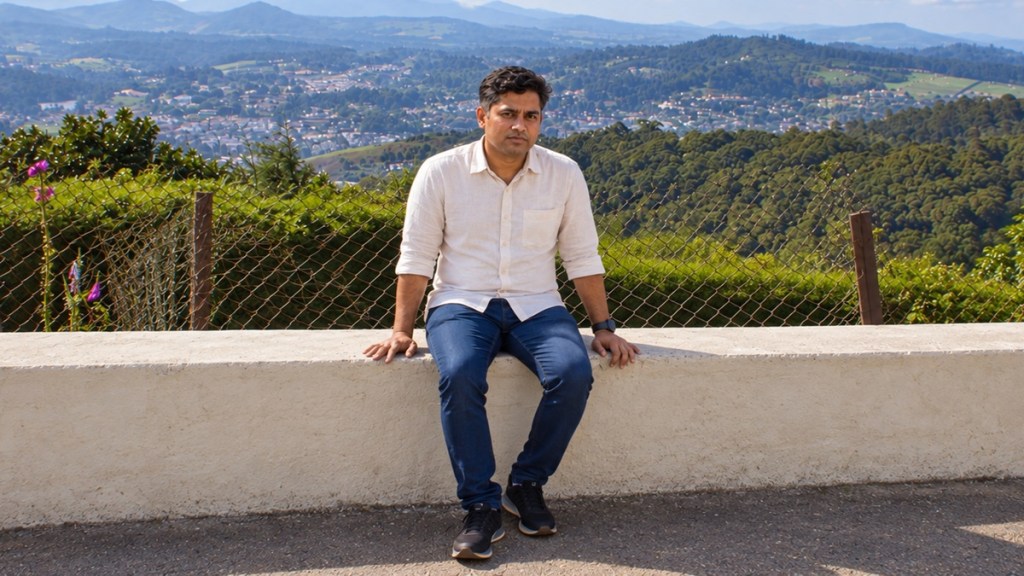

Rajiv Solanki spends his working days keeping accounts. As a Senior Divisional Accountant in Rajasthan’s Public Works Department in Jaipur, his job is to make sure the numbers add up and nothing is left off the sheet.
His own retirement sheet has a gap in it. It may be the largest number on the page.
Rajiv is 43. He has invested through SIPs for ten years, has built about Rs 32 lakh, and wants Rs 7 crore by the time he retires at 60. He is also unusually open about his doubts. “Rs 7 crore is the target I have in mind, but I want to understand whether my current investment plan will be enough,” he says.
That question deserves a straight answer. Getting there means running his numbers properly, and then looking at the one item his answers never mention.
Everyday Crorepatis, Financial Express Digital’s series on salaried Indians building serious wealth, has mostly featured people who have already crossed a big number. Rajiv is still in the middle of the climb, and he wants to know whether the route he has picked actually reaches the top.
Building a Rs 32 lakh corpus on a government salary
Rajiv is the only child of a retired state government employee and a homemaker. He did his BCom in Jaipur, cleared a competitive exam at 23, and has been in government service for about 20 years.
His salary began at around Rs 35,000 a month and is now about Rs 1.55 lakh. That is a rise of roughly four and a half times over two decades, the steady climb of a government pay scale rather than anything dramatic. “Salary has increased over the years, but family responsibilities have also increased,” he says.
Those responsibilities are real. His wife is a homemaker. His son is 14 and in Class 8. As an only child, he looks after his parents as well. He owns a flat in Jaipur and pays an EMI of about Rs 18,000 a month on it. Household spending, including that EMI, comes to about Rs 82,000. “After all expenses, around Rs 55,000 is left with me,” he says.
He started investing about ten years ago with a Rs 10,000 monthly SIP and has raised it by around 10% each year. It now stands at about Rs 26,000. “I feel this is easier than starting with a very big SIP in the beginning,” he says.
On that path, he has put in roughly Rs 19 lakh in total. It is now worth about Rs 32 lakh.
The 11.5% reality check: Mutual fund returns vs. expectations
That works out to an annual return of about 11.5%. That is close to what the broad Indian market has delivered. The Nifty 50 Total Return Index returned around 11.4% a year over the past 20 years, according to figures cited by Business Today in May 2026. Rajiv’s money, in other words, has earned roughly the market’s return.
Sudhir Dandotiya, who appeared earlier in this series, described his own returns as fairly average and built a fortune anyway. Rajiv’s sit in the same honest middle.
His plan, however, assumes something better. He expects 13% to 14% a year from here. The same Business Today analysis puts the long-run return of Indian equities since 1990 at about 13.2% a year. Rajiv is penciling in a return at or above the market’s 35-year average, and above what his own portfolio has actually earned.
The Rs 50 lakh gap in his SIP plan
The calculation below assumes he keeps his existing Rs 32 lakh invested, continues his Rs 26,000 SIP, raises it by 10% every year for the next 17 years, and earns the same return in every one of those years.
| Annual return | Estimated corpus at 60 |
| 11% | About Rs 4.7 cr |
| 12% | About Rs 5.2 cr |
| 13% | About Rs 5.8 cr |
| 14% | About Rs 6.5 cr |
Even at the top of his own range, he falls about Rs 50 lakh short. To reach Rs 7 crore on this plan, his portfolio would need to earn roughly 14.6% a year for 17 years without a break.
The gap can be closed with contributions rather than hope. At a 12% return, starting from about Rs 41,500 a month today instead of Rs 26,000, and still stepping up by 10% a year, would get him to Rs 7 crore. That is an extra Rs 15,500 a month from the Rs 55,000 he has left.
Before he finds that money, though, there is a more important question to settle.
How the Old Pension Scheme could change his retirement math
In its 2022 budget, Rajasthan became the first state to bring back the old pension scheme, for employees appointed on or after January 1, 2004. The current government has also continued the scheme.
Rajiv joined state service about 20 years ago, which places him in that cohort. Under the old scheme, a retiring employee typically receives about half of the last drawn basic pay as a pension for life, with dearness relief revised twice a year to keep pace with prices.
Not one of his answers mentions a pension. Whether he is covered, and on what terms, is something only his own service records can confirm.
If he is covered, he is likely to retire on a handsome pension. He still has about 17 years of service left. Pay commissions come roughly once a decade; the 8th, constituted in November 2025, has yet to submit its report. Rajasthan has followed earlier central commissions with its own pay revisions. Rajiv is likely to benefit from at least two such revisions before he retires, and each would raise the base on which his pension is calculated.
Putting a figure on it today would be guesswork, since the amount depends on pay commissions and dearness allowance increases that have not happened yet. But a lifelong income that rises with prices is exactly what most private-sector employees try to build through their investments.
Naresh Bhardwaj, the first person profiled in this series, spent 17 years putting money into NPS so he could buy a pension of about Rs 1 lakh a month. Rajiv may already have a pension written into his terms of service. His father, a retired state government employee, belongs to the generation for whom that was simply assumed.
That changes what his mutual funds are for. A Rs 7 crore target quietly assumes his SIPs must fund every month of retirement. With a pension covering regular expenses, his portfolio could do a narrower job: his son’s education, large one-off costs and whatever the pension does not cover.
That would reduce his dependence on mutual funds considerably. He would not need returns above the market’s long-run record, and might not need to stretch his SIP to Rs 41,500 a month either. None of this makes his SIPs wasted. But a Rs 7 crore target built as if no pension exists may be asking far more of his salary than his retirement needs.
The hidden threat: Funding higher education in 4 years
There is a nearer pressure too. His son is 14. In about four years, college costs will start, at exactly the stage when Rajiv’s plan needs the SIP to keep rising by 10% a year.
His answers do not mention a separate fund for his son’s education. Without one, there is a real risk that the step-up stalls, or that the retirement portfolio gets dipped into. He names the worry himself. “I have to take care of my parents, my son’s education and my own retirement. I have a home loan also.”
Can Rajiv Solanki reach Rs 7 crore by Age 60?
Rajiv asked whether he is on the right track. On the evidence of his journey so far, he largely is. He has invested for ten years, raised his SIP as his pay rose, and earned roughly what the market offered.
The part that needs work is the destination. If the old pension scheme applies to him, Rs 7 crore may not be the right target at all, and the biggest source of income in his retirement could be one he has not yet written down.
For a man who balances accounts for a living, that is the line worth checking first.
Disclaimer: This article is based on the personal financial journey, disclosures and projections shared by the individual featured in the story. Future corpus estimates, pension calculations and retirement projections are based on the assumptions provided by the individual, including expected investment returns, prevailing tax laws and current NPS/PPF rules, all of which are subject to change. Pension amounts will depend on the final corpus, annuity rates available at the time of retirement and applicable tax rules. The PPF interest rate is notified by the government every quarter and may change over time.
This article is intended solely for informational purposes and should not be construed as investment, tax or financial planning advice, or as an endorsement of any investment strategy. Readers should assess their own financial goals, risk appetite and consult a qualified financial or tax adviser before making investment or retirement planning decisions.
Every financial journey has a turning point. What’s yours?
Financial Express is launching a new series highlighting real experiences with money, investments, and the taxman. Did a sudden tax rule catch you off guard? Did a piece of financial advice change your life? Your story could provide invaluable, practical lessons for thousands of fellow taxpayers. Share your experience with us. We respect your privacy: no stories will be featured without a direct conversation and your full consent. Thank you.