


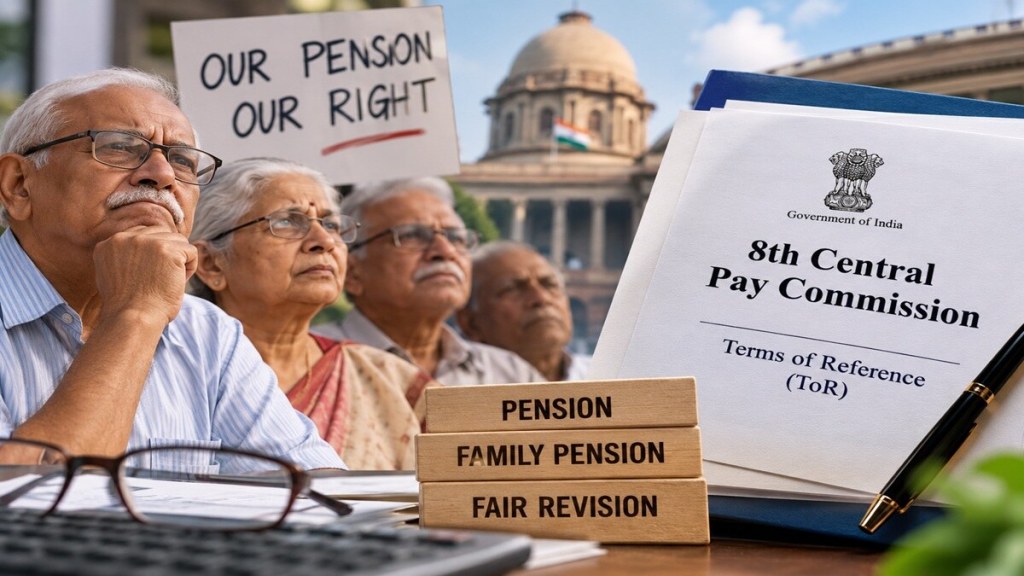

The 8th Central Pay Commission has entered a crucial phase of consultations, but a question that has been troubling a large section of retired government employees remains unresolved. Will pensioners who retired before January 1, 2026, also get their pensions revised under the 8th Pay Commission?
The latest demand has come from the Retired Employees Welfare Association (REWA), which has written to Prime Minister Narendra Modi seeking an amendment to the Commission’s Terms of Reference (ToR).
In its September 7 representation, REWA said there is “serious confusion and apprehension” among about 69 lakh pensioners and family pensioners over whether their pensions will be revised. The association wants the government to specifically add pre-January 1, 2026 retirees to the 8th Pay Commission’s mandate.
The demand is not new. Several employee and pensioner organisations have raised the same concern since the ToR were notified in November 2025. What makes the latest REWA letter important is the timing: the Commission is now holding consultations with employee and pensioner organisations and has already collected formal submissions.
What exactly is REWA asking for?
The dispute centres on Para 2(e) of the 8th Pay Commission’s ToR.
The government notification says the Commission will review the “Death-cum-Retirement Gratuity and pensions” of employees who are not covered under the National Pension System, including the Unified Pension Scheme.
Pensioner organisations, however, argue that this wording does not clearly say that the Commission has to revise the pensions of employees who have already retired before January 1, 2026.
REWA has therefore asked the government to add a specific provision saying that the 8th Pay Commission should also recommend revision of pension and family pension of all pensioners and family pensioners who retired before January 1, 2026.
The association has also asked the government to issue an immediate clarification if a formal amendment is not made.
This distinction is important because being allowed to submit representations to the Pay Commission is not the same as having a specific issue included in its mandate.
The Commission invited pensioners and service associations to submit their views earlier this year, but the question of whether it can make recommendations on a particular issue ultimately depends on the scope given to it by the government.
Why pensioners are worried about the wording
The pensioners’ organisations are comparing the 8th CPC ToR with those of previous Pay Commissions.
For example, the Staff Side of the National Council-Joint Consultative Machinery (NC-JCM) pointed out that the 7th Pay Commission’s ToR specifically referred to revision of pension for employees who had retired before the effective date of the recommendations.
REWA has made a similar point. It says that the 5th and 6th Pay Commission ToRs also explicitly referred to pensioners and family pensioners, while the current ToR does not use the same language for pre-2026 retirees.
That is why pensioner bodies do not want to rely simply on an interpretation of the existing wording. They want the government to put it in writing.
REWA is not the first body to raise the issue
The issue has been running almost from the time the 8th Pay Commission’s ToR were notified.
In November 2025, the Bharat Pensioners’ Samaj (BPS) and All India Defence Employees’ Federation (AIDEF) raised similar concerns.
BPS sought explicit inclusion of pension revision for pensioners and family pensioners and objected to the phrase “unfunded cost of non-contributory pension schemes” in the ToR. It argued that the wording treats pension primarily as a financial liability rather than recognising the pensioner’s entitlement.
AIDEF has also argued that the ToR do not specifically cover pension revision for past pensioners, parity between past and future pensioners, family pension revision and other retirement benefits. It proposed that the ToR explicitly cover pension and family pension revision for employees retiring before and after January 1, 2026.
The NC-JCM Staff Side also sought amendments to the ToR. Its demands included pension revision for existing pensioners and family pensioners, restoration of the Old Pension Scheme, a clear January 1, 2026 effective date and interim relief.
So, the current REWA demand is part of a much longer-running disagreement over the scope of the Commission.
The other contentious issue: ‘unfunded cost’ of pension
The pensioners’ concerns are not limited to whether old pensioners are included.
The 8th CPC ToR ask the Commission to keep in view the “unfunded cost of non-contributory pension schemes”, along with fiscal prudence and the need to ensure resources for development and welfare.
Pensioner bodies have objected to this language.
BPS has argued that the phrase could influence how the Commission approaches pension obligations. It has sought deletion or replacement of the term.
AIDEF has made a similar demand, arguing that pension revision should be considered as a retirement benefit and that the ToR should explicitly cover pensioners under different pension arrangements.
This is likely to remain one of the bigger debates as the Commission moves from collecting representations to considering recommendations.
Pension parity is another major demand
Another concern is parity between old and new pensioners.
Pensioner organisations want retirees who retired before January 1, 2026 to be treated fairly alongside employees retiring after the new Pay Commission recommendations take effect.
AIDEF has specifically called for parity between past and future pensioners, while BPS has also demanded pension revision parity for pensioners and family pensioners who retired on or before January 1, 2026.
This issue matters because a new pension structure could otherwise create a gap between people who retired just before the new system and those who retire after it.
8th Pay Commission: Where does it stand today?
The 8th Central Pay Commission was first announced by the government in January 2025. The Union Cabinet approved its ToR on October 28, 2025, and the government formally constituted the Commission through a Gazette notification dated November 3, 2025.
The Commission is headed by Justice Ranjana Prakash Desai, with Prof. Pulak Ghosh as part-time member and Pankaj Jain as member-secretary.
The Commission has been given 18 months from the date of its constitution to submit its recommendations. That puts the formal deadline around May 2027, unless the government changes the timeline or the Commission’s work leads to an extension. The ToR also allow the Commission to consider interim reports if necessary.
8th Pay Commission timeline
| Date | What happened |
| January 2025 | Government announced the 8th Pay Commission |
| February 2025 | Consultations began on the proposed ToR |
| October 28, 2025 | Cabinet approved the ToR |
| November 3, 2025 | 8th Pay Commission formally constituted |
| Feb 5–Mar 31, 2026 | Commission invited responses through its questionnaire |
| Mar 5–Jun 15, 2026 | Employees, pensioners and other stakeholders submitted memoranda |
| May 2026 onwards | Commission began wider consultations and state/UT meetings |
| Jul–Sep 2026 | Consultations and state visits continued |
| Sep 7–8, 2026 | Consultations held in Chennai |
| September 9, 2026 | Consultation scheduled in Puducherry |
| Sep 16–18, 2026 | Chandigarh consultations scheduled |
| Oct 7–8, 2026 | Bengaluru consultations scheduled |
| Around May 2027 | 18-month deadline for submitting recommendations |
The Commission’s official website shows that consultations have been taking place across states and with associations and unions. It has scheduled meetings in Chandigarh later this month and Bengaluru in October.
The formal questionnaire exercise is already over. The Commission sought responses through MyGov between February 5 and March 31, while its structured memorandum exercise ran from March 5 to June 15.
In other words, the Commission is now moving deeper into consultations and evidence gathering rather than being at the stage of merely setting up its framework.
What happens from here?
For pensioners, the immediate question is whether the government will respond to the demand to amend the ToR.
There is a precedent for changing Pay Commission ToRs after they have been notified. The 5th and 6th Pay Commissions, for example, operated under amended terms, while the 7th CPC’s deadline was also extended through a subsequent resolution.
But there is no government decision yet to amend the 8th CPC ToR to specifically include pre-January 1, 2026 pensioners. Therefore, it would be premature to say that old pensioners have definitely been excluded—or that their pension revision has definitely been guaranteed.
That is the key distinction at this stage.
The Commission can hear pensioners, receive their memoranda and consider their arguments. But a formal change in its mandate would require government action.
What could happen over the next year?
The broad sequence is likely to be:
1. More consultations:
The Commission will continue meeting employee and pensioner organisations, ministries, departments and other stakeholders. Its official calendar already runs into October 2026.
2. Examination of submissions:
The questionnaire and memorandum exercises have closed, giving the Commission a large body of stakeholder inputs to examine.
3. Possible government decision on ToR:
If the government accepts the representations, it could amend the ToR through another resolution. But there is currently no announced decision to do so.
4. Recommendations:
The Commission has 18 months from its constitution to submit its recommendations, taking the process to around May 2027. It can also consider interim reports where necessary.
5. Government decision on implementation:
Even after the Commission submits its report, its recommendations do not automatically become law or take effect. The government will have to examine and decide what to accept and how to implement it.
This is why pensioners are particularly focused on the date of effect.
The government said when approving the ToR that, going by the usual 10-year cycle, the effect of the 8th CPC recommendations would normally be expected from January 1, 2026. However, January 1, 2026 is not written as the implementation date in the notified ToR.
Employee and pensioner organisations have therefore also demanded that the date be formally specified.
So, when will pensioners actually see higher pension?
There is no confirmed payment date yet.
The Commission’s recommendations are expected only after its consultation and examination process. Its formal 18-month window runs from November 3, 2025, which points to around May 2027 for the report. After that, the government will have to consider the recommendations and decide on implementation.
If the final decision provides an effective date of January 1, 2026, arrears could follow for the eligible period. But that is not a decision that has been announced yet.
For pre-2026 pensioners, therefore, the immediate battle is slightly different from the larger debate over the eventual pension increase.
Their first question is simpler: Will the 8th Pay Commission formally have the power to recommend revision of their pension and family pension at all?
That is precisely why REWA has again approached the Prime Minister, asking the government to remove the ambiguity before the Commission gets further into the recommendation process.
What pensioners should watch now
For the coming months, the three developments that matter most are:
Whether the government amends the 8th CPC ToR to explicitly include pre-January 1, 2026 pensioners and family pensioners.
Whether the Commission’s recommendations address pension parity, family pension and other retirement benefits.
What effective date the government finally approves after the Commission submits its report.
For now, the 8th Pay Commission is still in the consultation and recommendation-building stage. The pension revision question for existing pensioners remains contested, and the government’s next move on the ToR could become an important turning point.
Disclaimer: The information in this story is based on representations made by pensioners’ and employees’ organisations, government notifications and publicly available information on the 8th Central Pay Commission. The government has not yet announced any amendment to the Terms of Reference (ToR) specifically covering revision of pension and family pension for pre-January 1, 2026 retirees. The final scope, recommendations, effective date and implementation of the 8th Pay Commission will depend on decisions taken by the government. Readers should not treat the discussion on possible pension revision, arrears or timelines as a confirmation of future benefits.