


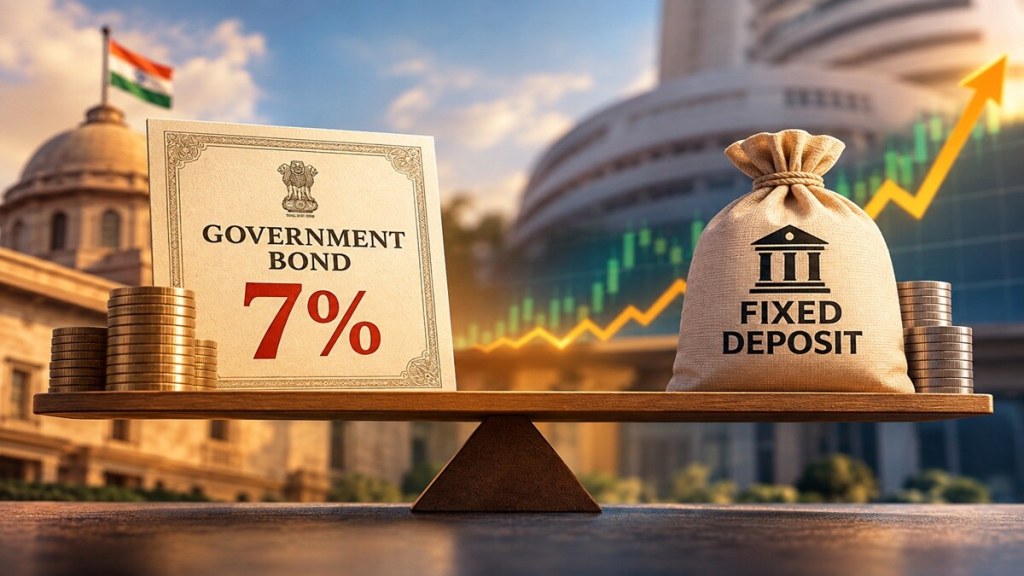

For conservative investors, a 7% return from a government-backed investment can look attractive, especially when bank fixed deposit rates are largely in the 6% to 7.5% range.
But there is a catch.
The 7% number that investors are looking at is not the same as the 6% to 7.5% interest rate on a bank FD. A government bond can give you a predictable return if you hold it until maturity, but its market price can move sharply before maturity.
And that distinction has become important now.
India’s benchmark 10-year government bond yield crossed the 7% mark this week as global bond yields moved higher, crude oil prices remained elevated and expectations around the Reserve Bank of India’s next policy decision changed. The benchmark 6.94% 2036 bond yield rose 6 basis points on September 24 to close at 7.1067%, its highest level since May 21. Bond yields and prices move in opposite directions.
The move in India is also part of a broader global bond-market story.
Why are global bond yields rising?
The US Treasury market is closely watched by investors across the world because US government bonds are considered a benchmark for global borrowing costs.
Long-term US Treasury yields have been rising sharply. The 30-year Treasury yield moved to around 5.46% on September 24, its highest level in more than two decades, while the 10-year yield moved above 5.1%. The five-year yield also moved above 5%.
For investors, the important point is not simply that US yields have crossed a particular number. It is that yields at the longer end of the curve are remaining high even as markets reassess the outlook for inflation, interest rates and economic growth.
For years, 5% on the US 10-year Treasury was viewed as a level that could create turbulence across financial markets. Higher US yields can influence the return that investors demand from other bond markets, including India.
That does not mean Indian bond yields mechanically move in line with US Treasury yields. Domestic inflation, crude prices, government borrowing, liquidity and RBI policy remain important factors.
But global yields can change the backdrop.
As Thomas Stephen, Director and Head – Preferred, Anand Rathi Share and Stock Brokers, explains, higher global yields can reduce the relative attractiveness of Indian bonds unless Indian securities offer enough compensation to investors.
“Elevated global yields can put upward pressure on Indian government bond yields, although the relationship is not one-to-one,” Stephen says.
There is another channel at work too.
If US bond yields remain high, foreign investors may demand higher returns from emerging-market bonds. Higher global yields can also affect portfolio flows and currencies.
For India, the oil-price factor makes the situation more complicated.
Higher crude prices can put pressure on India’s inflation outlook. That, in turn, can influence expectations about RBI policy.
What does this mean for the RBI?
This is where the recent rise in bond yields becomes more important for Indian investors.
The RBI has to balance growth, inflation and liquidity conditions while deciding the direction of monetary policy. Rising global yields by themselves do not force the RBI to raise rates. But if higher crude prices, a weaker rupee and global inflationary pressures add to domestic inflation risks, the market can start pricing in a less accommodative policy.
That is already visible in bond-market expectations.
Reuters reported that the sharp rise in Indian bond yields on September 24 was accompanied by stronger expectations of a hawkish RBI decision at the next policy meeting.
The RBI has also been withdrawing excess banking-system liquidity. Reuters reported earlier this week that the central bank had significantly reduced the banking system’s liquidity surplus through bond sales, foreign-exchange intervention and other measures.
For investors, the immediate takeaway is that the 7% yield on the 10-year government bond should not automatically be interpreted as a signal that rates have peaked.
If inflationary pressures intensify or global yields stay elevated, Indian bond yields could move higher.
And that is important because somebody buying a long-duration bond today faces a different risk from somebody opening an FD.
A 7% government bond versus an FD
At first glance, the comparison looks simple.
A 10-year government bond is yielding around 7%. Bank FDs across various banks and tenures are also offering rates in this broad range.
For example, HDFC Bank’s rates for deposits below Rs 3 crore range from 6.25% to 6.50% across many longer tenures, while senior citizens get an additional rate in several categories.
Some banks offer higher rates. IDFC FIRST Bank, for instance, lists rates of up to 7.10% for certain tenures for regular customers and 7.35% for senior citizens.
Some small finance banks are offering even higher rates on selected tenures. But higher FD rates also need to be considered in the context of the bank, deposit insurance limits and the specific tenure.
So the question is not simply whether a G-Sec pays 7% and an FD pays 6.5% or 7%.
The more important question is: what kind of certainty does the investor need?
“A 10-year G-Sec yielding around 7% provides a sovereign-backed instrument with effectively no credit risk, whereas bank FDs carry bank credit risk,” says Stephen.
However, he points out that interest from both instruments is taxable at the applicable income-tax rate. Therefore, a 7% G-Sec does not automatically mean a higher post-tax return than an FD.
This is an important point for investors who compare products only on their headline interest rate.
The biggest difference is what happens if you need your money early
An FD is relatively straightforward.
You put money into the deposit for a specified tenure and, if you hold it until maturity, you know the maturity value based on the applicable terms.
A government bond works differently.
You can hold it until maturity and receive the principal according to the terms of the security. But if you sell it before maturity, its market price will depend on prevailing interest rates.
If interest rates rise after you buy the bond, the price of your existing bond generally falls.
If rates fall, the price can rise.
This is why a 7% yield does not mean that your investment will necessarily show a 7% return if you buy a long-duration government bond and sell it after two or three years.
As Stephen explains, an investor who intends to hold the G-Sec until maturity can lock in the prevailing yield, while someone who may need to exit before maturity has to consider mark-to-market gains or losses.
This is particularly important when the bond has a long duration.
For example, if a bond has a modified duration of seven years, a 1 percentage point rise in yield could roughly translate into a 7% decline in its price, before accounting for convexity.
That does not mean an investor holding the bond to maturity automatically loses 7% of the principal. The price movement matters primarily when the investor needs to sell before maturity or when the bond is being valued at market prices.
So should conservative investors move money from FDs to G-Secs?
Not necessarily.
A 7% government bond yield makes G-Secs relevant for conservative investors, but it does not make FDs redundant.
Adhil Shetty, CEO, BankBazaar, says the decision should depend on the investor’s investment horizon, liquidity requirements and tolerance for price movements.
“At around 7% the 10-year government bond yield is higher than many FD rates. However, yield alone should not drive the decision,” Shetty says.
FDs can be useful for investors who want predictable maturity proceeds and are matching their investments to specific financial goals.
G-Secs can make more sense for someone who has a longer investment horizon and is comfortable holding the security through interest-rate cycles.
That difference becomes particularly important for retired investors.
Someone depending on regular income and who may need to withdraw money at short notice may not want to take unnecessary interest-rate risk merely to earn a slightly higher headline yield.
On the other hand, an investor with money that will not be required for several years may be more comfortable locking in a relatively high government bond yield.
But what if bond yields rise further?
This is the risk investors should not ignore.
The current 7% yield may look attractive today. But if the 10-year yield moves to 7.5%, a bond purchased at today’s yield will generally lose market value.
That is the opportunity cost of locking in too early.
“If yields subsequently rise materially, a bond purchased today at 7% could underperform newer bonds offering higher yields,” Stephen says.
The opposite can also happen.
If inflation falls, crude prices ease, global yields decline and expectations of lower interest rates return, Indian bond yields could fall. In that situation, existing bonds bought at higher yields could gain in market value.
This is why long-duration government bonds can offer capital gains in addition to their coupon income when yields decline.
But the same feature creates losses when yields rise.
What about the next few months?
For investors considering G-Secs now, the next few months could be particularly important.
Global bond yields, crude prices, currency movements, domestic inflation and RBI liquidity will remain key variables.
The sharp rise in US Treasury yields and oil prices has already pushed Indian bond yields higher and changed market expectations around the RBI’s next policy meeting.
This does not mean investors should try to predict the exact peak in bond yields.
Timing the bond market can be difficult.
Instead, investors should first decide whether they actually need a long-duration investment.
Shetty says investors should avoid taking excessive duration risk simply to lock in a higher yield when yields are still being influenced by oil prices, global rates and domestic liquidity.
For someone whose priority is capital stability and predictable maturity proceeds, an FD can continue to play an important role.
For someone with a long horizon who wants sovereign-credit-quality exposure and is prepared to hold the investment through interim price fluctuations, G-Secs can play a larger role.
The bottom line
The 7% yield on the 10-year government bond is certainly worth watching. It comes at a time when global bond yields have moved sharply higher and Indian bond yields have followed.
But investors should not treat the 7% figure as a simple alternative to an FD.
A government bond and an FD solve slightly different problems.
An FD offers simplicity and predictable maturity proceeds. A G-Sec offers sovereign credit quality and the ability to lock in a long-term yield, but its market price can fluctuate significantly before maturity.
The tax treatment also matters because interest income from both is taxable.
For a conservative investor, therefore, the decision should begin with one question: When will I need this money?
If the money is required over the short or medium term, taking long-duration interest-rate risk merely because the G-Sec yield has crossed 7% may not be appropriate.
If the money can remain invested for a long period and the investor is comfortable with interim price movements, the current yield level makes government bonds worth considering as part of the fixed-income allocation.
The 7% number is attractive.
But for a conservative investor, the more important number is not the yield on the screen. It is the length of time the investor can stay invested without needing to sell.
Disclaimer: This article is for information purposes only and should not be treated as investment advice. Investors should consider their investment horizon, liquidity requirements, taxation and risk tolerance before investing in government securities or bank fixed deposits. Rates and market conditions can change.
Every financial journey has a turning point. What’s yours?
Financial Express is launching a new series highlighting real experiences with money, investments, and the taxman. Did a sudden tax rule catch you off guard? Did a piece of financial advice change your life? Your story could provide invaluable, practical lessons for thousands of fellow taxpayers. Share your experience with us. We respect your privacy: no stories will be featured without a direct conversation and your full consent. Thank you.