


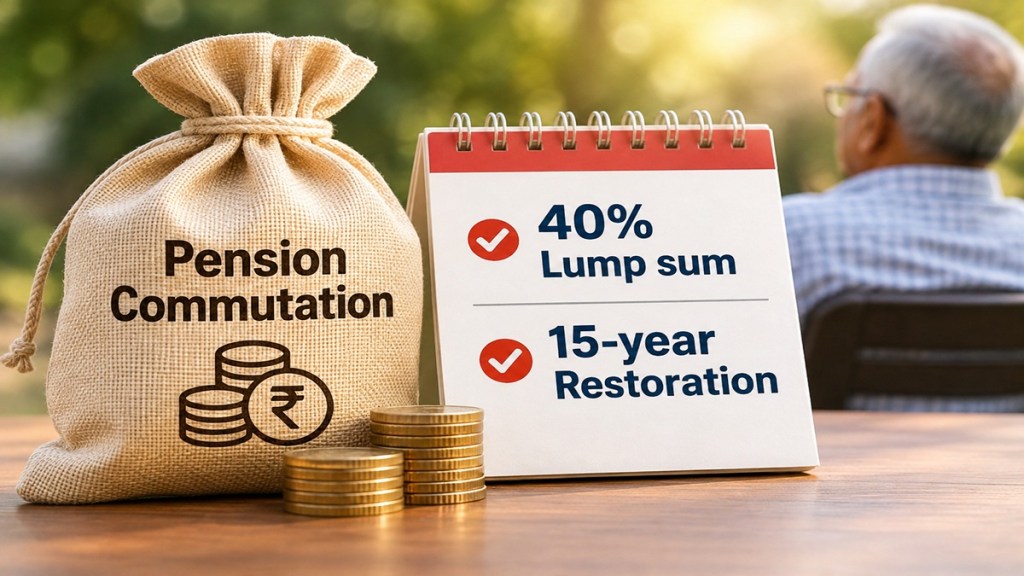

Central government employees retiring from service have the option of taking a part of their pension as a lump-sum payment instead of receiving the entire amount every month. Under the existing rules, they can commute up to 40% of their pension. The commuted portion is deducted from their monthly pension, but it is restored after 15 years.
The rules around pension commutation have now received fresh clarification from the Department of Pension and Pensioners’ Welfare. In four separate Office Memorandums, issued last week, the department has clarified the rules relating to the date of commutation, medical examination requirements and eligibility in cases where departmental or judicial proceedings are pending.
These clarifications do not change the maximum 40% commutation limit or the 15-year restoration period. However, they are important for employees planning retirement, as the timing of the application and the category of pension can determine whether a medical examination is required and how the lump-sum amount is calculated.
How does 40% pension commutation work?
Under Rule 5 of the Central Civil Services (Commutation of Pension) Rules, 1981, a government employee can commute up to 40% of the pension for a lump-sum payment. The employee can also choose to commute a smaller portion.
For instance, suppose an employee is entitled to a monthly basic pension of Rs 50,000 at retirement. If the employee chooses to commute 40% of the pension, Rs 20,000 will be converted into a lump-sum amount. The pensioner will receive the lump sum upfront, while the monthly basic pension will come down to Rs 30,000.
The lump-sum amount is calculated using the prescribed commutation table. The calculation takes into account the portion of pension being commuted, the applicable commutation factor and the pensioner’s age next birthday.
The employee must therefore weigh the immediate requirement for money against the reduction in monthly pension income over the following years.
When is the commuted pension restored?
The commuted portion is not deducted permanently. Under Rule 10-A of the CCS (Commutation of Pension) Rules, 1981, the commuted amount is restored after completion of 15 years from the date the reduction in pension due to commutation becomes operative.
Continuing with the example of a Rs 50,000 monthly basic pension, the pensioner receives Rs 30,000 as basic pension after commuting 40%. Once the applicable 15-year period is completed, the deducted portion of Rs 20,000 is restored. The basic pension then returns to Rs 50,000, subject to applicable pension revisions.
One important point is that the 15-year period is not automatically counted from the date of retirement in every case. It is linked to the date on which the reduction in pension becomes effective under the rules.
Where the commuted value is paid during the first month of retirement and the reduction is reflected in the first pension payment, the period can be counted from the date of retirement. In other cases, the date on which the pension reduction becomes operative is relevant.
When can pensioners commute pension without a medical examination?
The latest government clarification also explains the circumstances in which pensioners can commute a portion of their pension without undergoing a medical examination.
Under Rule 12 of the 1981 rules, this facility is available to specified categories of pensioners. These include employees receiving superannuation pension, retiring pension, pension on absorption in a corporation or company, and compensation pension following abolition of a permanent post. It also covers pension authorised after the conclusion of departmental or judicial proceedings.
The October 29 memorandum states that Rule 12 provides for commutation “without medical examination” for applicants authorised to receive these categories of pension.
For ordinary superannuation and retiring pension cases, employees need to submit their application in the prescribed form within one year of retirement to avail of commutation without medical examination.
The memorandum also clarifies that provisional pension sanctioned under Rule 62 is included in certain specified categories, including superannuation, retiring and compensation pension.
When is a medical examination compulsory?
Not every pensioner can commute pension without a medical examination. Under Rule 18 of the 1981 rules, medical examination is mandatory in specified situations.
These include employees retiring on invalid pension, employees compulsorily retired as a penalty and granted pension, and those receiving compassionate allowance.
The requirement also applies to pensioners who do not submit their commutation application within one year of retirement in cases covered by the relevant provisions.
The department has clarified that such applicants can commute the eligible portion of their pension only after being declared medically fit by the appropriate medical authority. The amount commuted will remain subject to the maximum limit prescribed under Rule 5.
What happens if departmental or judicial proceedings are pending?
Another important clarification concerns government employees whose pension is provisional because departmental or judicial proceedings are pending.
The department has made it clear that provisional pension sanctioned under Rule 8 of the CCS (Pension) Rules, 2021 cannot be commuted while such proceedings are pending.
The memorandum refers to Rule 4 of the 1981 Commutation Rules, which bars the commutation of provisional pension during the pendency of departmental or judicial proceedings.
However, the restriction does not continue indefinitely. Once the proceedings are concluded and an order authorising pension, either fully or partially, is issued, the pensioner can apply for commutation under Rule 13.
There is also a specific relief relating to medical examination. If the application reaches the Head of Office within one year from the date of the order authorising pension, medical examination is not required. If the application is received after this period, medical examination becomes mandatory.
This is particularly relevant for employees whose regular pension is authorised only after the conclusion of departmental or judicial proceedings.
Which date determines the commuted lump-sum amount?
The department has also clarified when commutation becomes absolute. This is important because the date determines the commutation value payable to the pensioner.
According to the memorandum, the date depends on the circumstances of the case.
In a post-retirement application, commutation becomes absolute on the date the Head of Office receives the application in Form 1. In an eligible pre-retirement superannuation case, it becomes absolute on the day following retirement. Where medical examination is required, the relevant date is the day the medical authority signs the medical report in Part III of Form 4.
The memorandum specifically states that the date of commutation becoming absolute “determines the quantum of the commuted value of pension”.
The lump sum is calculated using the commutation value table prescribed and applicable on that date. Therefore, the timing of the application and completion of the required medical formalities can matter when calculating the amount payable.
What should retiring employees keep in mind?
The latest clarifications underline the importance of submitting the commutation application on time and understanding the applicable rules before opting for a lump-sum payment.
While the maximum commutation limit remains 40% and the restoration period remains 15 years, employees should check whether their pension category allows commutation without medical examination. Those facing departmental or judicial proceedings should also understand that provisional pension cannot be commuted until the proceedings are concluded and pension is authorised.
For employees approaching retirement, the decision should not be based only on the lump sum available upfront. They should also consider the reduction in monthly pension, their regular expenses, other retirement income and how they plan to use or invest the commuted amount.
Disclaimer: This article is for informational purposes only. It is based on the Office Memorandums issued by the Department of Pension and Pensioners’ Welfare on October 29, 2026, and the relevant provisions of the CCS (Commutation of Pension) Rules, 1981. Pensioners should refer to the applicable government rules and consult their Head of Office or pension-disbursing authority for clarification regarding their individual cases.
Every financial journey has a turning point. What’s yours?
Financial Express is launching a new series highlighting real experiences with money, investments, and the taxman. Did a sudden tax rule catch you off guard? Did a piece of financial advice change your life? Your story could provide invaluable, practical lessons for thousands of fellow taxpayers. Share your experience with us. We respect your privacy: no stories will be featured without a direct conversation and your full consent. Thank you.