


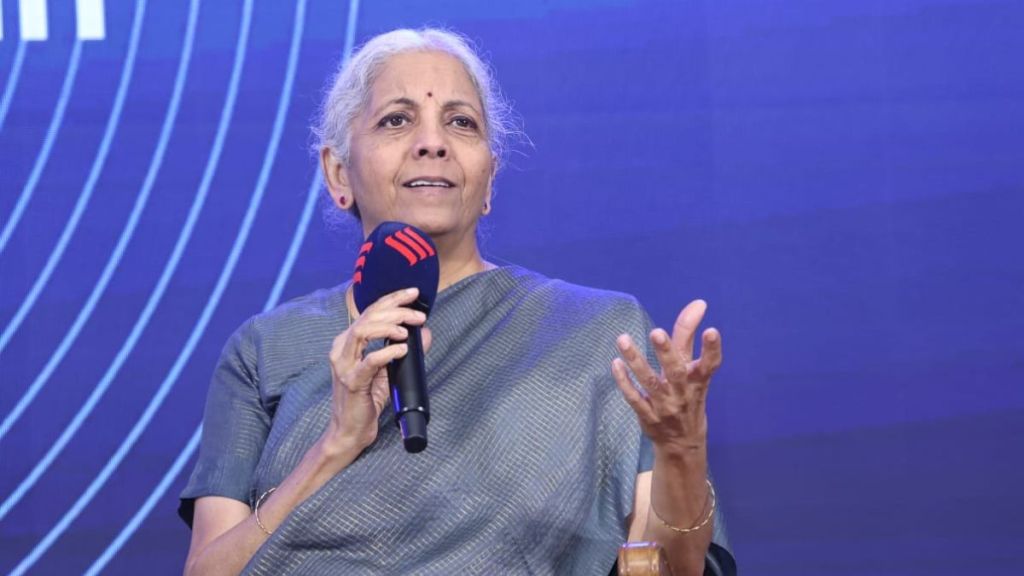

With her tenth Budget just weeks away, Finance Minister Nirmala Sitharaman reassured investors that given the FPI outflows, “voices of concern are louder and I will consider all this.”
The Union Finance Minister Nirmala Sitharaman was the chief guest at the FE Leadership Awards and speaking at a fireside chat with Financial Express Editor Shyamal Majumdar, she spoke on a wide range of topics including foreign outflows, concerns around equity market taxation and the pace of private sector investment.
While she did not announce any specific tax relief or commit to a fresh set of measures for foreign portfolio investors (FPIs) or FIIs, she acknowledged the concerns of market participants and underlined the importance of equity capital in sustaining economic growth.
Here are nine key takeaways from her interaction at the Financial Express Event that the stock market and corporate India should watch.
1. Government acknowledges concerns over foreign investor outflows
Foreign investor selling has been one of the major concerns for the Indian equity market. Market participants have been looking for measures that could improve India’s attractiveness for overseas funds, particularly at a time when global investors have other investment options.
When asked whether the upcoming Budget would roll out the red carpet for foreign portfolio investors, Sitharaman acknowledged that the government was aware of the concerns among investors. She also pointed out that India’s taxation structure was similar in 2023-24, when the country witnessed strong capital inflows.
However, she said the situation has changed since then, with higher net foreign institutional investor outflows. The Finance Minister added that these flows have started reversing and foreign investors are beginning to return.
“I appreciate and recognise the concerns and anxieties prevailing among retail investors and equity market participants,” she said.
However, she did not indicate whether the Budget would introduce any specific changes to the taxation framework to attract overseas investors.

2. Equity capital is important to sustain economic growth
The Finance Minister also highlighted the need for equity capital as India looks to maintain its economic growth momentum. While the government has focused on deepening and widening the country’s bond market over the past few years, she said there are now calls for similar support for the equity market.
The distinction matters for businesses. Companies can raise money through debt or equity to fund expansion, new projects and other capital requirements. A stronger equity market can help businesses access funds without depending entirely on borrowing.
Sitharaman linked the need for capital to India’s growth ambitions, saying the country needs funding to sustain growth of more than 7%.
“At a time when economic growth is important and people are putting in their best efforts to sustain growth of over 7%, we need capital to maintain that momentum,” she said.
She added that equity capital has become particularly important, even as the government has spent considerable time strengthening the bond market.
“I would not want to say more at this stage, but I recognise these concerns,” she said when asked about possible measures to attract foreign investors.
3. Private sector investment is beginning to pick up, but spending remains selective
A broad-based private sector investment cycle has been one of the key expectations for the Indian economy. Although several companies have healthy balance sheets, businesses have remained selective about committing funds to fresh projects and expanding capacity.
When asked whether she was frustrated by the slow pace of corporate investment, Sitharaman said her assessment had changed over the past couple of years.
“I would have said yes a couple of years ago, and I probably have said yes earlier also. But now I am not going to say that, because I am seeing industry come out. I am seeing industry invest,” she said.
She acknowledged that companies may still be selective about where they invest. Some may choose particular sectors, while others may avoid expanding in areas where they already have a significant presence.
4. GST reforms have improved demand visibility for companies
Sitharaman attributed part of the improvement in private sector investment sentiment to the next-generation GST reforms introduced in September 2025.
According to her, the changes have made consumption and demand more visible to businesses. This gives companies greater confidence to invest, increase production and meet the demand they see in the market.
“Industry now has the confidence that demand exists in the market. It can invest, produce and reach the levels it wants to achieve,” she said.
The Finance Minister also referred to the October GST collection figures, which were the highest ever. She said the numbers reflected the role of domestic consumption in supporting the economy.
“The improvement in consumption has provided clear visibility to businesses, and that is why I am seeing investments coming from the private sector,” she said.
5. No clear commitment on a Budget package for foreign investors
The possibility of a Budget announcement aimed at attracting foreign capital was raised more than once during the interaction. When asked whether the government would make a concerted effort to attract dollars and whether taxation changes could form part of that approach.
Sitharaman did not give a direct assurance. Instead, she said the government would first listen to stakeholders, understand their concerns and then examine what could realistically be done.
“We will hear all the stakeholders, understand what the government can realistically do and then act accordingly,” she said.
She added, “First, we need to hear them and then examine what we can do.”
6. MSMEs and startups are expanding India’s corporate base
Concerns that a small number of large business groups dominate India’s economy also came up during the discussion. Sitharaman disagreed with the suggestion that economic activity is concentrated among only a handful of companies.
She pointed to the growth of MSMEs and startups, saying businesses are emerging and expanding across sectors.
“Today, MSMEs are flourishing,” she said, explaining that the government changed the definition of MSMEs to allow businesses to grow without immediately losing the benefits available to them.
The intention, she said, is to help micro enterprises expand into small businesses, small businesses into medium enterprises, and medium enterprises into large companies.
She also highlighted the contribution of the MSME sector to exports, saying it accounts for 40% of India’s total exports.
“If the MSME sector accounts for 40% of India’s total exports, one can understand the extent of its reach across the country,” she said.
7. PLI incentives will remain linked to actual production
The government’s Production-Linked Incentive (PLI) scheme was another subject discussed during the interaction. The scheme provides incentives to companies that increase production in selected sectors.
Sitharaman said the government expects companies to demonstrate additional production before they can receive the benefits.
“That is where I think our methodology has been through the Production-Linked Incentive (PLI) scheme. We tell companies that if they demonstrate additional incremental production, they can avail themselves of the incentives,” she said.
She added that the scheme has shown success, although there are sectors where it has not delivered the expected results.
“The PLI scheme has shown success. However, there are certain sectors where it has not been as successful. We will have to examine what went wrong in those sectors,” she said.
8. Government procurement and regulatory rules are being reviewed
The Finance Minister also spoke about the government’s efforts to address regulatory hurdles and improve the ease of doing business.
She referred to changes in government procurement rules, tender conditions, project execution and bank guarantees. According to her, the Department of Expenditure periodically reviews procurement provisions to make them more transparent and reduce unnecessary complications for businesses.
Sitharaman said there was a time when companies avoided bidding for certain government tenders because the conditions were too difficult. She said the rules have since been simplified and made more user-friendly.
“Several issues that were earlier pain points for industry have been addressed,” she said.
She also cited the continuation of certain provisions introduced during the Covid-19 pandemic. For instance, companies were allowed to conduct annual general meetings through video conferencing, and the facility was not withdrawn after the pandemic.
9. Industry should maintain regular engagement with the government
Sitharaman said businesses should not limit their interaction with the government to the annual Budget exercise. While she said companies were welcome to make demands, she also wanted them to provide regular feedback on whether policies were helping them grow.
She said the government needs to understand whether businesses are making progress, what difficulties they continue to face and whether additional changes are required.
“That interaction should be active and continuous,” she said.
The Finance Minister also said the government and industry should not operate as separate entities, with companies submitting representations before the Budget and then stepping away.
“We are all together in this effort. We have to build India and take India forward. We have reached an inflection point, and we should not fail ourselves,” she said.
What does this mean for the markets?
Sitharaman’s interaction touched on several issues that investors will track ahead of the next Budget – foreign investor flows, equity capital, private sector investment, domestic consumption and the policy environment for businesses.
Her acknowledgement of concerns around FPI outflows is significant, but there was no confirmation of a tax change or a special package for overseas investors. Similarly, her assessment that private investment is improving points to a possible change in corporate sentiment, although she acknowledged that companies are still choosing where to spend.