




After being cautious on Indian equities for nearly two years, Bank of America Securities has turned more constructive on the market. They now have a December 2026 Nifty target of 26,200, implying 12% potential upside. The brokerage believes several risks that had weighed on Indian equities have either played out or are already reflected in prices, while resilient economic indicators and a likely end to earnings downgrades could provide support to the market.
BofA, however, is not calling for a smooth recovery. It sees three risks still active around Federal Reserve policy, large primary-market fund raises and the longer-term impact of artificial intelligence on employment. Against that backdrop, the brokerage has shifted its preference from small and midcaps towards large caps and highlighted 22 stock ideas where its analysts see either attractive valuations or strong earnings growth and visibility.
BofA turns constructive on Nifty after two years of caution
BofA said it had remained cautious on Indian markets since August 2024, when it highlighted a series of risks that could keep equities volatile. Its latest strategy note marks a change in stance, with the brokerage now seeing a more favourable risk-reward for the Nifty.
The key reason is that five of the eight risks identified earlier have either played out or moved close to worst-case assumptions. BofA pointed to crude oil, the rupee, weak monsoons, commodities and RBI rate hikes as areas where much of the adverse scenario has already been reflected.
The brokerage expects crude to average$81 a barrel in the fourth quarter of calendar year 2026, despite the recent move above$100. BofA noted that crude has reversed from the$100 level seven times over the past seven months, suggesting that the recent spike may not necessarily become a sustained trend.
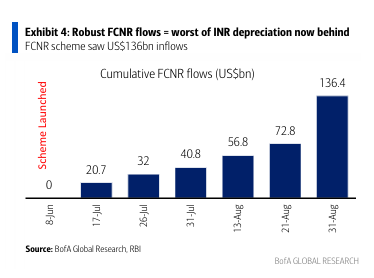
Currency pressures have also eased in BofA’s assessment. The brokerage highlighted$136 billion of cumulative FCNR inflows and said these flows should help stabilise the rupee, with the bias now towards appreciation. On the monsoon front, the current deficit of 13% is already close to the 15% deficit that had represented the worst-case weather scenario in BofA’s earlier assessment.
Three risks remain: Fed, fundraising and AI disruption
While five risks have moved closer to being priced in, BofA said three remain important for Indian equities.
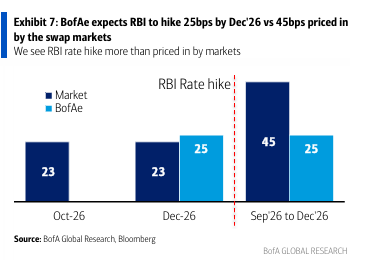
The first is US Federal Reserve policy. BofA expects 75 basis points of Fed rate hikes between September and December 2026, compared with only 35 basis points currently priced into US swap markets. A more aggressive rate-hike cycle could keep US Treasury yields elevated and put pressure on emerging-market flows.
That matters for India because foreign investor flows have already been weak. BofA said India had seen US$25.5 billion of foreign investor outflows in calendar year 2026 so far and conservatively expects the figure to reach US$35 billion for the full year.
The second risk comes from India’s primary market. BofA expects large and lumpy fund raising of around US$30 billion between September and December, compared with $36 billion raised in the first part of the year. October is expected to be the peak month, creating a potential drain on liquidity available for the secondary market.
The third is more structural. BofA continues to flag AI disruption and its possible impact on employment as a longer-term risk for India. The brokerage also pointed out that India has been a notable laggard in the global AI-led market rally since the launch of ChatGPT in November 2022.
Why BofA thinks the Indian economy can absorb these risks
Despite the market’s concerns, BofA sees several signs that the underlying Indian economy remains resilient.
The brokerage said high-frequency indicators and first-quarter FY27 earnings were stronger than expected even during the peak of the West Asia conflict. Its assessment of 20 companies, representing around 51% of Nifty market capitalisation, showed better-than-expected performance across several operating indicators.
BofA also said its economics team had recently upgraded macro forecasts. Stabilising currency conditions, higher liquidity following strong FCNR deposits and continued growth in central government capital expenditure are expected to provide support to the economy.
This distinction between the market and the economy is central to BofA’s latest strategy. While foreign flows, global interest rates and fund raising can keep equities volatile, the brokerage believes domestic growth has remained stronger than the market’s performance might suggest.
Earnings cuts may finally be coming to an end
Another important part of BofA’s India strategy is its view that the earnings downgrade cycle is nearing its end.
The brokerage noted that consensus earnings estimates for FY27 have already been cut by 230 basis points year to date. It now believes the large earnings cuts are behind the market and forecasts Nifty earnings growth of 10% in FY27 and 15% in FY28.
“We believe earnings cuts have now peaked,” BofA noted.
The brokerage’s December 2026 Nifty target of 26,200 is based on FY27 earnings of 1,208 and FY28 earnings of 1,392, with a blended earnings estimate of 1,301. It applies a 20-times multiple, slightly above the 10-year long-term average of 18.9 times. In its bear case, BofA sees the Nifty at 21,800, implying 7% downside, using a 17-times multiple.
Nifty valuations have become more reasonable
BofA’s valuation argument is also more supportive after the recent correction.
The brokerage noted that the Nifty was trading at 17.6 times one-year forward earnings, close to its negative one-standard-deviation level of 17 times. This puts valuations closer to the lower end of their historical range.
BofA’s analysis of eight market crises over the past two decades found that Nifty valuations have typically contracted towards the negative one-standard-deviation level during periods of stress, before expanding back towards or above long-term averages once the crisis passes.
“Currently, Nifty’s valuations are below long term averages providing scope for some valuation expansion,” BofA explained.
The brokerage therefore sees room for both earnings growth and some valuation expansion to support the Nifty’s December target.
BofA changes course on small and midcaps
One of the more significant changes in the strategy is BofA’s shift from small and midcaps towards large caps.
Small and mid-cap indices had outperformed the Nifty by 13% to 20% year to date, according to the brokerage. That strong performance has also pushed their valuation premium to 43%, compared with 53% at the peak.
BofA still sees individual opportunities among smaller companies but believes the valuation advantage has become less compelling after the rally. At the same time, the brokerage expects small and midcap earnings growth to revive, estimating an 849-basis-point earnings growth premium over the Nifty between FY26 and FY28.
“Although we continue to see select opportunities within SMID, we reverse our preference for SMIDs & suggest switching to large caps,” BofA said.
The brokerage added that investors would need to remain nimble and focus on companies offering either value or strong earnings growth and visibility.
What BofA’s India strategy means for investors
The latest strategy marks a notable shift from BofA’s earlier defensive stance. The brokerage is now balancing the remaining global and domestic risks against resilient economic growth, a potential end to earnings downgrades and more reasonable Nifty valuations.
The strategy remains cautious on global liquidity, foreign flows and AI-related structural risks. But BofA’s base case suggests that if the remaining near-term risks peak as expected, the combination of earnings recovery and some valuation normalisation could support the Nifty through the end of 2026.
The key portfolio shift is towards large caps after the strong run in small and midcaps..
Disclaimer: This article is based on BofA Global Research’s Equity Strategy – India: Known Unknowns report and presents the brokerage’s views, forecasts, Nifty target, stock ratings, price objectives, earnings estimates, sector preferences and investment rationale as published in that report. The stock-level upside percentages in this article are calculations based on the current prices and price objectives stated by BofA in its research and should not be interpreted as assured or expected returns. Price objectives are estimates based on the brokerage’s valuation assumptions and can change as earnings forecasts, interest rates, commodity prices, exchange rates, economic conditions, company fundamentals and market valuations change. Equity markets and individual securities can experience significant volatility, and investors may lose part or all of their invested capital. BofA itself identifies Federal Reserve policy, large primary-market issuances and the potential impact of artificial intelligence on employment as continuing risks to its India market view, while its bear case assumes further earnings pressure and valuation contraction. The report also states that BofA Securities does and seeks to do business with issuers covered in its research reports and that the firm may have conflicts of interest that could affect the objectivity of its research. Its disclosures also show investment-banking, market-making and other business relationships involving several companies covered in the report. Investors should therefore treat the research as one input into their decision-making process rather than as personalised investment advice. Readers should independently assess the financial position, valuation, business outlook, risks and suitability of any security before making an investment decision and consider their own financial objectives, financial circumstances and risk tolerance. Past performance and analyst price objectives are not guarantees of future results. Those who require personalised guidance should consult a qualified financial adviser. This article is intended for informational purposes only and should not be construed as a solicitation or recommendation to buy or sell any security, or as a guarantee of future market or stock performance.