




Foreign institutional investors could return to Indian equities as some near-term pressures ease, but Bernstein does not expect that buying to automatically mark the return of a sustained foreign capital cycle. The brokerage expects FII flows to be flat to modestly positive over the next 12 months, while arguing that India needs to build globally competitive businesses before overseas funds have a stronger reason to make long-term allocations.
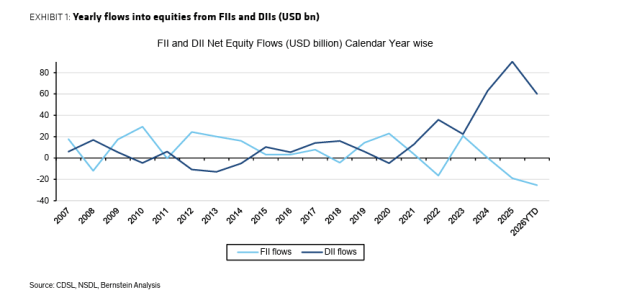
The assessment comes after a sharp deterioration in foreign flows. Bernstein said FIIs have net invested only $4 billion in Indian equities over the past decade, compared with $300 billion from domestic institutional investors. Over the last two years, FIIs have withdrawn $40 billion. The latest 24-month period recorded combined FII outflows of $56.3 billion, against inflows of $38.6 billion during the preceding 24 months.
FIIs could return to trade India, but long-term allocations need more
Bernstein said the more useful question is not when FIIs will return, but why they would return to India in the first place.
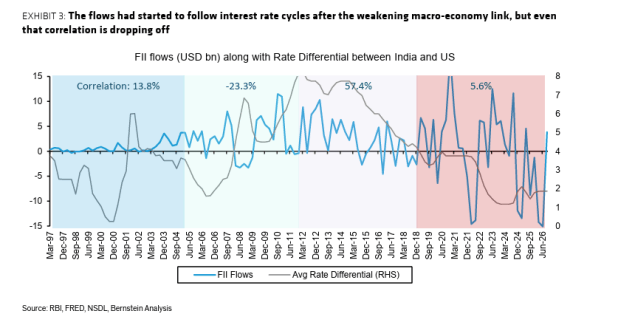
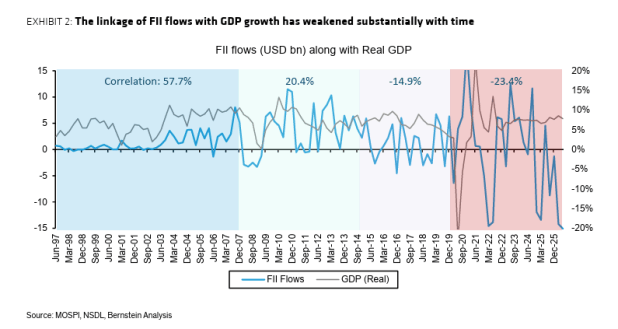
The brokerage said the relationship between India’s economic growth and FII flows has weakened substantially over time. Strong GDP growth once had a much closer relationship with foreign flows, but that connection has weakened to the point where the latest period shows a negative correlation. The relationship between FII flows and the India-US interest-rate differential has also weakened after becoming an important driver between 2012 and 2018.
Bernstein wrote, “The billion dollar question is not when the FIIs will return, but why the FIIs will return, if at all they do.”
The brokerage said the traditional cycle has broken down over the past four years, with domestic institutional flows continuing to grow while foreign flows have reached new lows. It also noted that the Nifty has delivered only around 6% annualised returns in US dollar terms over the past decade, while the last two years have seen annualised declines of around 11%.
Semiconductors and batteries could provide new sources of foreign capital
Bernstein said a lasting revival in foreign flows would require India to build industries that can compete beyond the domestic market.
The brokerage pointed to advanced semiconductor manufacturing, batteries and energy storage, along with greater energy self-sufficiency. It said these areas could provide the type of new industrial capabilities that would give overseas funds a stronger reason to build long-term positions in India.
Bernstein wrote that sustained foreign participation would depend on “India’s ability to build globally competitive industries in emerging areas”, rather than simply on an improvement in temporary market conditions.
The report specifically calls for “advanced semiconductor manufacturing rather than just assembly”, indicating that Bernstein sees a significant difference between building manufacturing capacity and developing businesses that can compete globally.
The brokerage also pointed to batteries and energy storage as areas where India needs deeper capabilities. It said the country must develop businesses capable of gaining meaningful market share globally if it wants to support durable foreign capital inflows.
Space, defence and deep-tech remain early-stage opportunities
Bernstein also mentioned space, defence, semiconductors and deep-tech innovation among the areas where India is beginning to develop capabilities that could eventually become relevant to global capital allocation.
The brokerage cautioned that most of these industries remain too small to have a material impact on capital flows across much of this decade. Their eventual importance will depend on whether companies in these sectors can grow to a scale that allows large overseas funds to deploy substantial amounts of capital.
Bernstein said, “We are seeing early signs of this in areas such as space, defense, semiconductors, and deep-tech innovation”, while adding that most of these industries remain too small to materially influence capital allocation decisions for now.
The report therefore places the emphasis on building scale, technology capabilities and globally competitive businesses rather than simply expanding domestic demand in these industries.
EVs and solar show where India needs more corporate investment
Electric vehicles and solar also feature in Bernstein’s assessment of India’s difficulties in developing new industries.
The brokerage said India has struggled to scale in EVs, semiconductors and solar, and pointed to the reluctance of companies with the deepest financial resources to commit sufficient capital to these areas.
Bernstein said, “One reason India has struggled to scale in emerging technologies such as EVs, semiconductors and solar is the reluctance of companies with the deepest pockets to commit capital.”
The brokerage’s concern is that many large companies remain focused on established businesses instead of putting enough money into industries that could generate India’s next phase of growth. That leaves overseas funds with fewer large, liquid companies through which they can gain exposure to emerging technologies.
Small and midcaps face liquidity and scale constraints
If large companies do not provide enough exposure to new growth areas, Bernstein said overseas funds would have to look towards small and mid-cap companies. The brokerage, however, sees several constraints in that part of the market.
Many SMIDs have low free floats, limited liquidity and sparse research coverage, according to Bernstein. Large institutional funds also require specialist teams, dedicated resources and long investment periods to identify which smaller companies can become major businesses.
Bernstein said, “But separating quality from noise and identifying future giants requires specialist teams, dedicated resources and long investment horizons.”
The brokerage also noted that smaller stocks can attract money on the back of news-driven narratives and then face sharp selling when quarterly performance disappoints. By the time a small number of successful companies become large enough for substantial institutional ownership, much of their value creation may already have taken place.
Rupee weakness has become a bigger factor in FII flows
Currency performance has become increasingly important in Bernstein’s assessment of foreign flows into India.
The brokerage found that the correlation between FII flows and movements in the rupee against the US dollar reached 72.9% in the latest period examined. It said this relationship has strengthened considerably compared with earlier periods.
Bernstein explained that foreign funds ultimately measure returns in dollar terms, making currency movements an important part of the return calculation. A weaker rupee can therefore reduce dollar returns even when an Indian equity performs well in local-currency terms.
The brokerage wrote that “Foreign money, of late, seems to be dictated more by currency stability.”
Bernstein also compared FII flows with the broader dollar index to remove the direct effect of rupee weakness caused by FII outflows. That relationship strengthened after 2020 and reached more than 50% during the latest 11 quarters examined in the report.
High Indian valuations continue to weigh on foreign flows
Bernstein also examined India’s valuation relative to emerging markets rather than relying only on absolute valuation levels.
The brokerage found that higher relative valuations have increasingly coincided with weaker FII flows, particularly after 2020. Its analysis showed average relative valuations rising from 109% between June 2005 and December 2010 to 162% between December 2023 and September 2026.
Over those same periods, net FII flows moved from an inflow of $68 billion to an outflow of $44 billion.
Bernstein said, “valuations do seem to be a deciding factor for FIIs when they decide to deploy money into markets.”
The brokerage’s analysis suggests that India’s premium relative to other emerging markets has become increasingly relevant to foreign capital allocation decisions, particularly as competing markets offer alternative opportunities.
Earnings revisions could matter more than reported earnings growth
Bernstein found little meaningful relationship between current-quarter earnings growth and FII flows. The relationship was also weak when foreign flows were compared with the previous quarter’s earnings growth.
The brokerage then examined forward earnings revisions, including changes to estimates for the current and following quarters. Among the measures tested, revisions to the next quarter’s earnings over a three-month period showed the strongest relationship with FII flows.
Bernstein said, “The relationship has historically been weak apart from the 2011-2015 phase but is getting stronger again.”
The finding suggests that the direction of future earnings expectations could carry more weight than earnings growth that has already been reported. The relationship remains uneven across periods, so Bernstein does not present earnings revisions as a single explanation for foreign flows.
What could bring FIIs back over the next year?
Bernstein expects foreign flows to improve modestly if some of the recent pressures ease.
Lower oil prices, faster earnings growth and better macroeconomic conditions could bring foreign capital back for periods, according to the brokerage. Such flows would be cyclical and would not necessarily mean that overseas funds have resumed making large structural allocations to India.
Bernstein said, “Our view that FII flows are likely to be flat to modestly positive over the next 12 months remains unchanged”, while adding that this expectation is based mainly on the easing of recent headwinds rather than a meaningful improvement in the structural factors driving long-term foreign capital allocation.
The brokerage also rejected the idea that foreign money is simply waiting for the AI trade to peak or the Middle East crisis to end before returning to India in large amounts.
India needs companies that can compete globally
Bernstein’s longer-term argument rests on India’s ability to build companies that can compete in international markets.
The brokerage said India needs advanced semiconductor manufacturing, deeper battery and energy-storage capabilities and greater energy self-sufficiency. It also pointed to space, defence and deep-tech as areas where early progress is visible.
Bernstein wrote, “Above all, India must demonstrate that it can create the next generation of globally relevant companies, not merely consume technologies developed elsewhere.”
The distinction is important to the brokerage’s thesis. Developing domestic industries alone may not be sufficient to attract sustained foreign capital. Companies must eventually reach a size and competitive position that makes them meaningful destinations for large global funds.
Foreign flows could return before a structural revival takes shape
Bernstein’s assessment leaves room for foreign money to return to Indian equities, particularly if oil prices fall, earnings improve or currency pressures ease. But the brokerage does not see those developments as sufficient on their own to restore the older FII cycle.
For a sustained revival, the brokerage wants to see new engines of competitiveness, innovation and global relevance. That brings semiconductors, batteries, energy storage, space, defence and deep-tech into the discussion, while EVs and solar remain examples of areas where India still needs greater scale and capital commitment.
Disclaimer: This article is based on an India Strategy report published by Bernstein. The views on FII flows, valuations, currency movements, earnings revisions, macroeconomic conditions, sectors and emerging industries are those of Bernstein and its analysts and have been reproduced or paraphrased for informational purposes. The expectation of flat to modestly positive FII flows over the next 12 months is an analyst view and is not a guarantee or forecast of actual foreign investment flows. Historical correlations between FII flows and economic growth, interest-rate differentials, currency movements, earnings revisions or valuations do not establish causation and may not persist in future periods. References to semiconductors, batteries, energy storage, space, defence, deep-tech, electric vehicles and solar reflect the industries discussed by Bernstein and should not be interpreted as sector-specific investment recommendations. The report does not provide individual stock recommendations or sector allocation targets in the analysis discussed above. Readers should independently evaluate the underlying research, market conditions and associated risks and, where appropriate, consult a SEBI-registered investment adviser before making investment decisions. Past performance, historical relationships and analyst estimates are not indicative of future results.