


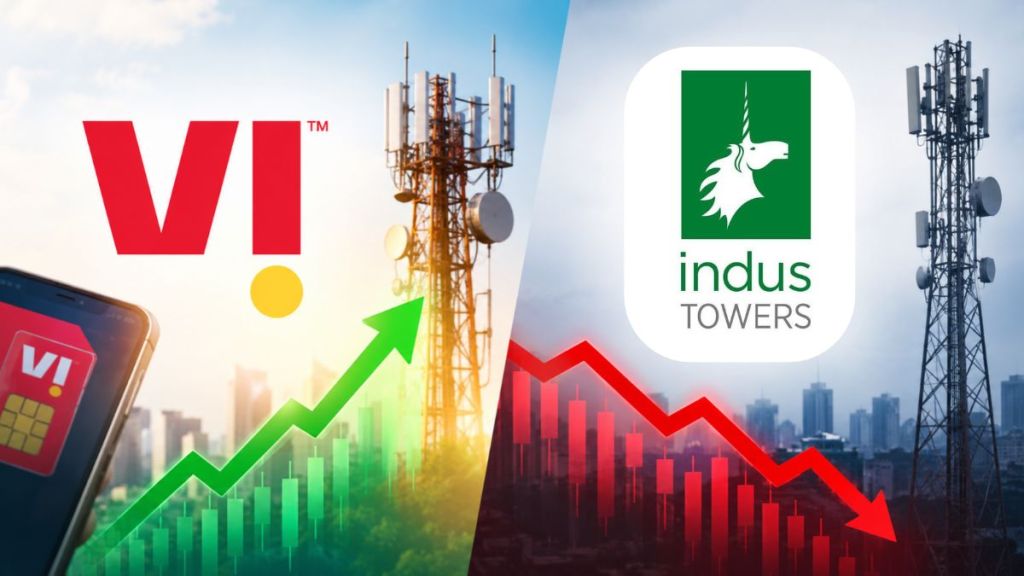

Two key telecom sector players, Vodafone Idea and Indus Towers have taken sharply different trajectory in the stock market over the past six months. Vodafone Idea has gained 53%. Indus Towers, meanwhile, has fallen 12% in the last 6 months.
According to Kotak Institutional Equities, any meaningful improvement in Vodafone Idea’s financial position should also provide some benefit to Indus Towers, its tower infrastructure provider. The latter could gain through higher rental income and a lower risk of delayed payments.
Here is a detailed analysis of Kotak Institutional Equities’ investment rationale behind it –
Vodafone Idea’s rally raises a bigger question
According to the brokerage report, the sharp move in Vodafone Idea’s stock may partly be linked to the government’s decision in April to reduce its adjusted gross revenue dues by Rs 22,700 crore and allow repayment over a longer period.
That changed the company’s near-term financial burden.
Kotak’s assessment suggests there is still a large gap between the improvement in sentiment and Vodafone Idea’s underlying financial position.
The brokerage said, “The large outperformance of Vodafone Idea over Indus Tower over the past six months is perplexing.”
If Vodafone Idea’s financial outlook improves, Indus Towers should also benefit as the telecom operator becomes better placed to pay tower rentals.
Vodafone Idea: Kotak says AGR relief changed equation, but not everything
Adjusted gross revenue, or AGR, refers to the revenue-based dues that telecom operators are required to pay to the government.
The reduction in these dues has eased some pressure on Vodafone Idea. However, according to the Kotak report, the company could continue to report losses for several years.
Kotak expects Vodafone Idea to remain loss-making even in FY29 under its current assumptions. These include a moderate recovery in wireless subscribers and a meaningful increase in average revenue per user, or ARPU.
The brokerage said Vodafone Idea would need a much sharper increase in ARPU, or further relief on AGR and spectrum liabilities, to bridge its cash-flow gap.
Can Vodafone Idea turn the rally into cash flow?
Kotak in its report added that the Vodafone Idea’s market capitalisation of around Rs 1.5 lakh crore appears to reflect expectations of significantly better profits and cash generation over time.
But the company is expected to face negative free cash flow for several years. It also has sizeable spectrum and AGR-related repayments ahead.
Kotak said, “It is anybody’s guess as to how Vodafone Idea’s medium-to-long term cash flows will shape up.”
What does Indus Towers bring to the table?
Kotak Institutional Equities added that Indus Towers is expected to see a steady increase in revenue, earnings before interest, taxes, depreciation and amortisation (EBITDA), and net profit between FY26-FY29.
The company also trades at 13.3 times one-year forward price-to-earnings (P/E) and 6.3 times one-year forward enterprise value to EBITDA.
Kotak sees a potential upside scenario if Vodafone Idea rolls out capital expenditure faster than expected.
Why the telecom link matters
Indus Towers’ business depends heavily on telecom operators using their tower infrastructure.
The key question now is what happens if Vodafone Idea spends more on its network?
According to the brokerage report, faster capital expenditure by Vodafone Idea could create upside risks to Indus Towers’ estimates. Kotak assumes Vodafone Idea will be able to continue paying tower rentals.
The brokerage also does not see a significant downside from Indus Towers’ Africa tower investments, citing the presence of an anchor tenant, relatively low capital expenditure requirements and growth prospects.
For Kotak, the 65 percentage point divergence is difficult to explain purely through the expected improvement in Vodafone Idea’s financial position.
Disclaimer: This article is based on research reports from one or more brokerage firms and is for informational purposes only. The views, target prices, and recommendations expressed are those of the respective brokerage firms and do not reflect the official policy or position of Financial Express. This should not be construed as an offer, solicitation, or recommendation to buy or sell securities. Investors must conduct their own independent due diligence and seek advice from a SEBI-registered financial advisor before making any investment decisions.