



India’s critical-mineral push is beginning to create business opportunities well before commercial mining starts, with activity emerging across exploration, drilling, research vessels, subsea technology and mineral processing. L&T, Garden Reach Shipbuilders & Engineers (GRSE), Vedanta and Titagarh Rail Systems are entering different parts of that chain, but the scale and timing of their exposure vary significantly.
National Critical Mineral Mission: What it entails
The National Critical Mineral Mission has planned 1,200 critical-mineral exploration projects through FY31, while the Geological Survey of India conducted 230 projects in FY26, according to a September 2026 KPMG-FICCI report. India has explored less than 15% of its obvious geological potential and consumes less than 1% of the global exploration budget, the report said.
The deep-sea opportunity is further out. India has exploration rights over 75,000 sq km in the Central Indian Ocean Basin, estimated to contain about 366 million tonnes of polymetallic nodules containing nickel, cobalt, manganese and copper. However, the domestic offshore auction failed to attract adequate bids.
“India’s deep-sea critical-minerals programme is currently an exploration and technology-development theme, not a commercial mining theme,” said Ankit Soni, Research Analyst at Mirae Asset Sharekhan.
“Therefore, the immediate opportunity lies in research vessels and exploration infrastructure, not mining companies,” he added.
That puts GRSE and Titagarh closer to the immediate deep-sea opportunity through research vessels, while L&T has an engineering and technology connection. Vedanta, on the other hand, is taking direct exposure to land-based critical-mineral exploration.
Vedanta takes the mining and exploration route
Vedanta has secured 10 critical-mineral blocks covering gold, manganese, copper, nickel-chromium-PGE, tungsten, graphite, vanadium, rare earth elements and potash, with exploration underway across five blocks. The company was also declared the successful bidder for the Punnam manganese block in Andhra Pradesh.
In August, Vedanta commissioned what it described as India’s first high-speed hydrostatic portable drilling rig, capable of drilling up to 1,000 metres compared with the typical 300–400 metre range. The rig has been deployed at two exploration sites in Chhattisgarh targeting gold and critical minerals including nickel, chromium and platinum group elements.
Netra Deshpande, Research Analyst at Mirae Asset Sharekhan, said the rig is part of a much wider exploration programme, but the assets remain at an early stage. “These are still early-stage assets,” Deshpande added.
“Its nickel-chromium-PGE blocks at Genjana (Bihar) and Gollarahatti-Mallenahalli (Karnataka) have been classified at G4 level, the first of the four exploration stages, and the use of a rig does not mean that a commercial resource has been found,” she explained.
Deshpande said a commercial resource would require “extensive drilling, independent resource estimation and feasibility studies over a long period”.
According to her, “as a baseline, global mine development from discovery to production has averaged on the order of 15 years,” she said. “A composite licence gets you over part of the Indian regulation, but forest clearance and land acquisition tend to eat that benefit up.”
Vedanta has not disclosed any timeframe for resource discoveries or commercial production from these blocks. Deshpande said any timeline for commercialisation should therefore be treated as an estimate rather than a disclosed company target.
The distinction is important because the new exploration portfolio does not yet represent proven reserves or an identified production stream.
Vedanta’s existing metals operations provide a separate earnings base. In Q1 FY27, the company reported revenue of Rs 23,456 crore, and growth capex of Rs 1,148 crore. EBITDA margin was about 57%.
The KPMG-FICCI report says India’s opportunity in critical minerals extends beyond extraction to separation, refining, advanced materials and recycling. It also points to technology requirements across the mining-to-metals value chain.
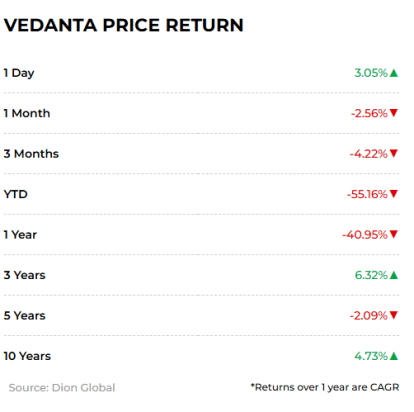
Vedanta share price performance
| Company | Current critical-mineral linkage | Disclosed scale |
| Vedanta | Critical-mineral exploration and mining blocks | 10 blocks |
| GRSE | Specialised ocean research vessels | 4 vessels; about Rs 1,821 crore original combined contract value |
| Titagarh | Research vessels and shipbuilding | Rs 445 crore GSI-vessel subcontract |
| L&T | Deep-ocean engineering and technology | Titanium forgings and engineering support for Matsya-6000 |
GRSE gets work before deep-sea mining begins
For India’s deep-sea programme, the nearer-term commercial opportunity is in vessels and equipment required to explore the seabed.
GRSE is building four specialised research vessels with an original combined contract value of about Rs 1,821 crore. These include the Rs 840-crore Sagar Manthan Ocean Research Vessel for NCPOR, a Rs 491-crore Acoustic Research Ship for NPOL and two Coastal Research Vessels for the Geological Survey of India.
“Garden Reach Shipbuilders & Engineers, or GRSE, has the clearest exposure. It is building four specialised research vessels with an original combined contract value of about Rs 1,821 crore,” Mirae’s Soni explained.
The Ministry of Earth Sciences said in a September 9 Press Information Bureau release that ORV Sagar Manthan, built by GRSE for the National Centre for Polar and Ocean Research, was launched at the Rishi Bankim Shipyard in Kolkata.
According to the PIB release, the vessel was designed, engineered and constructed by GRSE for NCPOR under the Ministry of Earth Sciences. The ministry described it as India’s first advanced ‘Ocean Research Vessel’ built by GRSE and said it would strengthen India’s indigenous oceanographic research and maritime technology capabilities.
The ministry said the vessel would support research into oceans, climate dynamics and marine systems and strengthen India’s maritime research capabilities.
The research-vessel opportunity, however, remains smaller than GRSE’s core defence business.
Harshit Kapadia, Vice President – Capital Goods, Consumer Electricals and Consumer Electronics at Elara Securities, said, “GRSE 5% of order book is attributed to special vessel for deep sea exploration. Based on the upcoming pipeline, there could be an order for another 2-3 ships.”
“We dont think that it would be a material earnings drivers as its contribution is in single-digit. Additionally, there are large defence order in pipeline such as NGC and P17B Frigate, that would be help move the earnings over next five years,” Kapadia said.
Soni estimates that GRSE’s remaining research-vessel backlog was approximately Rs 1,448 crore as of June 30, 2026, or about 10.6% of its Rs 13,596-crore order book.
“During peak execution, we estimate that research vessels could contribute roughly Rs 400–600 crore annually, equivalent to around 5–8% of revenue,” Soni said.
“That makes the segment strategically meaningful but not transformational. It diversifies GRSE beyond defence, gives the company access to civilian scientific budgets and helps maintain yard utilisation between major naval orders,” he said.
“However, margins may be constrained by imported equipment, first-of-class engineering and subcontracting,” Soni elaborated.
| GRSE research-vessel exposure | Details |
| Original combined contract value | About Rs 1,821 crore |
| Remaining research-vessel backlog | About Rs 1,448 crore |
| Share of Rs 13,596-crore order book | About 10.6% |
| Estimated annual revenue contribution at peak execution | Rs 400–600 crore |
| Estimated revenue contribution | About 5–8% |
GRSE’s overall order book stood at Rs 13,596 crore as of June 30, 2026. Management said it comprised 11 projects and 44 marine platforms, including nine warships for the Indian Navy, one P17 Alpha advanced frigate, four Next-Generation Offshore Patrol Vessels, four Anti-Submarine Shallow Water Craft, two Coastal Research Vessels and one Acoustic Research Ship.
In Q1 FY27, GRSE’s revenue from operations rose 39% year-on-year to Rs 1,815 crore, while profit after tax increased 44% to Rs 173 crore.
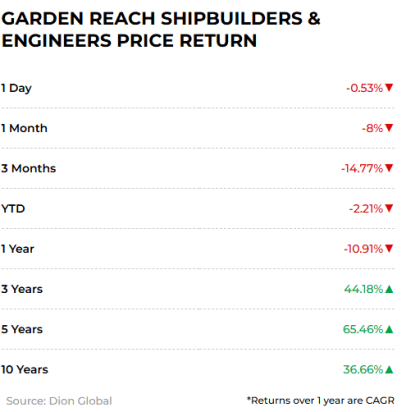
GRSE share price performance
Titagarh extends the vessel opportunity beyond rail
Titagarh’s connection to the deep-sea exploration programme comes through research vessels, alongside its substantially larger passenger and freight rail operations.
The company previously delivered two research vessels to the National Institute of Ocean Technology and now has a Rs 445-crore pre-GST subcontract from GRSE for construction of the two GSI vessels, according to Soni.
“The second-clear beneficiary is Titagarh Rail Systems. It previously delivered two research vessels to NIOT and now has a Rs 445-crore pre-GST subcontract from GRSE to construct the two GSI vessels,” Soni highlighted.
Titagarh’s standalone order book stood at Rs 13,335 crore at the end of Q1 FY27, including Rs 10,395 crore from Passenger Rail Systems and Rs 2,470 crore from Freight Rail Systems. Its total order book, including its share of joint-venture orders, stood at Rs 26,635 crore.
The passenger rail business accounted for about 31% of Q1 revenue, with more than 30 coaches dispatched during the quarter. Titagarh plans to increase coach production to 45–50 coaches per quarter in FY27 and establish annual production capacity of more than 850 coaches by 2028-29.
Its maritime business is also expanding. Titagarh Naval Systems is setting up a brownfield shipyard at Falta with planned capex of about Rs 600 crore and has secured Rs 169 crore under the Shipbuilding Financial Assistance Scheme.
The company is pursuing opportunities in small vessels, passenger ferries and craft and is working with international partners on hovercraft for the Indian Coast Guard. It is also targeting opportunities with ONGC, IWAI, the Indian Navy, the Coast Guard and Sagarmala.
The maritime expansion gives Titagarh a wider manufacturing connection to India’s ocean infrastructure build-out, but the company’s direct critical-mineral exposure remains tied primarily to research-vessel contracts.
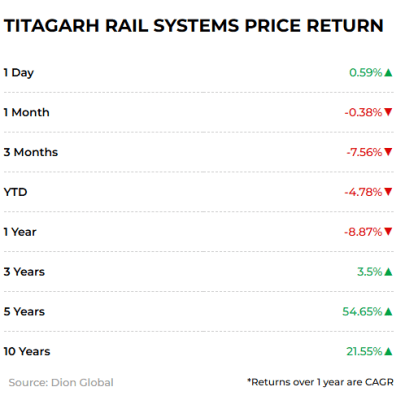
Titagarh Rail Systems share price performance
L&T brings deep-ocean engineering capability
L&T’s connection to the theme is more technology-led and currently much smaller in financial terms.
Listing out the reason why this engineering company is in focus, Soni said, “For heavy engineering, Larsen & Toubro is well placed. It developed critical titanium forgings for Matsya-6000, hosted the submersible’s wet trials at Kattupalli and has extensive offshore and subsea engineering capability.”
“However, its current Deep Ocean Mission revenue is immaterial relative to its overall business,” he added.
L&T’s Q1 FY27 investor presentation describes the group as India’s largest engineering and construction company, with interests spanning EPC projects, hi-tech manufacturing and services.
The company has continued to add technology-intensive manufacturing and defence capabilities. During Q1, L&T entered into a strategic collaboration with French company Exail to deliver an advanced unmanned mine counter-measure suite for the Indian Navy’s mine counter-measure vessels programme.
For the critical-mineral theme, however, the present financial contribution from deep-ocean work is small compared with L&T’s overall business.
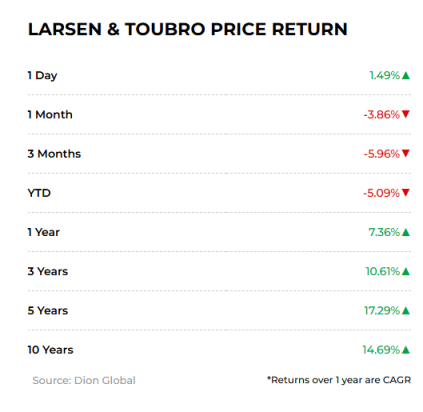
L&T share price performance
Deep-sea exploration still depends on specialised technology
Building research vessels is only one part of the deep-sea programme. Exploration at depths of 5,000–6,000 metres requires specialised subsea payloads and systems. “The key bottleneck is the 5,000–6,000-metre subsea payload,” Soni said.
“India still depends materially on overseas suppliers for AUVs, sonar, scientific winches, A-frames and ROV-handling systems,” he further elaborated and stated that , “no Indian-listed company has yet demonstrated a comparable, fully integrated deep-rated technology stack.”
That leaves a significant technology gap between building an exploration vessel and having an entirely domestic deep-sea exploration system.
It also separates Vedanta’s opportunity from that of GRSE and Titagarh. Vedanta has direct exposure to critical-mineral exploration on land, while the shipbuilders are supplying infrastructure for exploration. Soni noted that no offshore mineral block has been successfully awarded for commercial mining.
Exploration remains the first hurdle
The broader mining opportunity faces its own execution challenges. The KPMG-FICCI report says India has explored less than 15% of its obvious geological potential and consumes less than 1% of the global exploration budget.
“Availability of capital is hence not the only reason for the potential challenges in this space,” the report stated.
The report identified the ability to convert capital into “scientifically proven exploration targets”, “high-quality and cost-efficient drilling program”, deeper deposit exploration, higher-confidence resources and investment-ready blocks as key requirements.
Technology is also expected to play a larger role. The KPMG-FICCI report identifies technologies including downhole sensing, passive seismic and coiled-tubing drilling as part of the toolkit that could improve exploration efficiency.
For Vedanta, exploration success has to be followed by resource definition, mine development, processing and refining. For GRSE and Titagarh, the nearer-term opportunity is in infrastructure supporting exploration. For L&T, the exposure lies in engineering and specialised technology.
Policy support has to translate into projects
India’s policy architecture is expanding beyond mineral auctions, with measures covering exploration, recycling, processing and manufacturing.
The KPMG-FICCI report lists the National Critical Mineral Mission, a Rs 1,500-crore incentive scheme for critical-mineral recycling, a Rs 7,280-crore scheme for sintered rare-earth permanent magnets and a Rs 500-crore allocation for four critical-mineral processing parks.
The Ministry of Earth Sciences’ PIB release on Sagar Manthan provides a separate example of how the policy push is translating into physical infrastructure. The ministry said the vessel’s launch was an important step towards indigenous oceanographic research and maritime technology, with the vessel intended to generate data on oceans, climate dynamics and marine systems.
The eventual business impact will depend on how quickly these measures translate into exploration projects, resource discoveries, processing capacity, equipment orders and downstream manufacturing.
That distinction is visible across the four companies. Vedanta is taking exploration risk before resources can be established. GRSE and Titagarh already have contracted work tied to ocean research. L&T has demonstrated deep-ocean engineering capabilities, but the current revenue contribution from the theme remains immaterial to its overall business.
Conclusion
India’s critical-mineral push is creating an industrial chain that begins well before commercial mining. Research vessels, drilling systems and subsea technology are generating identifiable business opportunities today, while mining, processing and refining remain longer-duration opportunities.
For GRSE, specialised research vessels can add a civilian scientific business alongside its much larger defence order pipeline. Titagarh has a smaller but contracted research-vessel opportunity alongside its rail and maritime expansion. L&T’s role is centred on specialised engineering, while Vedanta has taken direct exposure to land-based critical-mineral exploration.
Disclaimer: This article is for informational purposes only and should not be construed as investment advice, a recommendation to buy, sell or hold any security, or a solicitation to transact in any financial instrument. The views, estimates and opinions quoted in this article are those of the respective analysts, government sources or companies and do not necessarily represent the views of Financial Express or the author. Investors should conduct their own research and consider their financial objectives, risk tolerance and investment horizon before making any investment decision. Exploration blocks, mineral resources, research-vessel programmes, government schemes and corporate projects discussed in this article remain subject to regulatory approvals, execution risks, resource discovery, commercial viability and other conditions. Early-stage exploration activity should not be treated as evidence of future commercial production or earnings. The analysts quoted in this article are SEBI-registered research analysts, and their views are presented for attribution and informational purposes only.