



The four stocks created through Vedanata’s demerger are entering a fresh phase of growth as analysts assess the earnings and execution triggers after their inclusion in the Nifty 500. Vedanta Aluminium Metal Ltd. will also enter the Nifty 100 and Nifty Next 50, giving it a wider benchmark presence compared to Vedanta Power, Vedanta Oil & Gas and Vedanta Iron & Steel.
The demerger took effect from May 1, 2026, with shareholders receiving one share in each of the four new companies for every Vedanata share held. The four businesses were separately listed on the BSE and NSE on June 15 after a special pre-open price discovery session. Vedanta Ltd. remains the residual company, housing Hindustan Zinc, Zinc International, copper and ferrochrome.
Netra Deshpande, Research Analyst at Mirae Asset Sharekhan, said, “The demerger is designed to remove the conglomerate discount by letting each vertical be priced on its own merits. Nifty 500 entry is the first formal validation of that, because it makes each entity separately benchmarkable.” Arun Kailasan, Research Analyst at Geojit Investments, said the inclusion should improve visibility, liquidity and research coverage, but sustained re-rating would depend on earnings delivery and execution.
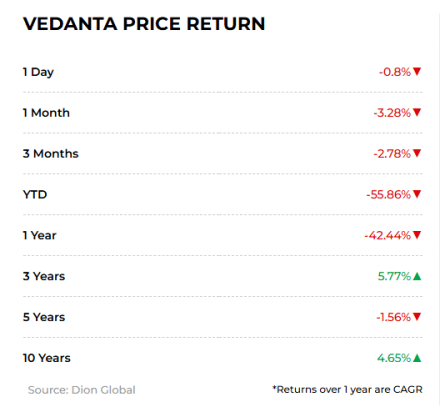
Vedanta share price performance
Vedanta Aluminium
Deshpande said, “The rebalancing could result in substantial passive inflows for four companies, with Vedanta Aluminium getting the lion’s share around $150 million.” She said BALCO’s smelting ramp-up was the immediate production driver, with Q1 FY27 production at 168 kt, up 16.7%. She also pointed to Kuraloi coal and Sijimali bauxite as the next raw-material integration triggers. Value-added output rose 14% year-on-year to 389 kt, while alumina production increased 41% to 826 kt.
Kailasan highlighted that , “The inclusion should improve investor visibility, research coverage, liquidity and price discovery. It also allows the businesses to be evaluated as pure-play sector exposures rather than as part of a diversified conglomerate. Passive inflows are expected to be skewed towards Vedanta Aluminium, given its simultaneous inclusion in the Nifty 100 and Nifty Next 50. For all four companies, however, sustained re-rating will ultimately depend on earnings delivery and execution.”
The operating triggers are also visible. Vedanta Aluminium’s Q1 FY27 earnings presentation showed record aluminium production of 632 kt, up 5% year-on-year, while value-added production reached 389 kt. Revenue stood at Rs 21,105 crore, EBITDA at Rs 10,499 crore and profit after tax at Rs 6,597 crore. Net debt to EBITDA improved to 0.9x from 1.3x in Q4 FY26, with net debt reduction of Rs 3,481 crore.
Rajesh Kumar, Chief Executive Officer of Vedanta Aluminium Metal, said during the company’s Q1 FY27 earnings call on July 30, 2026, “Looking ahead, our focus remains on accelerating growth through ramp-up of Lanjigarh and increased volume from BALCO Potline 3 and sustained cost optimization through additional domestic bauxite.” He added, “Our captive coal, we have received the mining lease and mine opening permission for Kuraloi, and we plan to start the mine in this quarter.”
Kailasan explained that , “For Vedanta Aluminium, the key growth drivers over the next 12-24 months are volume growth and lower production costs. The commissioning and ramp-up of BALCO’s expanded smelter capacity, higher alumina production at Lanjigarh, and increasing availability of captive bauxite and coal should help improve margins and support earnings growth.”
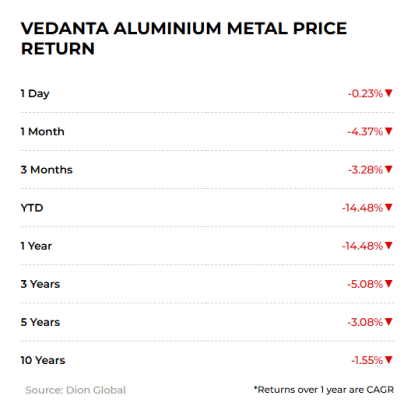
Vedanta Aluminium share price performance
| Vedanta Aluminium Metal | Latest position | Key milestone |
| Aluminium production | 632 kt in Q1 FY27 | BALCO ramp-up |
| Value-added production | 389 kt | Further volume growth |
| Alumina production | 826 kt | Lanjigarh ramp-up |
| Kuraloi coal block | Mining lease and mine opening permission received | Mine start |
| Sijimali bauxite mine | EC and FC-II received | First ore |
The immediate checkpoints are the BALCO ramp-up, Sijimali’s first ore, Stage-II forest clearance and activity at Kuraloi.
Vedanta Power
Coming to Vedanta Power, Deshpande said, “Long- and medium-term PPAs in Punjab, Odisha, Tamil Nadu and Kerala provide 74% of Q1 FY27 revenues. Meenakshi Energy sales rose 245% year-on-year to 1,350 million units, taking total power sales to 5,225 million units, up 38%.”Talwandi Sabo’s plant availability improved to 86% from 77% sequentially.”
She also pointed to a five-year 500 MW Tamil Nadu contract from May 2026 and the need to monitor merchant-price exposure as additional PPAs are secured.
Kailasan said, “For Vedanta Power, the key near-term trigger is the restart of Unit 1 at the Sakti plant, which has been offline since an April boiler accident and is expected to resume operations by early October 2026.”
He pointed out that “Investors will also track the commissioning of the second 600 MW Sakti unit by March 2027, progress in securing long term PPAs for untied capacity, greater use of lower cost domestic coal at the Meenakshi plant, and a potential Rs. 300cr refund following a favourable tribunal ruling. Together, these could support earnings recovery and cash flow growth.”
Rajinder Ahuja, Chief Executive Officer of Vedanta Power, said during the company’s Q1 FY27 earnings call on July 30, 2026, “As a standalone power business, we now have a greater strategic focus, sharper accountability and a stronger platform for long-term value creation in power sectors.” Ahuja said Vedanta Power had 4.2 GW of current operating capacity and aimed to reach 4.8 GW by the end of FY27.
He also said, “Today, approximately 74% of our total volume is secured through medium and long-term PPAs. While 85% of our coal requirement is backed by long-term coal linkages and provides with strong stability and visibility of the revenues and the cost.”
Kailasan said the second Sakti unit is expected to be commissioned by March 2027, taking total capacity to 4,780 MW.
The immediate milestones are the Sakti Unit 1 restart, Unit 2 commissioning, further PPAs and higher domestic coal usage at Meenakshi.
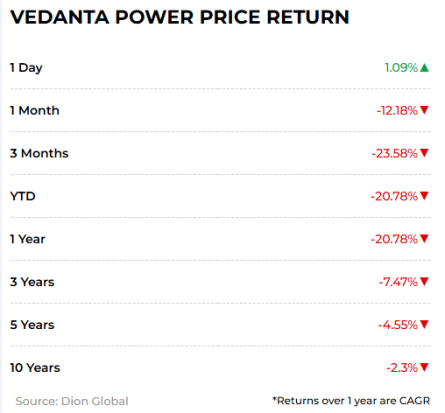
Vedanta Power share price performance
Vedanta Oil & Gas
Vedanta Oil & Gas has a production-recovery story, with analysts focusing on Rajasthan North, field interventions and resource-to-reserve conversion.
Gross operated production averaged 77.7 thousand barrels of oil equivalent per day in Q1 FY27, including 63.1 thousand from Rajasthan, 11.6 thousand from offshore assets and 3.1 thousand from OALP blocks. Revenue stood at Rs 2,507 crore and EBITDA at Rs 1,232 crore, with an EBITDA margin of 49%. Unit operating cost fell 3% sequentially to $17.4 per barrel.
Jim Gast, Chief Executive Officer of Vedanta Oil & Gas, said during the company’s Q1 FY27 earnings call on July 30, 2026, “Our priority remains to strengthen decline management, accelerate well interventions, improve execution and maintain high asset reliability.” He also said, “The focus is to remain strong cost discipline while supporting safe operations, production reliability and future volume delivery.”
Deshpande said, “Higher Mangala recovery, production optimisation and resource-to-reserve conversion would be the main drivers.” The company has allocated $200 million to Rajasthan North in FY27, with annual field-development spending expected at about Rs 3,000 crore.
Management has also set an ambition to increase recovery from about 30% to 60% through existing technologies, workovers, sidetracks and interventions.
Kailasan’s focus is whether the additional field-development spending can translate into higher production and cash generation.
The company corrected its investor presentation through an August 5 filing, revising ROCE to 7.04%, changing the disclosure to “Net Debt: Near Zero” and reporting liquid investments including cash and cash equivalents of Rs 2,859 crore. The company said the corrections did not change its reported or reviewed financial results.
The key milestone is whether the Rajasthan North programme can counter natural production decline while maintaining cost discipline.
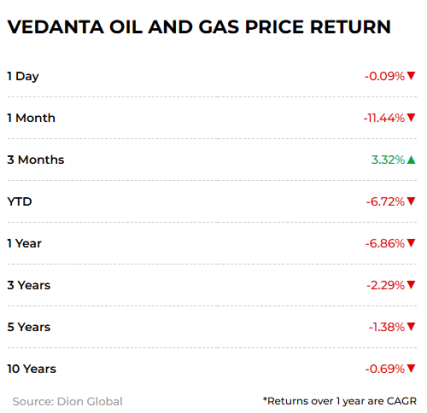
Vedanta Oil and Gas share price performance
Vedanta Iron & Steel
Vedanta Iron & Steel is entering a large capacity expansion cycle, with Bokaro and captive mining assets providing the main triggers.
Deshpande said, “Bokaro’s capacity is planned to rise to 3 MTPA by 2026 and 5 MTPA by FY29, with a new blast furnace, pellet plant, coke oven batteries and oxygen plant. Bicholim’s capacity is planned to rise from 3 MTPA to 3.6 MTPA, while the 0.5 MTPA Cudnem mine is planned for FY27 and Janthakal in Karnataka for FY28.”
The board has approved Rs 3,697 crore of investment, comprising Rs 2,975 crore for ESL Phase 1A and Rs 722 crore for the Goa ductile iron pipe project. Only Rs 64 crore and Rs 17 crore respectively had been spent in Q1 FY27, leaving most of the approved investment yet to be deployed.
The company’s presentation puts current steel capacity at 3 MTPA and post-expansion capacity at 5 MTPA, alongside 15 MTPA of operational iron-ore capacity.
Pankaj Sharma, Chief Executive Officer of Vedanta Iron & Steel, said during the company’s Q1 FY27 earnings call on July 30, 2026, “During the quarter, we received a stage 1 forest clearance for Bokaro expansion project. We remain on track to deliver the project by end of financial year.” He added, “The ductile iron pipe project in Goa is progressing well and is expected to be completed during the later part of the year.”
The company’s Q1 performance provides a starting point for the expansion. Revenue increased 18% year-on-year to Rs 3,662 crore and EBITDA rose 54% to Rs 515 crore. Steel and iron-ore production increased 4%, while steel sellable production stood at 582 kt and iron-ore production at 2.6 million tonnes. Net debt post demerger adjustments stood at Rs 2,733 crore, with net debt to EBITDA at 1.3x.
Deshpande said, “The ESL Bokaro project includes a 0.5 MTPA coke oven, an increase in hot-metal capacity from 1.7 MTPA to 3.2 MTPA and a 0.42 MTPA ductile iron pipe factory in Goa targeted for FY28.”
| Stock | Analyst’s main trigger | Management’s operating focus | Next checkpoint |
| Vedanta Aluminium Metal | BALCO ramp-up and lower costs | Lanjigarh, BALCO Potline 3 and captive raw materials | BALCO, Sijimali and Kuraloi |
| Vedanta Power | Sakti and PPAs | 4.8 GW capacity target and contracted volumes | Sakti Unit 1 and Unit 2 |
| Vedanta Oil & Gas | Rajasthan production recovery | Field development and interventions | Rajasthan North output |
| Vedanta Iron & Steel | Bokaro expansion | Mining and integrated steel expansion | Bokaro and Goa projects |
Conclusion
The Nifty inclusion gives the four demerged Vedanta stocks a common market trigger, but analysts are focusing on company-specific operating milestones rather than the index event alone.
Deshpande’s focus is on BALCO and raw-material integration at Vedanta Aluminium, Sakti and PPAs at Vedanta Power, Rajasthan North at Vedanta Oil & Gas and Bokaro at Vedanta Iron & Steel. Kailasan said the index inclusion should improve visibility, research coverage, liquidity and price discovery, but that “sustained re-rating will ultimately depend on earnings delivery and execution.”
The next full standalone quarterly results, project commissioning, production growth, capex deployment and cash-flow performance will show how the four businesses are progressing after the demerger.
Disclaimer: This article is for informational purposes only and should not be construed as investment advice, a recommendation to buy, sell or hold any security, or a solicitation to transact in any financial instrument. The views, estimates and opinions quoted in this article are those of the respective analysts and company management and are presented for attribution and informational purposes only. Readers are advised to consult a SEBI-registered investment adviser or other SEBI-registered financial professional before making any investment decision. Management ambitions, production targets, capacity plans and capital expenditure programmes discussed in this article should not be treated as completed projects or guaranteed outcomes and remain subject to execution, approvals, commissioning schedules, market conditions and other factors.