




India’s logistics sector is gradually moving towards more organised warehousing and asset-sharing models, but palletisation and pallet pooling remain at an early stage. UBS sees this gap as a long-term opportunity for LEAP India, which has built a nationwide network of pooled pallets, containers and material-handling equipment.
The brokerage has initiated coverage on LEAP India Ltd. with a ‘Buy’ rating and a target price of Rs 175, implying 24.8% upside from the report price of Rs 140.30. UBS expects the company’s revenue to grow at 19% CAGR and EBITDA at 21% CAGR between FY26 and FY31E, with higher movement-hire adoption expected to improve asset productivity and returns.
UBS sees LEAP India benefiting from low palletisation in India
UBS analysts pointed out that LEAP is operating in a market where palletisation and pooling penetration remain well below levels seen in developed markets.
Only 17% of goods movement in India is currently palletised, according to UBS, compared with 60% in China, 73% in the Gulf Cooperation Council and 89% to 94% in developed markets. Pallet-pooling penetration in India is also just 9.4%.
UBS expects India’s total pallet volumes to increase from 106 million units in FY26 to 164 million by FY31E. Pooled pallet volumes are expected to double from 10 million to 20 million units over the same period, implying around 15% CAGR.
The brokerage estimates that pooling penetration could reach 12.2% by FY31E, still leaving significant room for expansion. At 25% pooling penetration, UBS estimates the addressable market could reach around Rs 3,200 crore, while 40% penetration could take the opportunity to Rs 5,000 crore.
Movement hire could improve asset productivity
The key part of the UBS thesis is the increasing use of movement hire.
Under static hire, pallets remain at a particular customer location and generate rental income over the period of deployment. Movement hire allows the same pallet to move between manufacturers, warehouses, distributors and retailers, generating revenue across multiple legs of the supply chain.
UBS expects movement-hire penetration to increase from 32.2% of LEAP’s pallet pool in FY26 to 46% by FY31E. The movement-hire pallet base is estimated to increase from 2.9 million units to 6.9 million units during the period.
“We believe LEAP’s next phase of value creation will be driven by improving asset productivity, while it continues to expand its asset base,” UBS said.
Its pallet-level analysis shows ROCE of 4.3% for a newly acquired pallet under static hire at current yields, compared with 12.4% under movement hire. As pallets become fully depreciated, the estimated ROCE rises to 10.5% under static hire and 18.3% under movement hire.
In a higher movement-hire case, UBS estimates that a mature pallet could generate ROCE of 24.2%.
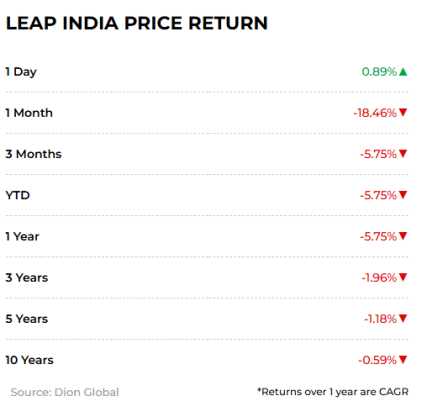
LEAP India share price performance
LEAP has built a nationwide operating network
UBS said LEAP’s competitive position goes beyond the size of its asset pool.
The company manages around 14.9 million assets across pallets, containers and material-handling equipment. It serves more than 1,000 customers through 28 fulfilment centres and over 10,500 touchpoints across India.
The brokerage estimates that LEAP has around 90% share of India’s organised pallet-pooling market. It also points to technology-enabled tracking, asset retrieval, maintenance and lifecycle management as important parts of the company’s operating platform.
“Each incremental customer and touchpoint potentially adds another node through which LEAP’s assets can circulate,” UBS said.
The brokerage believes greater network density can improve asset circulation and reduce the distance involved in retrieving and redeploying pallets. It also sees the scale of the network as a barrier for new entrants, given the capital required to build a comparable asset base and service infrastructure.
Warehouse expansion could support pallet adoption
UBS expects the expansion of organised warehousing to support greater use of standardised pallets.
Grade-A warehousing stock is projected to increase from 296 million sq ft in FY26 to 703 million sq ft by FY31E. Modern warehouses increasingly use forklifts, pallet racking, conveyors and automated material-handling systems, which require standardised pallets for efficient operations.
The brokerage also points to India’s logistics costs, which it estimates at around 14% of GDP. Faster loading and unloading, better warehouse throughput and lower dependence on manual handling could encourage companies to adopt palletised logistics.
UBS said palletisation can reduce loading and unloading time by up to 80-90%.
LEAP’s revenue mix is broadening
Pallets remain the largest part of LEAP’s business, accounting for around 60% of revenue. UBS expects pallet revenue to grow at 19% CAGR between FY26 and FY31E, supported by higher pallet volumes and improving yields as movement hire gains traction.
The brokerage expects pallet revenue to increase from Rs 440 crore in FY26 to Rs 1,061 crore by FY31E.
Containers account for around 21% of revenue. UBS expects container revenue to grow from Rs 154 crore in FY26 to Rs 297 crore by FY31E.
Material-handling equipment, which contributes around 16% of revenue, is expected to grow from Rs 114 crore in FY26 to Rs 331 crore by FY31E.
Overall, UBS expects LEAP’s revenue to rise from Rs 730 crore in FY26 to Rs 1,718 crore by FY31E.
UBS expects margins and cash generation to improve
The brokerage expects EBITDA margins to increase from 49.5% in FY26 to 53.8% by FY31e, aided by operating leverage and greater asset productivity.
Free cash flow is expected to improve as the business becomes less dependent on asset additions for growth. UBS forecasts capex intensity to decline from 53% of sales in FY26 to 30% by FY31.
The brokerage expects free cash flow to move from negative Rs 164 crore in FY26 to Rs 153 crore by FY31, with positive generation beginning from FY28E in its estimates.
IPO proceeds to support balance-sheet needs
LEAP India raised Rs 2,480 crore through its IPO, including a fresh issue of Rs 480 crore. UBS said the fresh equity is expected to be used towards debt repayment and general corporate purposes.
The company was listed on August 14, 2026.
UBS expects the combination of a growing pooled-asset market, a larger movement-hire contribution and increasing asset productivity to drive LEAP’s earnings over the next several years.
The brokerage has valued the company through a discounted cash flow approach, using an 11.5% WACC and 5% terminal growth rate. Its Rs 175 target price implies 14x September 2028E EV/EBITDA.
For LEAP, the longer-term opportunity rests on getting more revenue from the asset base it already operates, while continuing to add pallets, containers and material-handling equipment as organised logistics expands across India.
| Key metric | UBS estimate |
| UBS rating | ‘Buy’ |
| Target price | Rs 175 |
| Upside | 24.8% |
| FY26-31E revenue CAGR | 19% |
| FY26-31E EBITDA CAGR | 21% |
| FY31E movement-hire penetration | 46% |
| FY31E ROCE | 14.7% |
Disclaimer: This article is based solely on the UBS research report on LEAP India. The target price, estimates, valuation assumptions, business outlook and other views attributed to UBS and its analysts are their own and have not been independently verified by the publication. The upside percentage is calculated using the price and target price stated in the report and does not represent a live market price. Actual financial and operating results may differ from brokerage estimates because of business execution, demand conditions, capital expenditure, financing, regulatory and market-related factors. This article is intended for informational purposes only and should not be construed as investment advice or a recommendation to buy or sell any security.