




The IT sector stocks would be in focus today after Accenture’s 7% growth and stable demand offered some encouragement and a positive read-through for Indian IT information technology companies. However, one must understand that they have not established that a broad recovery in technology spending is under way.
Though US technology services company beat its revenue guidance and reported strong bookings, the pricing pressure increased and client spending on discretionary projects remained subdued. Several big global banks and brokerage houses differ on what this means for Indian IT. Nuvama sees the results as slightly positive, while Jefferies warns that Accenture’s guidance points to slower organic growth and risks to earnings estimates for Indian IT companies.
IT sector Q2 preview: What Accenture results indicate
The IT sector outlook for the second quarter of FY27 remains modest. Nuvama expects HCLTech to lead growth among large-cap companies, followed by Tech Mahindra and Infosys, while TCS is likely to remain subdued and Wipro could report a decline. Midcap companies, particularly Coforge, Persistent Systems and Mphasis, are expected to outperform larger peers.
The larger question is whether demand for artificial intelligence, modernisation and enterprise transformation can offset pressure on traditional technology services. Nuvama remains positive on the sector over the medium to long term, while Jefferies advises caution because revenue growth and earnings momentum remain weak.
Accenture results beat guidance, but pricing pressure increases
Accenture reported revenue of $18.7 billion in the August 2026 quarter, up 7% year-on-year in constant currency terms and ahead of its guidance range. Revenue from consulting and managed services both grew 7%. New bookings rose 5% in constant currency terms to $22.2 billion, with consulting bookings increasing 6% to $9.4 billion and managed services bookings rising 3% to $12.8 billion.
The company recorded 37 clients with quarterly bookings of more than $100 million, taking the total number of such clients to 141. Its book-to-bill ratio, which compares bookings with revenue, stood at about 1.2 times. Managed services had a ratio of 1.4 times, compared with 1.0 times for consulting.
However, the stronger quarterly numbers did not signal a material improvement in discretionary spending. Jefferies noted that some deals delayed from the previous quarter were still pending and that pricing pressure had increased in several parts of Accenture’s business.
“While pricing was broadly stable through most of FY26, 4Q saw increased pricing pressure across several parts of the business,” Jefferies said in its October 2, 2026, report.
Accenture’s full-year FY26 revenue rose 5% in constant currency terms to $74.2 billion. Organic growth was around 3%, with acquisitions contributing approximately 2%, according to Nuvama. The company’s performance was also supported by federal business, while demand across some commercial segments remained weak.
Indian IT stocks: Q2 FY27 growth outlook
| Company | Q2FY27 growth outlook | Key trigger | Key concern |
|---|---|---|---|
| TCS | ~0.6% sequential CC growth | Large deal wins, BFSI demand | Weak September demand |
| Infosys | ~1.7% sequential CC growth | AI partnerships, cash generation | Possible guidance cut |
| HCLTech | ~2.7% sequential CC growth | IT services, ER&D, acquisitions | Organic growth quality |
| Wipro | ~1% sequential decline | Margin improvement | Weak revenue momentum |
| Tech Mahindra | ~1.6% sequential CC growth | Telecom deals, Orange ramp-up | Execution and attrition |
| LTIMindtree | ~1% sequential CC growth | Large deals, Randstad acquisition | Project ramp-up timing |
| Persistent Systems | ~6.5% sequential CC growth | Product engineering, deal momentum | Margin and execution |
| Mphasis | ~3.1% sequential CC growth | BFSI recovery, AI pipeline | Client spending |
| Coforge | ~13.2% sequential CC growth | Encora integration | Integration and margins |
Accenture’s FY27 guidance raises questions about Indian IT growth
Accenture expects revenue growth of 3-6% in FY27, including a contribution of 2-2.5 percentage points from acquisitions. Its guidance implies organic growth of around 1-3.5%, below the approximately 3.5% organic growth recorded in FY26, according to Jefferies.
That is a concern for Indian IT companies, whose growth is largely organic and whose revenue forecasts assume a gradual recovery in demand. Jefferies said consensus expectations for the six largest Indian IT companies point to growth accelerating to 4.6% in FY28 from 4% in FY27, leaving forecasts vulnerable if client spending does not improve.
“Enterprise budgets remain largely unchanged,” Jefferies said, citing Accenture management’s comments on the demand environment.
Accenture expects both consulting and managed services to grow in FY27. It also plans to spend about $5 billion on acquisitions, following $4.9 billion spent across 17 acquisitions in FY26. Its operating margin guidance for FY27 is 15.9-16.1%.
Nuvama takes a more constructive view of the results, particularly Accenture’s expectation that consulting will perform as well as managed services in FY27. Consulting growth matching managed services after 16 quarters could indicate early signs of improvement in discretionary spending, although the brokerage does not expect an immediate recovery.
“Accenture’s results, commentary and guidance are slightly positive for Indian IT,” Nuvama Research said in its October 1, 2026, report. The brokerage added that generative artificial intelligence could eventually expand the total addressable market for Indian IT companies.
Indian IT Q2 FY27 preview: Large cap growth remains close to 1%
Nuvama expects the second quarter to be mixed, with mid-cap companies outperforming large-cap peers. Across its coverage universe, the brokerage forecasts sequential constant-currency revenue growth ranging from a 1% decline to an increase of 13.2%, with Coforge expected to lead because of the integration of Encora.
For the large-cap companies, Nuvama’s estimates point to HCL Technologies Ltd. leading sequential growth, followed by Infosys, Tech Mahindra and LTM. TCS is expected to remain subdued, while Wipro is likely to report a decline.
Nuvama expects deal flows to remain decent for most companies despite a volatile demand environment. Margins could expand across much of the sector, supported by operating leverage and currency movements. However, the brokerage expects some companies to revise their full-year guidance, with Infosys likely to lower its revenue growth range.
The estimates are forecasts ahead of the results, rather than reported quarterly performance.
TCS: Muted growth likely as September demand weakens
Nuvama expects Tata Consultancy Services Ltd. to report sequential constant-currency revenue growth of about 0.6% in Q2FY27. It expects growth to remain modest because the pickup earlier in the quarter did not sustain through September amid geopolitical uncertainty.
The brokerage expects margins to expand by around 20 basis points sequentially. Large deal wins involving MHP, BSNL and Metro are among the areas it is watching, alongside demand in banking and financial services and developed markets.
Jefferies also expects a better performance than in the first quarter, but cautions that September could be affected by rate increases and weakness in the Middle East, particularly in manufacturing and retail.
For TCS, the key question is whether large deal wins translate into sustained revenue growth as clients remain cautious about discretionary projects.
Infosys Q2 preview: Subdued growth likely; valuations and cash generation offer support
Nuvama expects Infosys to report sequential constant-currency revenue growth of 1.7%, including acquisition-related contribution and the absence of a provision recorded in the previous quarter. It expects operating margins to expand by about 30 basis points.
The brokerage expects Infosys to lower its FY27 revenue growth guidance to 1-2.5% in constant currency terms, from its earlier range of 1.5-3%, while maintaining its margin guidance.
Anand Rathi’s sector preview also expects less than 1% organic sequential growth for Infosys, with around 50 basis points of additional growth from acquisition consolidation. Its assessment places greater emphasis on the company’s artificial intelligence partnerships, disciplined acquisitions and cash generation.
The valuation case remains important to the positive view. Anand Rathi estimates a free cash flow yield of around 9% and a dividend yield of about 5% for FY27. It also values the stock at 13.1 times estimated FY28 earnings, below its 15-year average forward multiple of 17.6 times.
A sustained improvement in discretionary spending, better execution and large deal wins remain important to a stronger growth outlook.
HCLTech: Strongest growth forecast among large caps
Nuvama expects HCLTech to report sequential constant-currency revenue growth of 2.7%, driven by information technology services and engineering research and development. Around 0.8 percentage points of the growth is expected to come from acquisitions.
The brokerage expects margins to expand by around 70 basis points, supported by revenue growth and currency movements. It also expects HCLTech to adjust its FY27 services revenue growth guidance while retaining the midpoint, with margin guidance likely to move towards the lower half of its existing range.
The acquisition contribution is important when assessing the underlying growth rate. While HCLTech is expected to lead the large-cap group, the quality and durability of organic growth will remain central to the outlook.
Wipro Q2 preview: Revenue decline expected to continue
Nuvama expects Wipro ’s IT services revenue to decline 1% sequentially in constant currency terms, including an estimated contribution of around 0.8 percentage points from acquisitions. It forecasts a modest margin improvement of 20 basis points.
The brokerage expects Wipro to guide for a sequential revenue change between a 2% decline and no growth in the following quarter, citing seasonality and higher employee furloughs.
Wipro’s near-term performance therefore remains weaker than that of its large-cap peers. A recovery will depend on improved client spending, stronger execution and the conversion of deal activity into revenue.
Tech Mahindra Q2: Telecom deals, execution support outlook
Nuvama expects Tech Mahindra to deliver sequential constant-currency revenue growth of about 1.6%, supported by telecom demand and the ramp-up of the Orange deal. The brokerage expects margins to expand by around 10 basis points despite wage increases and expects management to retain its FY27 margin guidance of 15%.
Anand Rathi also names Tech Mahindra among its preferred large-cap stocks, citing execution under chief executive Mohit Joshi and the company’s telecom business, which accounts for around one-third of revenue.
The brokerage sees large telecom contracts, including Orange and Telefónica, as opportunities to improve operating leverage. Execution, large deal wins and the ability to offset account attrition remain key factors to watch.
LTM Q2 preview: Large deals support medium-term outlook
Nuvama expects LTM to report sequential constant-currency revenue growth of about 1% in Q2FY27.
Anand Rathi identifies the company as a preferred large-cap stock, citing large deal wins and growth visibility despite a weaker near-term performance. Its outlook also points to the potential contribution from the proposed Randstad technology acquisition, which is expected to strengthen the company’s European presence and add capabilities.
The brokerage sees opportunities in agentic business process services, service lifecycle management and data capabilities. However, the timing of large project ramp-ups remains important because delayed execution could affect quarterly growth.
Persistent Systems: Product engineering and deal momentum support growth
Persistent Systems is expected to be among the stronger mid-cap performers in Q2FY27. Nuvama forecasts sequential constant-currency revenue growth of 6.5%, while Anand Rathi also names the company among its preferred mid-cap stocks.
The investment case centres on execution, product engineering and expanding exposure across industries. Anand Rathi expects the proposed Nagarro acquisition to strengthen Persistent’s European presence and broaden its industrial-sector footprint.
Persistent’s ability to convert its deal pipeline into revenue, while managing margins through wage increases and investment in new capabilities, will be important to sustaining its growth premium.
Mphasis: Banking recovery and artificial intelligence pipeline offer support
Nuvama expects Mphasis to report sequential constant-currency revenue growth of 3.1%, with margins expanding by around 50 basis points. Anand Rathi also favours the company, citing its focus on gaining market share and the possibility of a recovery in banking and financial services spending.
The brokerage points to a stronger deal pipeline and its Tria enterprise agency platform as factors that could support large-deal conversion, recurring revenue and broader client relationships.
Mphasis is expected to outperform the large-cap group, although the durability of growth will depend on client spending and the pace at which its pipeline converts into revenue.
Coforge: Encora integration drives the strongest growth forecast
Nuvama expects Coforge to report sequential constant-currency revenue growth of 13.2%, the highest among the companies in its coverage universe. The estimate includes the impact of integrating Encora, with organic growth expected to be around 4%.
Jefferies also prefers Coforge among mid-sized IT companies, alongside Sagility. Its broader concern is that Indian IT firms may need to rely more heavily on acquisitions to support growth if organic demand remains weak.
For Coforge, the key test is whether the integration of Encora adds scale and revenue while preserving margins and the company’s ability to win new business.
Artificial intelligence: New demand could offset pressure on traditional services
Artificial intelligence remains a central issue for the sector, but its impact is not uniform. Companies are using it to automate delivery, improve productivity and create new services, while clients are also seeking lower costs and greater output from existing contracts.
Accenture said more than 400 clients initiated advanced artificial intelligence work during FY26, including around 100 additional clients in the fourth quarter. It had 110,000 artificial intelligence and data professionals at year-end. Its management expects new AI-related work to offset productivity and cannibalisation effects over time.
Nuvama believes generative artificial intelligence could expand the market available to Indian IT companies as enterprises move from experimentation to implementation. Anand Rathi expects enterprise software spending to monetise these opportunities through FY27, with services demand following as deployments scale into FY28.
Jefferies is more cautious about the timing. It points to budgets moving towards AI infrastructure and AI-native companies, automation reducing revenue from traditional services, and global capability centres bringing more work in-house. AI-related revenue remains too small to fully offset deflation in legacy services.
The near-term challenge is to turn AI projects into recurring, scalable revenue without allowing productivity gains to translate into lower billing rates and margins.
Jefferies warns of slower organic growth and earnings risks
Jefferies sees three implications for Indian IT companies from Accenture’s guidance. First, growth in FY28 could fall short of expectations if the sector cannot accelerate organic revenue. Second, companies may need to increase acquisitions to support growth, potentially putting pressure on margins. Third, valuation multiples could find some support if concerns about the long-term viability of IT services ease, even without a near-term earnings recovery.
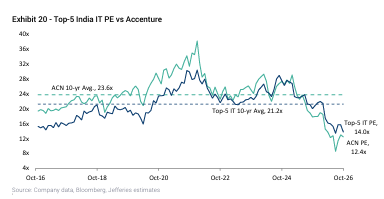
The firm said large Indian IT companies were trading at about 14 times one-year forward earnings, a premium to Accenture, rather than the historical discount seen over longer periods.
Jefferies remains cautious because it does not see enough earnings momentum to support a sustained re-rating. It prefers mid-sized IT companies and names Coforge and Sagility as its picks.
Nuvama, by contrast, remains positive on the sector over the medium to long term. It identifies Coforge, Mphasis, Tech Mahindra, TCS and Firstsource among its preferred stocks, while acknowledging that near-term volatility is likely to persist.
Indian IT companies: All eyes on FY27 guidance
Accenture’s results show that large contracts are still being signed and artificial intelligence projects are progressing, but stronger bookings have yet to translate into a broad recovery in discretionary spending. Its FY27 guidance also indicates that acquisitions will account for a larger share of growth.
For Indian IT companies, the next results season will test whether large deal wins are converting into revenue, whether clients are approving more discretionary projects and whether AI-related services can offset pricing pressure in traditional work.
Nuvama expects mid-cap companies to outperform large caps in Q2FY27 and remains positive over the medium to long term. Jefferies sees greater risks to future growth estimates and advises caution. The difference comes down to timing: whether enterprise AI and modernisation spending can scale quickly enough to counter weak organic demand and pressure on traditional services.
Disclaimer: This article provides factual analysis only and is not, and should not be construed as, an offer, solicitation, or recommendation to buy or sell securities. Investors must conduct their own independent due diligence and seek advice from a SEBI-registered financial advisor.