




India’s solar manufacturing story is moving from capacity announcements to a tougher question: what value should be attached to those plants once they are built and operating? Bernstein’s India Solar PV report examines that question through the planned cell and ingot capacity of Waaree Energies and Premier Energies, while Tata Power is assessed through its earnings profile.
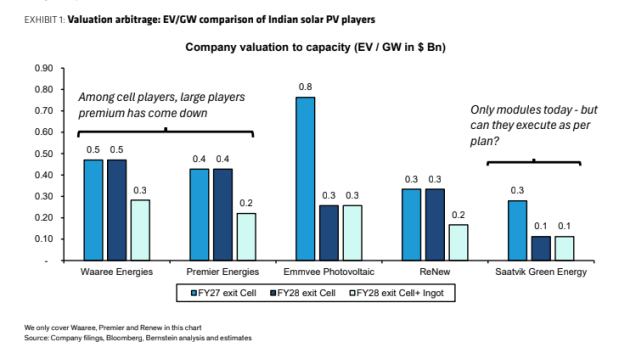
The brokerage’s analysis puts particular emphasis on the gap between capacity plans and execution. Its assessment of Waaree Energies Ltd. comes with the question: “Only modules today – but can they execute as per plan?”
Bernstein on Tata Power: ‘Outperform’
Tata Power sits outside Bernstein’s EV-per-GW manufacturing comparison. The company is instead assessed through its earnings estimates and valuation, reflecting the different composition of its power and renewable-energy operations.
Bernstein estimates EPS of Rs 14.91 for FY27 and Rs 17.26 for FY28. The corresponding P/E estimates are 24.3 times and 21 times, respectively.
The brokerage has set a target price of Rs 430 for the stock, implying 18.8% upside from the reference price used in its table.
For Tata Power, therefore, the solar connection forms part of a wider earnings-based valuation rather than a calculation tied to the company’s manufacturing capacity.
Bernstein on Waaree Energies: ‘Underperform’
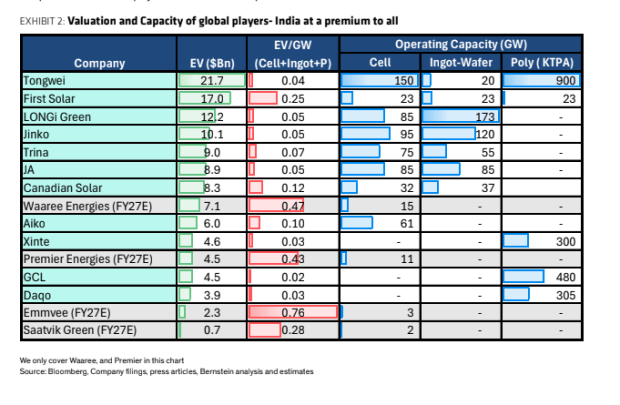
Waaree Energies is more directly exposed to the manufacturing expansion being examined in Bernstein’s report. The brokerage compares the company’s enterprise value with its expected exit-cell and cell-plus-ingot capacity.
Waaree is valued at about 0.5 times enterprise value per GW of FY27 exit-cell capacity and about 0.5 times on FY28 exit-cell capacity. On FY28 exit cell-plus-ingot capacity, the figure is about 0.3 times.
The execution question is central to Bernstein’s assessment. The report’s risk section says the planned solar cell-module manufacturing capacity in India may not come on time because of challenges involving equipment imports and visa issues.
Bernstein also lists early restrictions on solar wafer imports, an extension of the rooftop solar scheme beyond FY27 and success in new ventures such as battery manufacturing among the upside risks for Waaree Energies.
Bernstein’s targets for 3 renewable power stocks
| Stock | Target price | Implied upside/downside |
| Tata Power | Rs 430 | 18.8% upside |
| Waaree Energies | Rs 2,538 | 3.4% upside |
| Premier Energies | Rs 814 | 10.2% downside |
Bernstein on Premier Energies: ‘Underperform’
Premier Energies is assessed on a similar manufacturing-capacity basis, giving Bernstein a direct way to compare its valuation with Waaree Energies.
The company is valued at about 0.4 times enterprise value per GW of FY27 exit-cell capacity and about 0.4 times on FY28 exit-cell capacity. For FY28 exit cell-plus-ingot capacity, the figure is about 0.2 times.
Bernstein’s assessment of the cell manufacturing segment includes the observation: “Among cell players, large players premium has come down.”
Premier Energies’ EPS is estimated at Rs 40.08 for FY27 and Rs 38.75 for FY28.
The difference in capacity valuation between the two manufacturers is set out below.
| Company | FY27 exit-cell EV/GW | FY28 exit-cell EV/GW | FY28 exit cell + ingot EV/GW |
| Waaree Energies | ~0.5x | ~0.5x | ~0.3x |
| Premier Energies | ~0.4x | ~0.4x | ~0.2x |
For Waaree, the higher valuation attached to each capacity measure comes alongside a specific focus on the timing of its manufacturing expansion. Premier Energies carries lower EV-per-GW figures across the three measures provided in Bernstein’s comparison.
Manufacturing capacity is only useful once it comes online
Bernstein’s assessment of Waaree puts commissioning timelines at the centre of the manufacturing case. Equipment imports and visa-related issues are cited as possible causes of delays, while restrictions on solar wafer imports could support domestic production conditions.
The report also points to the rooftop solar scheme and battery manufacturing as additional factors that could influence the company’s prospects.
For Premier Energies, the lower valuation per GW provides a different starting point, but the economics still depend on how the planned manufacturing base develops and contributes to earnings.
That distinction separates the two manufacturers from Tata Power, whose valuation in the report rests on earnings estimates rather than an EV-per-GW manufacturing measure.
Bernstein’s outlook on key renewable sector plays
The three cases consequently rest on different valuation arguments. Tata Power is tied to its projected earnings, while Waaree Energies and Premier Energies are being judged alongside the amount of manufacturing capacity they plan to build and the value assigned to that capacity.
Disclaimer: This article is based solely on the Bernstein India Solar PV report provided. The ratings, target prices, earnings estimates, capacity figures, valuation measures, risk factors and other analytical views cited here belong to Bernstein and have not been independently verified by the publication. The implied upside and downside figures are calculated from the reference prices stated in Bernstein’s table and its corresponding target prices, and do not represent live market prices. Capacity additions, commissioning schedules, earnings forecasts, manufacturing economics, import conditions, policy measures and other assumptions may differ from actual outcomes. This article is intended for informational purposes only and should not be treated as investment advice or a recommendation to buy or sell any security.