



Tata Group stocks came under significant selling pressure today as the Tata succession tussle deepened and concerns about who leads Tata Sons next continues.
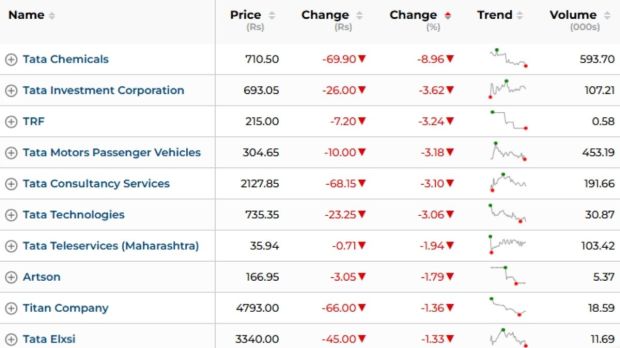
Tata Chemicals, Tata Investment Corporation and Tata Consultancy Services (TCS) were among the stocks that fell sharply in early trade.
The immediate trigger was a disagreement between Tata Trusts and the Tata Sons board over N Chandrasekaran’s reappointment as executive chairman. The issue has also brought the future of Tata Sons’ proposed listing back into focus.
Tata Group stocks fall sharply
Tata Chemicals fell as much as 8% in the intraday trade today. Tata Investment Corporation declined 5% and TCS slipped 3.5%.
Other Tata Group companies, including Tata Motors, Tata Elxsi and Tata Technologies, also traded lower, falling up to 3%.
The fall came a day after several Tata stocks had gained following the Tata Sons board’s decision to give Chandrasekaran another five-year term.
Tata Group stocks: Why did the sentiment change?
The key development was Tata Trusts’ opposition to the reappointment of N Chandra.
At the September 17 board meeting, Noel Tata, chairman of Tata Trusts, voted against the resolution. Tata Sons said the board approved Chandrasekaran’s reappointment through a majority vote.
Tata Trusts later disputed the validity of the decision. The trusts said the resolution was a “legal nullity” and argued that the Articles of Association of Tata Sons require the support of a majority of trust-nominated directors for such a decision.
This has created uncertainty around the continuation of Chandrasekaran beyond his current term, which ends in February 2027.
Tata Sons listing at the core of the growing tussle
There is another issue investors are watching closely – the possible listing of Tata Sons.
The Reserve Bank of India (RBI) has rejected Tata Sons’ request to remain private and unlisted. The regulator has also indicated that rules applicable to large core investment companies would require Tata Sons to become publicly held.
The Tata Sons board has now said it will take steps to comply with the RBI requirements.Tata Sons said in a statement following its September 17 board meeting, “The Board also resolved to initiate steps to comply with the applicable RBI guidelines and will seek guidance from RBI, Tata Trusts and other stakeholders on applicable compliance requirements.”
Tata Trusts, however, has maintained that listing is not the only possible route. It wants other structural options to be examined before a final decision is taken. The Tata Trusts asked Tata Sons to explore options other than Listing. As per the release, “The Board agreed that all available options, and not listing alone, should be thoroughly explored and assessed on an immediate basis, with the findings and recommendations presented to the Board. Following this review, a separate Board meeting will be convened to consider the assessment and determine the appropriate course of action.”
Why is the Tata Sons listing a core issue for the Tata Group?
Tata Sons is the holding company of the group, and some listed Tata companies have direct or indirect exposure to it.
Tata Chemicals and Tata Investment Corporation are particularly sensitive to developments involving Tata Sons. Tata Sons holds a 31.9% stake in Tata Chemicals and a 68.5% stake in Tata Investment Corporation.
Tata Sons listing tussle: What’s the key concern?
Deven R Choksey, Founder and MD of DRChoksey Finserv, said, “On the face of it, I think whatever is optical is not the reality. I think the face-off between the two individuals is there for a reason.”
According to him, “Noel Tata possibly wants time to list Tata Sons and he has clearly demanded that he would like to buy out the position of SP Group in the next two years and thereafter. On the other side, at the behest of RBI and the government, the Tata Sons chairman is basically required to list the company on a priority basis.”
“The reason for that being on a priority basis is because Tata Sons is a controlling organisation for all Tata Group listed companies and today as the situation is, all the listed companies demand a significantly large amount of capital in their respective businesses,” Choksey added.
He said the group also needs significant capital to fund its loss-making businesses and expand newer ventures. “Loss-making units require a capital outlay of around Rs 28,000-29,000 crores, which includes Air India, which is the largest loss-making company and which also includes Tata Digital from the perspective of looking at it and other companies that they have.”
“So all in all put together, they incur a loss of around Rs 28,000-29,000 crores, as against which Tata Sons receives the dividend from all listed companies put together of Rs 33,000 crores. So frankly, they don’t have much money left in their hands for whatever further expansion that they may require to fund other activities as well. On the other side, Tata Electronics requires 90,000 to 100,000 crores over a period of time,” he said.
According to Choksey, this is where the disagreement over the timing of a listing becomes important. “So all put together, I guess the classic fight is basically when to list. Now, Chandra being a professional chairman, he would obviously not want the group to not get the proper attention from the shareholders, particularly Tata Sons. And that is where he would insist that listing be done upfront.”
He said a listing could also provide Tata Sons with additional capital. “So that, I think, both things can happen. One, the capital required by Tata Sons can also be made available through listing process, which in turn can fund loss-making units, and also they can create new businesses out of it.”
However, Choksey said the Tata Sons listing could also create a separate ownership challenge because of the Shapoorji Pallonji Group’s stake. “Whereas, I think the other part of the challenge remains with Tata Sons, of course, because they have 17-18% shares held by SP, the Shapoorji Pallonji Group. And if Tata Sons do get listed, then Shapoorji Pallonji Group will get exits out of whatever shareholding that they have.”
“And that could cause a challenge for Tata Sons in particular, because Tata Sons would in turn not be able to control the new shareholder who comes into the company and who is a significantly large minority shareholder,” he said.
“Post-listing, there is a distinct possibility that significantly large minority shareholders can come up in the company. And that would be 17-18% which is of Shapoorji Pallonji Group. So some white knight investment can happen post-listing. And that’s a fear that obviously Tata Group would have. And that is the initial resistance of not getting listed,” Choksey said.
On Noel Tata’s role, he said, “As far as Noel Tata is concerned, he is basically enjoying the veto power given to him by the trust, who are investors in Tata Sons, wherein his decision becomes a final decision under the current regime in which they are operating.”
What investors need to watch?
Chandrasekaran also needs to be reappointed as a director at the Tata Sons annual general meeting (AGM) to continue as chairman. However, the AGM has already faced delays because of issues surrounding the quorum.
The structure of Tata Sons’ board could also become important. The company’s Articles of Association give trust-nominated directors a role in approving certain major decisions.
For investors, the immediate focus is therefore on three developments. This includes the validity of Chandrasekaran’s reappointment, the next steps on Tata Sons’ listing requirements and the timing of the pending AGM.
Disclaimer: This article provides factual analysis only and is not, and should not be construed as, an offer, solicitation, or recommendation to buy or sell securities. Investors must conduct their own independent due diligence and seek advice from a SEBI-registered financial advisor.